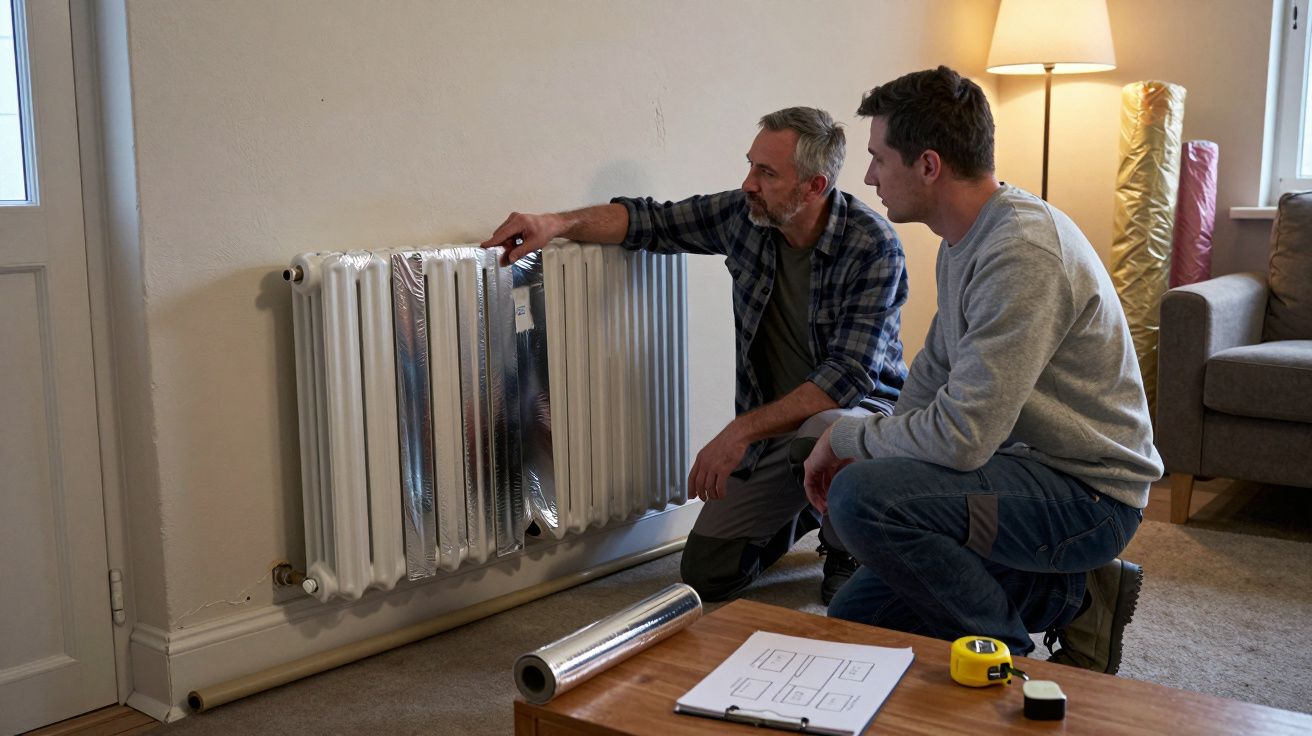
A retired heating engineer reveals where radiator foil actually works – and where it’s pointless
The silver sheets look like a clever shortcut: a cheap roll of radiator reflector foil and suddenly your home is toasty and efficient. That’s the promise on the packet, at least. Ask someone who spent 40 years designing heating systems, and the story gets less shiny.
In a small semi on the edge of town, a retired heating engineer spreads a crinkled offcut across the kitchen table. He has seen every trend pass through boiler rooms and front rooms: miracle additives, magnetic gadgets, smart valves that aren’t that smart. Radiator foil sits in the same category for him: sometimes useful, often wishful thinking.
“Foil can help,” he says, “but only in very specific places. In most houses, it’s like putting a plaster on the wrong knee.”
This is where it genuinely does something – and where you can save your money and your tape.
How radiators really lose heat (and why foil matters less than you think)
A radiator heats a room in two main ways: by warming the air that rises through it (convection) and by emitting infrared heat towards nearby surfaces (radiation). The silver foil only affects that second part – and only in one direction.
If a radiator sits on an external wall, some of its radiant heat heads straight into that cold surface. Foil behind it reflects a portion of this back into the room. That’s the theory, and in a few test cases, it works reasonably well.
But the engineer points out two limits straight away:
- On a typical system, only a fraction of the total heat is radiated directly backwards.
- Modern houses with insulated cavities or internal stud walls already lose less heat through the wall itself.
In other words, the silver doesn’t suddenly double your output. It nibbles at one pathway of loss. If your home leaks heat through draughty windows, uninsulated lofts or bare floors, those bigger holes swallow any small gain the foil offers.
The one situation where radiator foil actually earns its keep
Despite the caveats, there is a clear sweet spot where a roll of reflector foil makes practical sense. The engineer lists the conditions almost like a recipe.
“You want a radiator on an outside wall, preferably a solid, uninsulated one. You want enough room to fit rigid foil or proper reflector panels behind it, not just a sheet flapping down the back. And you want the heating on a fair bit of the time.”
Under those circumstances, the foil can:
- Slightly increase the room-side temperature of the wall surface.
- Cut the backward heat loss into cold brick.
- Allow the room to reach the same comfort level with marginally less boiler run-time.
In older terraces with single-skin brick walls and radiators tucked under leaky windows, the effect is more noticeable. People sometimes report that the wall no longer feels icy to the touch just above the skirting board. That’s the foil at work, sending heat back into the room instead of straight into the masonry.
For a well-used living room in a draughty Victorian with no wall insulation, the engineer calls decent-quality reflector panels “worth the faff”. Over a whole winter, the saving may not pay for a holiday, but it can shave a bit off the gas bill and make the sitting area feel more evenly warm.
Where radiator foil does almost nothing
Move away from that external-wall scenario, and the shine fades quickly. The retired engineer rattles through the most common “pointless foil” habits he’s seen.
1. Behind radiators on internal walls
If the wall behind the radiator faces another heated room, the heat that passes through it does not leave the building. It just helps warm the space next door. Reflecting some of that back adds little in overall terms and can even make the adjoining room fractionally cooler.
“You’re just borrowing from yourself at that point,” he shrugs. “The foil is making you feel clever without actually reducing the overall heat demand.”
2. On walls that are already insulated
Cavity insulation, insulated plasterboard or external wall insulation all reduce the rate at which heat moves through the wall. In these cases, there is simply less backward heat loss to begin with.
Sticking thin, flimsy foil on top of an already insulated wall mostly changes how it looks when you pull the radiator off for decorating. The engineer has seen plenty of these sheets peeling, torn or stained with dust and condensation, doing nothing useful.
3. Across the full wall behind long radiators
Many people run foil from skirting to window board behind a long radiator, assuming “more must be better”. In practice, most of the benefit comes from the section directly behind the hottest central part of the radiator. Excess foil above, below and to the sides adds cost but not performance.
Thin, crumpled foil taped in waves along the wall also leaves air gaps and pockets that can trap moisture and dust. It becomes an untidy decoration rather than a precision tool.
4. On radiators themselves
Occasionally he still finds foil wrapped around pipework or even draped over the top of radiators in an attempt to “direct heat”. It usually does the opposite, blocking air circulation and creating cold spots.
“Anything that stops warm air rising freely through the radiator grille is working against you,” he says. “Foil hats are for conspiracy theories, not your heating system.”
The hidden issues: condensation, dust and misplaced hope
Beyond simple inefficiency, badly installed foil can introduce small side effects that nobody mentions on the packaging. The engineer has unhooked enough radiators to notice patterns.
Where foil is stuck directly to cold, uninsulated walls without proper adhesive or coverage, condensation can form behind it. Moist air from the room sneaks around the edges, hits a cooler surface and leaves behind damp patches and mould. When the foil eventually droops, it can peel away bits of plaster with it.
There’s also the dust. Radiators draw air constantly; any loose-backed foil becomes a trap for fluff and debris. Over time, this can form a grim band of grey behind the metal fins. It seldom causes a functional problem, but it does make decorating and maintenance less appealing.
Above all, the retired engineer worries about radiator foil as a distraction. People fixate on the silver sheet and ignore the big wins:
- Uninsulated lofts with inches of bare joist.
- Gappy floorboards over icy crawl spaces.
- Single-glazed or poorly sealed windows.
- Old boilers running at low efficiency with badly balanced systems.
“Foil gets bought because it’s cheap and visible,” he says. “Proper insulation is neither of those things, but it’s where the real savings live.”
If you insist on using foil, do it properly
For those determined to give radiator foil a try, the engineer doesn’t object – he just wants it installed with some basic sense. Done correctly, it can deliver the modest gains it promises without side effects.
He suggests following a few grounded rules:
- Choose rigid boards or purpose-made panels, not thin kitchen foil. These keep their shape and stay where they’re put.
- Fix them to the wall, not the radiator, using adhesive suited to your plaster or brick, so the reflector sits flat.
- Cover only the area directly behind the radiator, especially the hotter central third, instead of wallpapering the whole wall in silver.
- Leave the top and bottom of the radiator clear, so air moves freely.
For DIY enthusiasts, he also recommends checking that the wall is dry and sound first. If there are signs of damp, crumbling plaster or salts, those problems deserve attention before adding any reflective layer. Foil is not a damp-proof membrane, however hopeful the marketing copy might sound.
Bigger, quieter wins: where your heating money works harder
When asked where a typical household should start instead of reaching for foil, the engineer barely hesitates. He lists a few interventions that usually outperform any silver sheet.
| Priority area | Why it beats foil |
|---|---|
| Loft insulation | Heat rises; topping up to modern standards often brings the biggest single saving. |
| Draught sealing | Stopping cold air leaks around doors, windows and floorboards improves comfort immediately. |
| TRVs and balancing | Properly adjusted thermostatic valves and a balanced system stop some rooms overheating. |
| Boiler controls | Weather compensation, smart thermostats and correct flow temperatures cut waste every day. |
None of these look as instantly satisfying as a shiny panel behind the radiator. They do, however, change how the whole system performs, not just one wall in one room.
“If the choice is forty quid on foil or forty quid on sealing gaps and adding loft insulation, I’d pick the loft every single time,” he says. “The foil is dessert. The insulation and controls are your main course.”
Rethinking “quick fixes” in a draughty house
The story of radiator foil fits a larger pattern. In an era of high energy prices and climate anxiety, small, visible gadgets feel comforting. They give us something to do, somewhere to point our worry. Yet the most effective measures are often the least glamorous and the hardest to photograph.
For households on tight budgets, the temptation of a roll of foil promising “up to 30% savings” is understandable. A retired engineer with four decades of call-outs and cold attics under his belt simply asks for a shift in priorities.
Seal what leaks rather than polishing what already works. Insulate what’s thin before layering over it with reflective tricks. Use foil where the physics genuinely favours it – behind radiators on cold, uninsulated external walls – and skip it elsewhere.
Comfort comes less from shiny add-ons than from steady, thoughtful work on the bones of a home. The silver can stay in the drawer until the big gaps are closed. Only then does it have a chance to quietly earn its keep, rather than just catching the eye.






Comments (0)
No comments yet. Be the first to comment!
Leave a Comment