After 50: the one daily stretch that protects your knees better than expensive supplements
Your knees do not suddenly “go” at 50. What usually happens is quieter: years of stiff hips, tight thighs, and lazy glutes slowly squeeze the joint until every stair feels like a negotiation. The good news is that one simple, daily stretch can give your knees more real protection than many shiny tubs of supplements.
You do not need a gym, a yoga mat, or heroic flexibility. You need a chair, a wall, and about two minutes a day. The move looks almost too simple to matter. But practiced consistently, it does what tablets cannot: it changes how your joints actually move.
The secret is in the front of your thigh.
What really makes knees hurt after 50
Most people blame cartilage, age, or “old injuries”. Often, the culprit sits higher up: tight quadriceps and hip flexors pulling the kneecap out of its sweet spot. Hours of sitting, driving, and leaning over phones shorten the muscles that cross the front of the hip and knee. Every step then grinds a little instead of gliding.
Inside the joint, your kneecap should track like a drawer on well-oiled runners. When the quads are tight, they yank that drawer sideways. Going downstairs, getting up from the sofa, kneeling in the garden-each movement adds a tiny bit of irritation. Supplements can change the chemistry of the joint slightly. A good stretch changes the physics.
The stretch below is designed to do exactly this: lengthen the line of tissue from hip to knee, free the kneecap, and give your cartilage a kinder ride. It is not glamorous. It works because it is boring, repeatable, and directly targeted.
Meet the “wall quad stretch”: the daily move your knees are missing
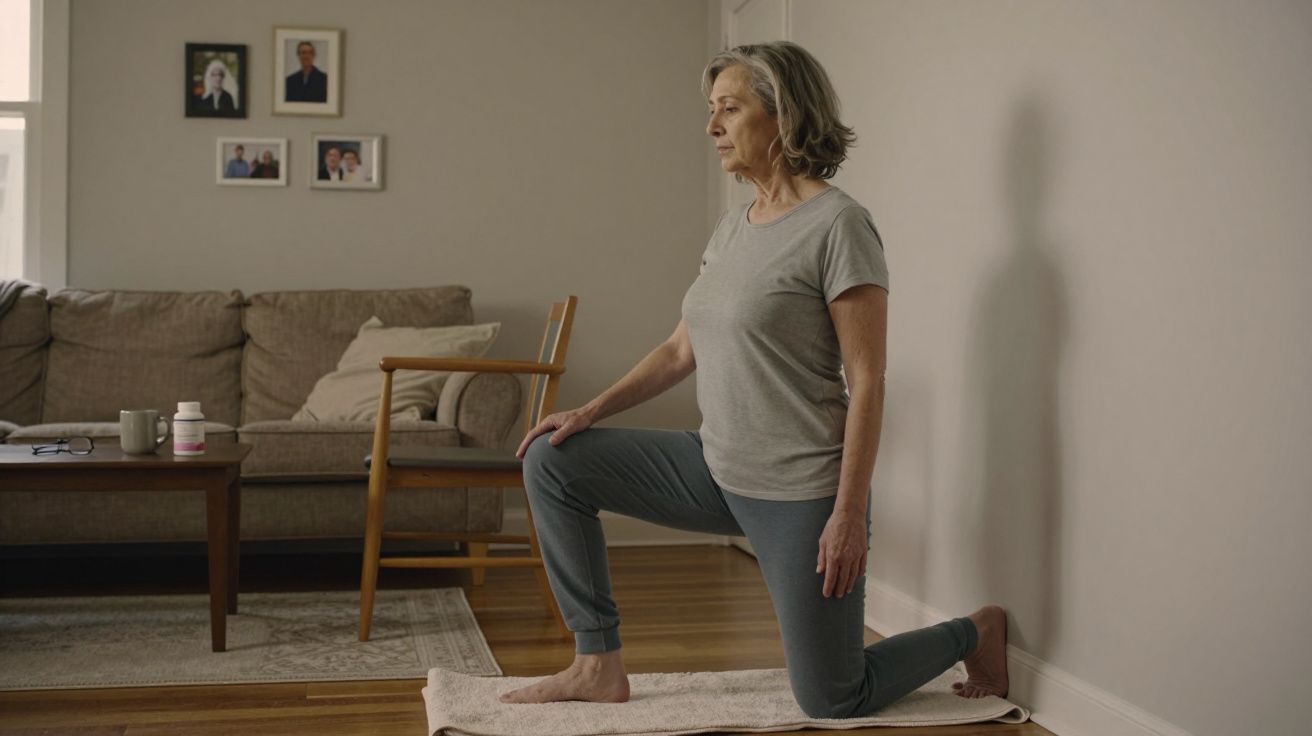
Picture a gentle half-kneel in front of a wall, with your back shin up the wall and your body tall. That is the wall quad stretch. It looks like a cross between a lunge and someone quietly searching for their reading glasses behind the sofa.
Set-up is simple:
- Place a folded towel or cushion on the floor, a few inches in front of a wall or sofa.
- Kneel on the cushion with your right knee, left foot flat in front of you like a lunge.
- Gently slide your right shin back so it rests against the wall (or sofa), toes pointing up.
- Hold on to a chair or the sofa arm for balance, then slowly bring your chest more upright.
At first, you may only be able to lean partway up. That is fine. You should feel a firm stretch along the front of the thigh and possibly up into the hip, not a sharp pain in the knee. Breathe. Stay. You are unhooking years of tightness one long exhale at a time.
How to do it tonight: 2 minutes, one wall, no drama
Aim for one minute per side, once a day. If that sounds long, start with 20–30 seconds and build up. Consistency beats intensity.
Try this routine:
Warm-up walk (2–5 minutes)
March on the spot or walk around your home. Warm muscles stretch better and protest less.Right side (up to 60 seconds)
- Kneel with your right knee near the wall, left foot in front.
- Slide your right shin up the wall, hold a chair, and gently lift your torso.
- Tuck your tailbone slightly under (think “zip up” your lower tummy) to avoid over-arching your back.
- Keep your chest open, eyes forward, and breathe slowly.
- Kneel with your right knee near the wall, left foot in front.
Left side (up to 60 seconds)
- Swap legs and repeat.
- Notice if one side feels tighter-that is common and useful to know.
- Swap legs and repeat.
Finish with 10 slow sit-to-stands from a chair
- Sit on a sturdy chair, feet hip-width.
- Stand up and sit down slowly without using your hands if you can.
- This wakes up your glutes and reinforces the new freedom around the knee.
- Sit on a sturdy chair, feet hip-width.
And yes, it works while you live your normal life. You are not adding a new hobby; you are adding 2–3 minutes that quietly change how tomorrow’s stairs will feel.
Why this stretch beats a capsule: the joint physics under your fingertips
Supplements aim to feed the joint from the inside. The wall quad stretch changes how forces travel through the joint from the outside. It gives you:
Better patella tracking
Looser quads mean the kneecap glides in its groove instead of being dragged sideways with every step or squat.Reduced pressure on cartilage
When the front-of-thigh line softens, compressive load spreads more evenly. Less “hot spot” wear, fewer sharp twinges on stairs.Happier hips and back
Tight hip flexors tug the pelvis forward, exaggerating your lower back curve. Lengthening them eases that pull, helping both back and knees.Muscle balance instead of over-reliance on the joint
Paired with simple strength work (like sit-to-stands), the stretch lets your muscles share the load so the knee is less of a punching bag.
Supplements have their place, especially under medical advice. But without changing the way your joint is being loaded, you are asking tablets to mop up what your posture and movement spill every day. The wall quad stretch quietly turns off the tap.
Common mistakes-and how to stay on the safe side
The move is simple, but a few errors can make it uncomfortable or ineffective. Here is how not to trip:
Ramming the knee into the wall
Use a cushion. Pain under the kneecap means adjust the padding or distance from the wall, not “push through”.Over-arching the lower back
If your back pinches, you have gone too upright or are letting your pelvis tip forward. Gently tuck your tailbone under and lean back out a little.Holding your breath
Breath-holding tightens everything. Aim for slow nasal breathing-four counts in, six counts out.Chasing “more stretch” with jerks
Let the stretch build like a slow tide, not a snap. A mild to moderate pull (5–7/10) is enough.
Listen to the joint, not your pride. A small, repeatable stretch you actually do every day beats a dramatic one that leaves you limping and reluctant tomorrow.
Making it a habit you keep, not a phase you quit
After 50, the body responds brilliantly to small, regular inputs. The challenge is rarely “Does it work?” but “Will I remember to do it?” A few tricks help:
Anchor it to an existing routine
Do the stretch right after brushing your teeth at night, or while the kettle boils in the morning.Use furniture as your reminder
Keep a folded towel by the wall you use. Visual prompts beat willpower at 7 am.Track tiny wins
Notice the first day the stairs feel smoother, or you can kneel in the garden a little longer. Those are your real “before and after”.Start with a 7-day experiment
Commit to one week, not “forever”. Most people feel some difference in that time: easier standing, less morning stiffness, fewer crackles.
You do not need to chase twenty different knee exercises. One good stretch, one simple strength move, done regularly, changes the landscape more than a drawer full of gadgets and powders.
What it changes, concretely, for the years ahead
The point of this daily stretch is not to become flexible for its own sake. It is to keep ordinary life ordinary:
- Getting up from low seats without planning your hands.
- Walking hills or stairs without doing mental pain calculations first.
- Gardening, playing with grandchildren, kneeling for DIY without bracing.
Done regularly, the wall quad stretch reduces the “background noise” around the knee that makes every movement feel risky. It will not reverse severe arthritis, but it will often make the joint you already have feel younger than the date on your passport.
Think of it as a quiet insurance policy: a few minutes a day that protect your knees better than many expensive things you swallow and then forget.
Quick reference: your knee-protecting mini-routine
| Step | What to do | Why it helps your knees |
|---|---|---|
| 1 | 2–5 minutes of gentle walking or marching on the spot | Warms muscles, safer and more comfortable stretch |
| 2 | Wall quad stretch, 30–60 seconds per side | Frees tight quads/hip flexors, improves kneecap tracking |
| 3 | 10 slow sit-to-stands from a chair | Strengthens glutes and thighs to support the joint |
FAQ:
- Is this safe if I already have knee osteoarthritis? Often yes, if you move slowly, use good padding, and avoid forcing the position. If any sharp or lasting pain appears in the joint itself, ease off and discuss it with your GP or physiotherapist before continuing.
- I cannot get my shin all the way to the wall-does it still work? Yes. Start further from the wall so the stretch feels firm but manageable. Over weeks, as tissues adapt, you may naturally move a little closer. The benefit comes from regular gentle loading, not extreme range.
- When will I feel a difference? Many people notice easier stairs or less stiffness within 1–2 weeks of daily practice. Deeper changes in flexibility and comfort typically build over 4–6 weeks.
- Can this replace my supplements or pain medication? No, not on its own. Think of it as a mechanical partner to whatever your doctor prescribes. Never stop prescribed medication without medical advice.
- What if kneeling is impossible for me? You can perform a gentler standing quad stretch holding a chair: heel towards your buttock, knees together, light support from your hand. It offers some of the same benefits without kneeling on the floor.


Comments (0)
No comments yet. Be the first to comment!
Leave a Comment