After 60: the standing-on-one-leg test doctors say predicts future health better than a blood test
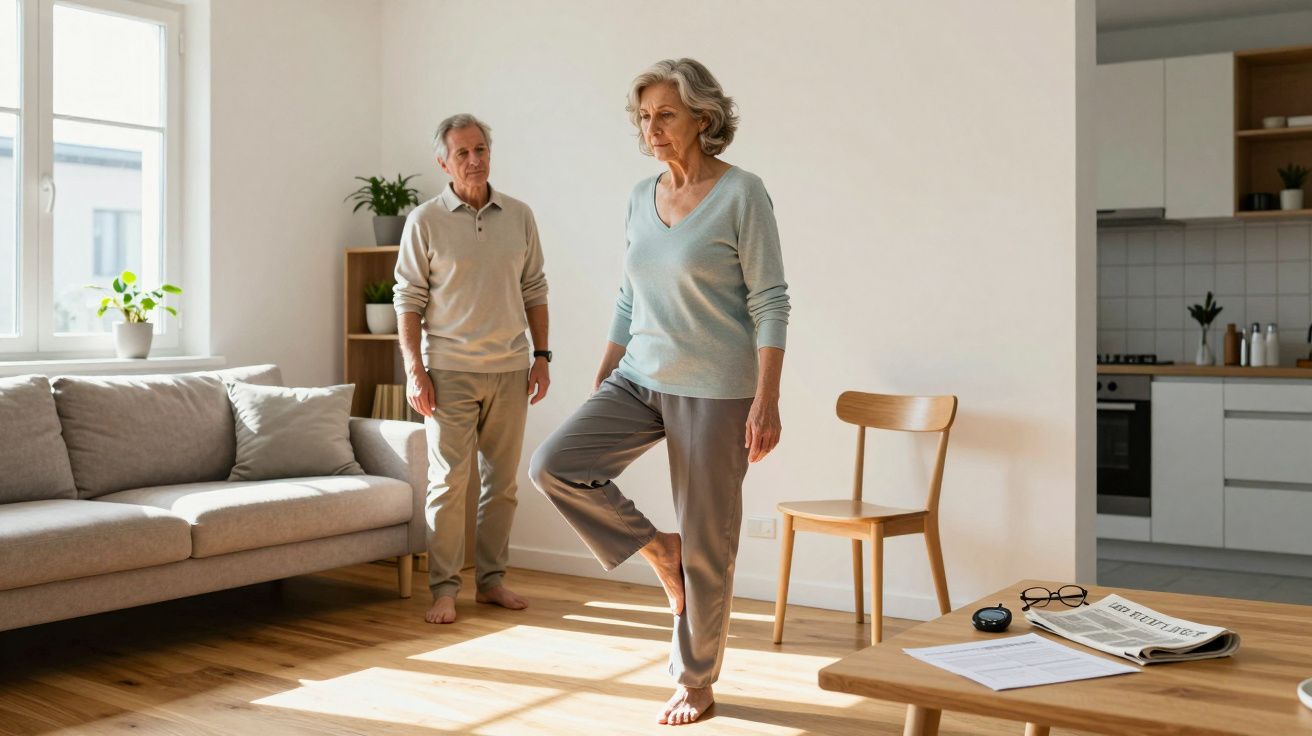
A stopwatch, a clear patch of floor and one simple question: can you stand on one leg for 10 seconds? For doctors working with older adults, this modest challenge is turning into a powerful early-warning signal – sometimes more telling than a normal blood test.
The “one-leg test” doesn’t replace standard check-ups or lab work. Instead, it captures something bloods often miss: how your whole body – brain, nerves, muscles and joints – works together in real time. That’s exactly what keeps you upright when the pavement is slippery, the bus lurches, or you get out of bed too quickly.
A few seconds on one leg can reveal years of wear, hidden weakness and future risk of falls, frailty and even early death.
Why balance becomes a vital sign after 60
Past 60, we lose muscle, joint mobility and nerve speed little by little. You don’t wake up one morning “frail”; you edge towards it. Balance is often the first quiet casualty.
Standing on one leg forces multiple systems to cooperate at once: the eyes fix a point, the inner ear senses movement, small muscles around the ankle and hip make constant micro-adjustments. If any link in that chain is weak, the wobble shows up quickly. That’s why researchers call balance a “global functional marker” – a snapshot of your body’s real-world resilience.
A normal blood test can show sugars, cholesterol or inflammation. Useful, but very specific. A failed balance test whispers something more general: your reserve is running down, even if your numbers on paper look fine.
How the one-leg test actually works
In clinics, the protocol is simple and standardised. You can reproduce a safer home version, but the spirit remains the same.
- Stand next to a stable support (a counter or heavy chair), barefoot or in flat shoes.
- Place your hands on your hips or let them hang loosely by your sides.
- Pick one leg up a few centimetres, with the knee slightly bent, and start counting.
- The stopwatch stops if you put the raised foot down, grab the support, hop, or move the standing foot.
Most research uses 10 seconds as the key threshold in people over 60. Being unable to hold for this length of time, even after a couple of attempts, has been linked to higher rates of falls, hospital admissions and earlier mortality in the following years.
It’s not about perfection. It’s about whether you can hold steady, without grabbing on, for those short but revealing seconds.
Typical benchmarks by age
These are not strict pass/fail rules, but rough guides clinicians often use:
| Age group | “Comfortable” target (both legs) | Potential concern zone |
|---|---|---|
| 50–59 | 20–30 seconds | Under 15 seconds |
| 60–69 | 15–20 seconds | Under 10 seconds |
| 70–79 | 10–15 seconds | Under 5–8 seconds |
| 80+ | 5–10 seconds | Unable to manage 5 seconds |
The key isn’t a single number. It’s the trend over time. If your 15 seconds become 7 within a year, that matters more than how you compare to your neighbour.
What a poor result is really telling you
Failing the 10-second test doesn’t mean you are about to have a stroke or break a hip. It means your reserve is thin, and several risks cluster together.
Doctors pay attention because reduced balance often travels with:
- Loss of leg strength and muscle mass (sarcopenia)
- Slower walking speed and shorter steps
- Stiffer ankles, knees or hips
- Reduced sensation in the feet (diabetes, nerve issues)
- Blood pressure drops on standing
- Mild cognitive or attention problems
- Multiple medications that affect alertness or blood pressure
You might feel “absolutely fine” sitting at the GP surgery. But life happens standing, turning, reaching. The one-leg test quietly exposes the gap between how you think you are doing and how your body behaves when challenged.
In many studies, poor balance predicted bad outcomes independently of age, sex and classic risk factors. In other words, balance adds information that blood tests alone can’t see.
How to try it safely at home
The one-leg test can be a useful self-check, but not at the cost of a bruised hip. Safety always comes first.
- Choose a corner of the room where you can lightly touch two walls or a kitchen counter and sturdy chair.
- Have someone with you the first few times, especially if you already use a stick or frame.
- Start with eyes open and shoes off. Pick the stronger leg first.
- Stop immediately if you feel dizzy, faint, or you sway more than you can control.
- Record your best of three tries per leg, rather than chasing one heroic attempt.
Repeat every few months rather than every weekend. This isn’t a party trick; it’s a gentle progress check.
If you regularly can’t manage the 10 seconds without clinging on, mention it at your next GP or physiotherapy appointment, even if you haven’t had any falls yet.
Why this outperforms “perfect” blood tests
For many of us in later life, the standard health conversation revolves around numbers on a print-out: HbA1c, LDL, eGFR. Yet many people with reassuring results still fall, break a bone, or slide into dependence.
The one-leg test cuts past that because it:
- Measures function, not chemistry
- Integrates multiple systems at once
- Picks up tiny deficits before they show clinically
- Is fast, cheap and repeatable in almost any setting
Blood tests tell you what’s in the tank. Balance tests tell you how the engine actually runs on the road. That difference matters when the pavement is wet or the stairs are dim.
Training your balance: the good news
Unlike your date of birth, balance is highly trainable at any age. The brain and muscles adapt within weeks when you challenge them in smart ways.
Short, daily sessions beat heroic efforts:
Everyday tweaks
- Stand on one leg while brushing your teeth, one hand near the sink.
- When waiting for the kettle, shift your weight slowly from one foot to the other.
- Walk down corridors placing one foot directly in front of the other, like on a tightrope, with a wall nearby.
Structured exercises
- Heel-to-toe walking in a straight line.
- Sit-to-stand repeats from a chair without using your hands.
- Gentle yoga or tai chi sessions, which combine balance, strength and calm breathing.
Environmental help
- Good lighting on stairs and landings.
- Secure handrails where you turn or step up.
- Non-slip mats that don’t bunch or curl at the edges.
Balance doesn’t improve in your head; it improves in your ankles, hips and reflexes when you nudge them, day after day.
Signs you should talk to a doctor promptly
Not every wobble is worrying. But some signals justify a proper review rather than self-help alone.
Seek medical advice if you notice:
- Sudden change in balance over days or weeks
- Falls, or near-falls where you grab furniture to save yourself
- New dizziness, double vision or slurred speech
- Numbness in feet or legs that’s getting worse
- Strong imbalance more on one side than the other
These may point to treatable problems: medication side-effects, inner-ear issues, low blood pressure, vitamin deficiencies or early neurological disease. The earlier they appear on a doctor’s radar, the more options you have.
Turning 10 seconds into a long-term habit
The true power of the one-leg test isn’t the stopwatch. It’s the routine it seeds in your day.
You start by testing yourself against 10 seconds. Then you quietly rearrange your life to protect and extend those seconds: walking a bit more, doing the chair stands, clearing clutter from the hallway, checking your footwear and prescriptions. Each small change shifts the odds away from falls and hospital beds.
The goal is not to become a circus acrobat at 75. The goal is to keep stepping into taxis, onto buses and over door thresholds without thinking about it.
Balance after 60 is not a fixed trait; it’s a daily practice and, increasingly, a vital sign. The next time you see your GP, don’t be surprised if, alongside blood pressure and pulse, they ask you to stand up, lift a foot and simply hold.


Comments (0)
No comments yet. Be the first to comment!
Leave a Comment