After 65: geriatricians reveal why short daytime naps might be helping your heart
The afternoons get longer after 65. Meals creep earlier, the armchair feels deeper, and that post‑lunch heaviness behind the eyes stops being an occasional visitor and starts feeling like part of the day. For a long time, many older adults were told to “push through” or risk ruining their night’s sleep.
Yet when you listen to geriatricians, cardiologists and sleep specialists these days, a quieter message is emerging: a brief, well‑placed nap might not be laziness at all. It may be one of the simpler, cheaper tools you have to give your heart and blood vessels a small daily reset.
The twist is in the details. It is not “sleep whenever, however long”. It is a specific kind of nap, at a specific time window, that seems to matter.
Why the heart cares about how you rest
Blood pressure does not run flat across the day. In healthy adults, it dips at night, then climbs again in the morning. After 65, this pattern often frays. Nights get more fragmented, medications pile up, and that natural night‑time “dip” can fade. The result is a heart that spends more hours each day pushing against higher pressure.
Short daytime naps appear, in several observational studies, to nudge this curve back towards something more forgiving. People who took brief, regular naps had slightly lower average blood pressure and fewer sharp afternoon spikes than their non‑napping peers, even when researchers adjusted for age, weight and medication.
Part of the effect is simple physiology. When you lie down and drift into light sleep, your nervous system shifts gear. The “fight or flight” branch eases off, heart rate slows, blood vessels relax a little. For twenty minutes, the system is allowed to stop bracing against the day.
Think of a short nap less as “extra sleep” and more as a pressure‑relief valve for your circulation.
What current research actually suggests
The evidence is not a blank cheque for long siestas, and doctors are quick to say so. Large European cohorts have hinted that people who nap briefly - around 20 to 30 minutes - may have a lower risk of cardiovascular events than those who never nap or those who doze for more than an hour most days.
On the flip side, very long daytime sleep, especially when new or unplanned, tends to track with poorer health: untreated sleep apnoea, depression, poorly controlled diabetes, heart failure. In those cases, the nap is more symptom than solution.
Randomised trials are smaller but point in a similar direction. When older adults are guided into early‑afternoon naps of 20 to 30 minutes, several weeks in a row, researchers often see modest reductions in systolic blood pressure, calmer heart‑rate variability profiles and improved reaction times. Not miracle numbers, but changes that, added up over months, may matter to an ageing heart.
The art of the “heart‑friendly” nap
A nap that helps your heart and a nap that leaves you groggy for hours are not the same thing. Geriatricians working in clinic often give very specific instructions, printed on a single sheet that lives on the fridge door.
- Aim for 15 to 30 minutes of actual sleep.
- Keep it once per day, most days, not scattered catnaps.
- Start the nap between 1 p.m. and 3 p.m. if you can.
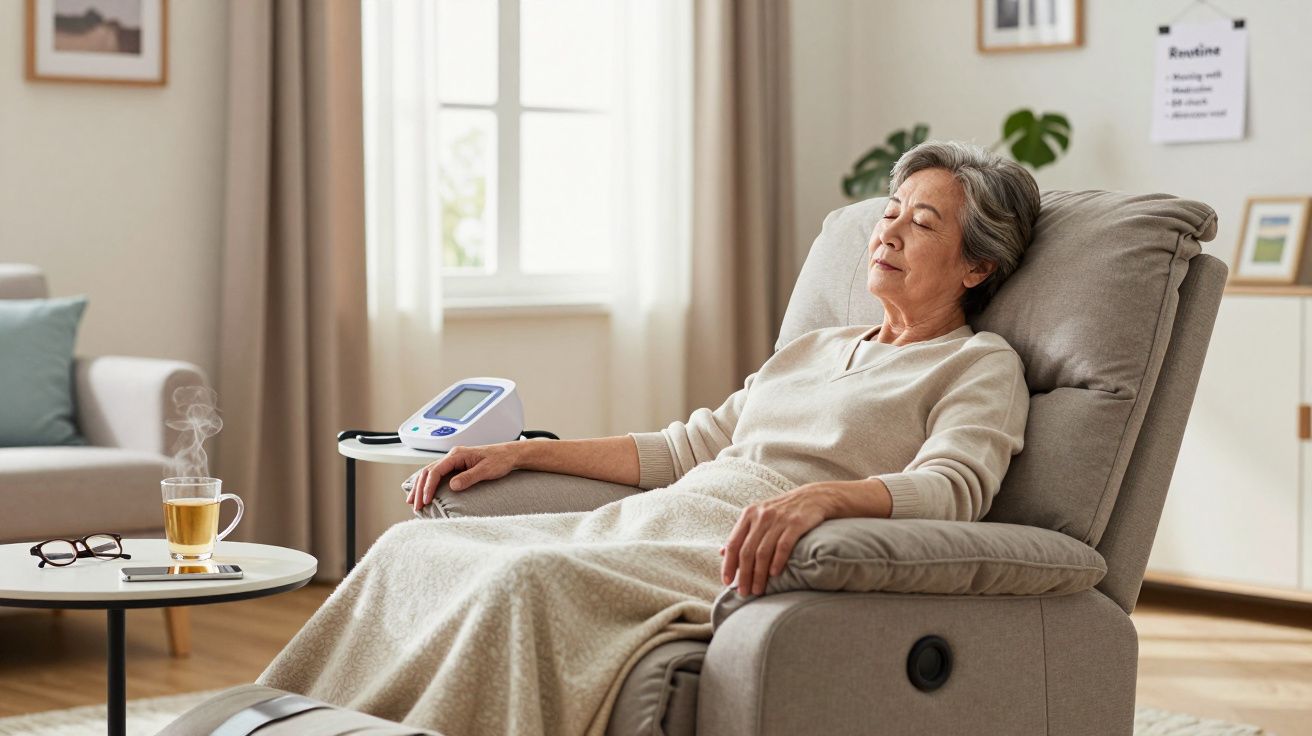
- Lie somewhere comfortable but not too cocoon‑like: a recliner, sofa or bed with curtains half‑drawn.
- Set a gentle alarm you can hear without jumping.
The goal is to dip into light non‑REM sleep, not dive head‑first into the deep stages your body reserves for night. Once you stay asleep past around 40 minutes, you are more likely to wake heavy‑headed, with blood pressure briefly rising rather than settling.
A good daytime nap should end with you feeling cleared out, not flattened.
A step‑by‑step routine older adults can actually follow
Many people do not “know how” to nap because they have spent decades forbidding themselves. Geriatricians often suggest a simple, repeatable script:
- Wind‑down cue: make a cup of decaf or herbal tea, read two pages of something calming, or listen to the same short radio segment or podcast each day.
- Body check: loosen belt or waistband, remove shoes, adjust pillows under knees if your back complains.
- Breathing bridge: three or four slow breaths, in through the nose, out through pursed lips, before closing your eyes.
- Permission thought: a neutral phrase like “this is what my heart meds would want me to do” to head off guilt or racing thoughts.
- Alarm set for 25–30 minutes: expect that you might take 5–10 minutes to drift off; that is fine.
Most people need about two weeks for the body to recognise this as a pattern. The nap becomes easier not because you are more tired, but because the brain starts to trust this daily pause.
How short naps quietly support an ageing heart
The benefits are rarely dramatic on a single day. They come from small, repeated nudges to systems that grow more fragile with age.
- Blood pressure smoothing: repeated short dips in sympathetic (“stress”) activity often translate into slightly lower 24‑hour averages.
- Heart rhythm stability: lighter, more parasympathetic‑dominant periods give the heart electrical system a break from constant high alert.
- Inflammation control: fragmented night sleep can stoke low‑grade inflammation; supplementing with a brief daytime doze may partially buffer this, especially in people who cannot easily fix their night‑time waking.
- Stress and mood: when afternoons feel less jagged, people are less likely to reach for sugary snacks, extra caffeine or alcohol to “keep going” - all of which tug on blood pressure, cholesterol and blood sugar over time.
There is also a behavioural layer. Someone who feels less drained at 4 p.m. is more likely to take that 10‑minute walk, cook something simple instead of leaning on processed ready meals, or actually do the home exercises the physiotherapist printed out.
| Effect | What changes during a short nap | Why it matters after 65 |
|---|---|---|
| Blood pressure | Slight drop in vascular tension and heart rate | Less strain on arteries already stiffened with age |
| Nervous system | Shift from “fight or flight” to “rest and digest” | Helps counter chronic stress and improve recovery |
| Energy and focus | Reduced sleepiness, clearer thinking for a few hours | Safer walking, better medication management, fewer falls |
Signs your nap is helping - and signs to be cautious
Not every older adult should start napping without a second thought. Geriatricians look for simple signals in clinic to tell whether this new habit is serving the person in front of them.
Helpful signals:
- You wake from the nap within 30 minutes feeling more alert, not disoriented.
- Your partner notices fewer irritable, “snappy” moments late in the day.
- You find it slightly easier to get up from a chair and start moving.
- Evening blood pressure readings, if you take them, drift a little lower over several weeks.
Warning signals:
- You regularly sleep more than an hour during the day without meaning to.
- You wake gasping, choking or with a pounding heart.
- Night‑time sleep becomes harder to initiate or more fragmented.
- You feel markedly weaker, more breathless or dizzy on standing in the afternoon.
Long, uncontrollable daytime sleep is a message, not a solution. It deserves a medical conversation, not just a better alarm.
Conditions such as untreated sleep apnoea, advanced heart failure, major depression or certain medications can all drive overwhelming daytime sleepiness. In those cases, “working on your nap” is like repainting a wall with a leaking pipe behind it.
Making room for naps without shrinking your life
One quiet fear many people voice is that if they “give in” to a nap, they will stop doing things that matter: seeing friends, volunteering, walking to the shops. The trick, geriatricians say, is not to let the nap expand and occupy the entire afternoon.
A few practical guardrails help:
- Anchor it to activity, not absence: put your nap after lunch and a short stroll, not after a morning in the armchair.
- Keep social plans in the diary: phone calls at 4 p.m., group classes, coffee with a neighbour. Let the nap support those, not replace them.
- Coordinate with medication: if blood pressure tablets or diuretics make you light‑headed, discuss timing with your GP so the nap does not overlap their peak effect.
- Protect the bedroom at night: keep the room for longer sleep and intimacy; daytime naps in a different spot reduce the risk of confusing your internal clock.
Some families turn the practice into a shared quiet time: older parent in the recliner, adult child catching up on emails nearby, television off. The house exhale becomes its own small ritual.
Who might benefit most from a planned nap?
Clinicians see particular gains in a few common groups:
- People with mildly raised blood pressure despite treatment, especially if values tend to surge in the afternoon.
- Older adults who wake very early and cannot easily extend their morning sleep but feel crushed by mid‑day.
- Carers and grandparents who do school pick‑ups, appointments and evening tasks; a brief reset makes the second half of the day safer and kinder on the heart.
- Those tapering off heavy evening alcohol or sedatives, where night sleep may be shaky for a while and a controlled nap can bridge the gap.
On the other hand, people with poorly controlled diabetes, significant insomnia, or those who already spend large parts of the day in bed should approach naps more cautiously and under direct medical guidance. For some, the priority is first to rebuild a solid night’s sleep.
A simple “nap plan” you can discuss with your doctor
Many geriatricians appreciate when patients arrive with something concrete:
- Your usual wake‑up time, bed time, and how often you wake at night.
- A note of when you feel most drained during the day.
- A week of home blood pressure readings, if you have a monitor.
- Any medications that cause drowsiness.
From there, you and your GP, practice nurse or geriatrician can agree on:
- The trial length (for example, a 4‑week experiment).
- The target nap window (say 1.30 p.m. to 2 p.m.).
- What you will watch for: mood, blood pressure, falls, night‑time sleep, overall energy.
Revisit after a month. If afternoons feel steadier and evenings calmer without wrecking your night, you may have found a small, sustainable ally for your heart.
FAQ:
- Will a short nap ruin my night’s sleep? In many adults over 65, a brief nap of 15–30 minutes in early afternoon does not worsen night sleep and may even improve it by easing evening exhaustion. Problems usually arise with long, late naps that bleed into the evening.
- Is it safe to nap if I have high blood pressure or heart disease? For many people, yes - and it may offer modest benefits - but it is important to clear it with your GP or cardiologist, especially if you have angina, arrhythmias or episodes of fainting.
- What if I simply cannot fall asleep during the nap window? Treat it as quiet rest time. Lying down, closing your eyes and breathing slowly still gives your heart and nervous system a break, even if you do not fully drift off.
- Do I need special pillows, gadgets or sleep trackers? No. A supportive chair or bed, a reliable alarm and a consistent routine matter far more than devices. Trackers can be interesting but are not essential for the heart benefits seen in studies.
- How quickly should I expect to notice any impact on my heart? Any blood pressure changes are typically modest and gradual, over weeks rather than days. What you may notice sooner is reduced afternoon sleepiness, steadier mood and slightly easier starts in the early evening.



Comments (0)
No comments yet. Be the first to comment!
Leave a Comment