The £1 pantry staple plumbers quietly use to loosen the toughest limescale around taps
The tap looks clean from across the room. Get closer and you see it: a grey‑white crust jammed around the base, a gritty collar on the spout, a spray head that splutters sideways instead of flowing straight. You scrub, you soak, you buy another “power descaler” promising miracles in ten minutes. The ring of limescale shrugs and stays put.
Ask a few plumbers what they actually reach for on stubborn jobs and the answer is rarely a bright, expensive bottle. More often it is a cheap, slightly sour staple that already sits at the back of your cupboard: plain white vinegar, usually under £1 a bottle in any supermarket.
Used with a bit of patience and the right set‑up, it softens rock‑hard deposits around taps, shower heads and sink overflows for a fraction of the price of specialist cleaners. The trick is less about muscle, more about letting mild acid do its slow, quiet work while you get on with your day.
Unassuming vinegar can turn cement‑like scale into a soft film you can wipe away with a cloth, without burning your nostrils or your chrome.
In a country where so many homes sit in hard‑water areas and replacement taps cost £60, £80, sometimes more, that £1 bottle suddenly looks less like a condiment and more like a small piece of household strategy.
Why limescale clings so stubbornly to taps
Tap water in much of the UK carries dissolved calcium and magnesium picked up from chalky ground. Heat it, let it dry, or leave it sitting in tiny crevices and those minerals fall out of solution as limescale. At first it shows up as a faint haze on chrome. Leave it for a few months and it grows into ridges and flakes that feel like stone.
Limescale loves edges: the join between tap and sink, the aerator where water meets air, the underside of a mixer spout where drips collect. Around baths and basins, the constant damp gives it a head start, so every shower bakes a little more mineral onto the surface. Ordinary washing‑up liquid barely touches it, because the problem is not grease or dirt. It is chemistry.
Most commercial descalers work by being acidic. They attack calcium carbonate and slowly dissolve it into the water so it can be rinsed away. Vinegar is simply a very mild version of the same idea. Acetic acid makes up about 5–8 per cent of that clear liquid in your cupboard. Given time and contact, it does the same job on scale, just more gently.
“You don’t need something that smells like it’ll strip paint,” one London plumber told me. “For taps and shower heads, white vinegar and patience gets you 80 per cent of the way.”
That combination – low cost, low fumes, high contact time – is the quiet advantage.
How plumbers actually use vinegar on crusted taps
If you ask three tradespeople how they descale taps on a budget, you get three versions of the same method: soak, wait, wipe, rinse. The details matter more than the brand.
1. Make friends with gravity
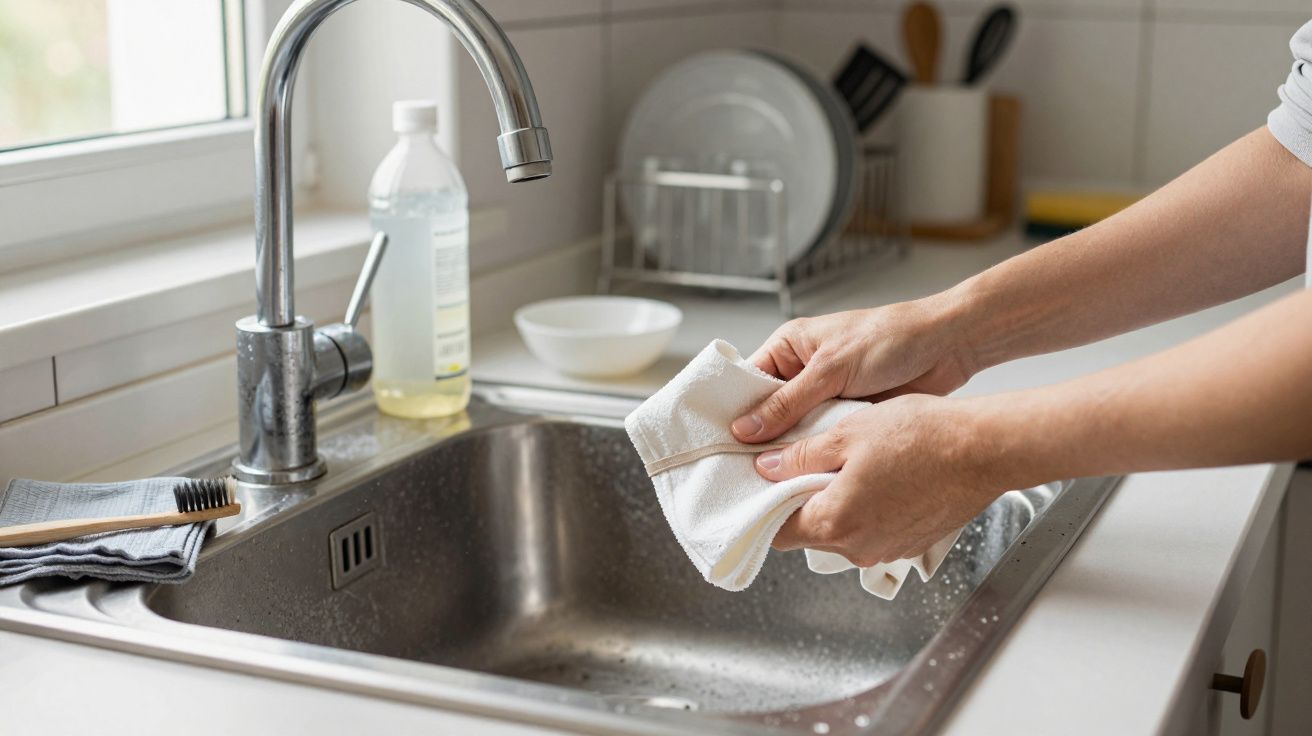
For vertical limescale rings at the base of a tap, plumbers often build a little vinegar “collar”. They wrap a reusable cloth or a thick wad of kitchen roll around the crusted area, then slowly pour white vinegar on until the fabric is fully soaked but not dripping everywhere. The aim is simple: keep acid pressed against the scale, not running straight down the plughole.
A small elastic band or a piece of string holds the bundle in place. Left for 30–60 minutes – or longer on heavy build‑up – the scale starts to soften under the wrap. You can lift the cloth halfway through, gently press with a fingernail or old plastic card and feel the difference between rock‑hard crust and something that now gives under pressure.
2. Let shower heads have a bath
Removable shower heads are easier. Many plumbers unscrew the rose or whole head and dunk it in a jug or bowl filled with warm water and a generous slug of vinegar. In rentals where the scale has been building for years, they skip the dilution and soak in neat vinegar for an hour or two, checking that any rubber seals sit above the liquid if possible.
For fixed heads that will not budge, a freezer bag half‑filled with vinegar, lifted over the head and secured with a band, works like a hanging bath. Once the fizzing slows, a soft brush or even an old toothbrush lifts away loosened flakes. Rinse well under running water and those clogged nozzles often spray straight again.
3. Scrub only at the end
In hard‑water homes, it is tempting to go in early with scourers and stiff brushes. Plumbers tend to save elbow grease for the very end. Once vinegar has done most of the dissolving, all you usually need is:
- A non‑scratch sponge or microfibre cloth for chrome.
- A soft nylon brush or toothbrush for grooves and aerators.
- A wooden cocktail stick or plastic pick for tiny holes, never metal.
Five minutes of this after an hour of soaking will almost always beat 20 minutes of aggressive scrubbing on dry, untouched scale.
Where vinegar shines – and where to be careful
Vinegar is not magic, and it is not suitable for every surface. Knowing where it behaves well stops you from trading limescale for damage.
| Good candidates | Use with care |
|---|---|
| Chrome taps and mixers | Natural stone (marble, limestone, travertine) |
| Stainless steel sinks | Some composite or resin sinks |
| Removable shower heads | Enamel with existing chips |
| Ceramic basins and toilets | Cheap plated finishes that already peel |
On chrome and stainless steel, mild acid followed by a thorough rinse and dry usually leaves a clean, streak‑free finish. On natural stone and some composites, acid can etch or dull the surface. If your tap or worktop sits directly on marble or limestone, shield the stone with cling film or a thick, wrung‑out cloth before you start wrapping vinegar‑soaked pads around the base.
If you are not sure what a surface is made from, test a tiny, hidden patch with diluted vinegar (half water, half vinegar) for ten minutes, then rinse and dry. Any roughness or dulling means stop there.
Rubber seals, O‑rings and modern cartridges generally tolerate short contact with diluted vinegar, but hours of soaking in neat acid is not wise. Plumbers often keep rubber fully above the soak line on shower heads, or limit soaking time to what is needed to loosen visible scale.
A simple routine that keeps limescale from turning into concrete
The most expensive call‑outs often start with years of “I’ll get to it later” around the taps. Once limescale builds inside cartridges and aerators, you do not just lose shine; you lose proper flow and, eventually, parts.
You do not need to turn into a weekly descaling vigilante. Quiet, repeatable habits work better.
- Once a month in hard‑water areas, wrap the base of kitchen and bathroom taps with vinegar‑soaked cloths for 20–30 minutes, wipe and rinse.
- Every couple of months, unscrew aerators (the small mesh at the tip of many taps), soak in a cup of vinegar for an hour, then scrub and refit.
- After showers or baths, a quick wipe around tap bases with a dry cloth removes the droplets that start tomorrow’s scale.
Those small moves keep mineral build‑up at the film stage instead of the “tiny cliff” stage. They also make it easier to spot leaks, hairline cracks or failing seals because you are not peering through a crust.
In the background, that £1 bottle quietly earns its keep, saving you from aggressive chemicals, dulled chrome and, sometimes, a new tap.
FAQ:
- Does any vinegar work, or does it have to be white? White (distilled) vinegar is best because it is colourless and will not stain. Malt or balsamic vinegars can leave sticky residue or tint pale surfaces.
- Can I mix vinegar with bleach for extra power? No. Never mix vinegar with bleach or products containing chlorine. The combination can release chlorine gas, which is dangerous to breathe.
- How long is it safe to leave vinegar on taps? For most chrome taps, up to an hour in contact with vinegar‑soaked cloths is fine, followed by a thorough rinse and dry. For delicate finishes, start with 10–15 minutes and test.
- Will vinegar fix internal limescale in boilers or kettles? It can help in kettles when diluted and boiled then rinsed, but boilers and complex heating systems need specialist treatments or professional servicing.
- What if the limescale does not budge after soaking? Very heavy, old deposits may need several rounds of soaking and gentle scraping with a plastic tool. If parts are badly pitted or flow is still poor, it may be cheaper in the long run to replace the fitting.
Comments (0)
No comments yet. Be the first to comment!
Leave a Comment