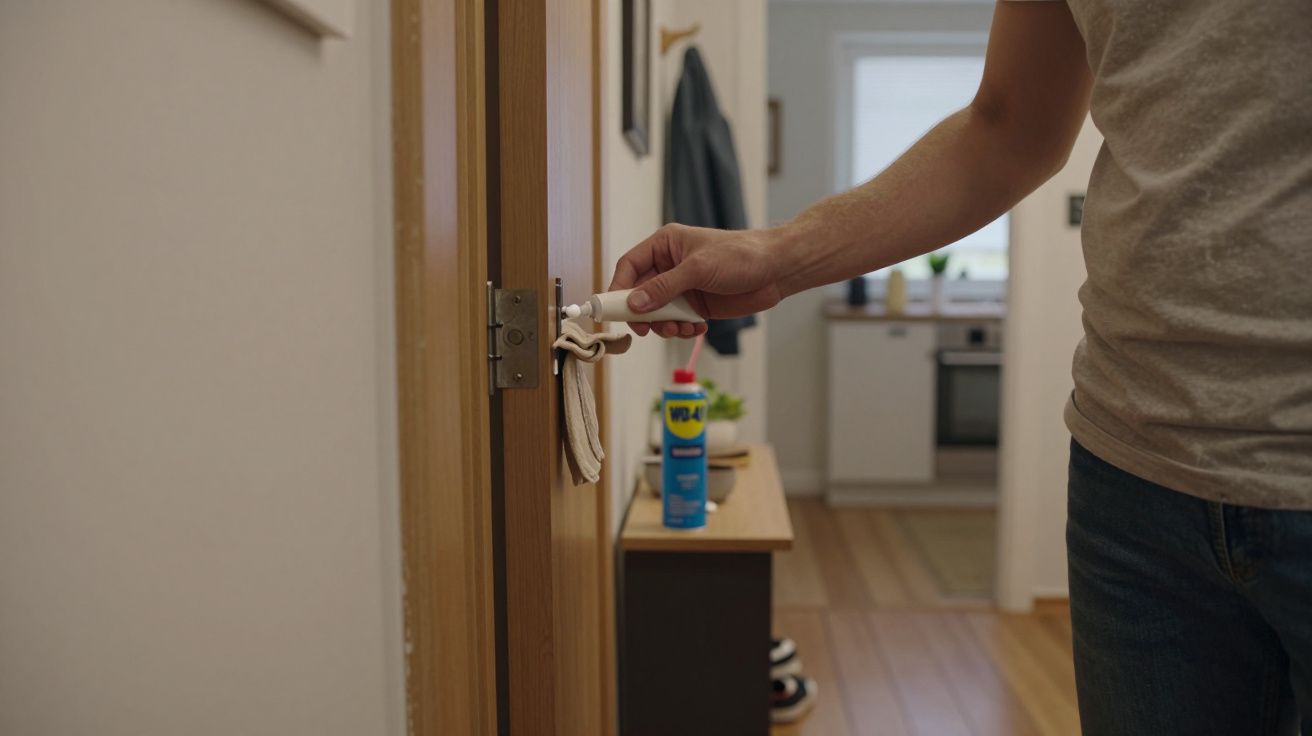
The £5 product mechanics use to stop squeaky doors for years – and it’s not WD‑40
The sort of squeak that gets you isn’t the dramatic one. It’s the faint, metallic groan every time someone nips to the kitchen, the bedroom door that complains on the late shift, the cupboard that gives you away when you’re looking for biscuits at 11pm. You tell yourself you’ll deal with it at the weekend. The weekend comes. The squeak stays.
Most people reach for the bright blue can without thinking. Spray, hope, walk away. Then, a few weeks later, the sound is back, slightly smug. Mechanics don’t do it that way. In garages and workshops, there’s a quieter favourite that costs about a fiver, doesn’t attract grime, and can keep a hinge silent for years: white lithium grease.
This isn’t a miracle hack. It’s basic maintenance done properly, with a product designed for the kind of metal‑on‑metal contact a door hinge lives with every day.
Why WD‑40 isn’t the long‑term fix you think it is
WD‑40 has its place. It’s brilliant at loosening stuck screws, displacing moisture from damp locks, and giving jammed parts a second chance. It’s primarily a solvent and water displacer, though, not a dedicated hinge lubricant, and that difference matters over time.
The thin fluid creeps in fast, which is why the squeak often stops straight away. It also evaporates and runs off just as quickly, taking rust and old grime with it but leaving only a light residue. On an open hinge that moves dozens of times a day, that film simply doesn’t last. Dust and dirt cling to it, gradually thickening into a sticky paste that can make the hinge worse than before.
Mechanics think in years, not hours. On door hinges they want something that:
- Stays where you put it instead of dripping down the paintwork
- Lubricates under pressure, again and again
- Resists water and road salt on cars, steam and condensation indoors
White lithium grease ticks those boxes in a way general‑purpose sprays rarely do.
“If it slides, pivots or creaks and you can see bare metal, lithium’s usually the answer,” as one MOT tester put it to me, wiping a hinge with the same casual certainty you’d reserve for buttering toast.
Meet the £5 workhorse: white lithium grease
White lithium grease sounds industrial, but on the shelf it looks almost boring: a small tube or spray can in off‑white, sometimes with ‘multi‑purpose grease’ on the label. Inside is a soap‑thickened mineral grease that clings to metal surfaces and keeps them separated under load. In practice, that means:
- The tiny contact points inside a hinge stop grinding
- Movement feels smooth rather than sticky or notchy
- The protective layer shrugs off humidity instead of washing away
For household use, two formats make life easy:
- Tube or pot – thicker, you apply with a cotton bud or fingertip
- Aerosol with straw – thinner on exit, but sets into grease once in place
Either will do the job. A single tube at around £5 will usually outlast several cans of quick‑fix spray because you need so little each time.
Where mechanics quietly use it every day
Look around a typical workshop and you’ll find white lithium grease in places that sound very familiar in a house:
| Part or area | What it does |
|---|---|
| Car door hinges & latches | Stops creaks, protects from weather and wash‑downs |
| Bonnet & boot catches | Keeps movement smooth, prevents sticking in winter |
| Seat runners & rails | Lets seats slide without grinding or jolting |
Those same conditions apply to a front door that faces the rain, a loft hatch that barely moves, or the cupboard hinges that protest every school morning. Once you see it that way, borrowing the garage solution for the hallway starts to feel obvious rather than niche.
How to silence a squeaky door properly (in five quiet minutes)
You don’t need a workshop to do this, just a steady hand and a cloth. Allow yourself one hinge as a test if you’re nervous, usually the top hinge on an interior door where marks will be less visible.
Protect the area
Open the door and tuck a bit of kitchen roll or an old cloth under the hinge to catch any drips. If your paintwork is precious, you can mask around the hinge with low‑tack tape.Clean first, always
Wipe the hinge with a dry cloth to lift dust and loose muck. If it’s visibly greasy, give it a quick once‑over with a drop of washing‑up liquid and water on the cloth, then dry well. Don’t soak the wood.Apply a tiny amount of grease
- With a tube: squeeze a pea‑sized dot onto a cotton bud and work it along the visible joint and hinge pin top.
- With a spray: use the straw, aim at the pin and moving joint, and give the lightest possible tap on the trigger. You want a sheen, not a waterfall.
- With a tube: squeeze a pea‑sized dot onto a cotton bud and work it along the visible joint and hinge pin top.
Work it in
Open and close the door ten to fifteen times. The hinge will draw the grease into the internal contact points. Wipe away any surplus that squeezes out.Listen, then adjust
If there’s still a faint squeak, repeat with a fraction more grease. If movement feels stiff or you see blobs, you’ve overdone it; just wipe off and keep using the door, the excess will thin with motion.
The whole process takes less time than boiling the kettle, but the effect can last for years rather than weeks.
The most satisfying part isn’t the silence itself. It’s realising you can fix that little daily irritation without a tradesperson, a full toolbox, or a bang‑on‑trend gadget.
Common mistake: spraying everything that moves
Once one door goes quiet, attention wanders. The cupboard. The garden gate. The fridge. The temptation is to walk around with a can, baptising every moving part in sight. That’s how you end up with greasy fingerprints, stained clothing and dusty streaks on white paint.
A better rule is simple: if you can see bare metal and it’s a pivot, hinge or slide, lithium grease is likely safe. If it’s plastic, rubber, or a lock barrel full of delicate pins, stop and check.
Here’s a quick guide.
| Use lithium grease? | Good candidates |
|---|---|
| Yes | Internal and external door hinges, metal latches, gate hinges, garage side‑doors, window stays |
| Sometimes | Sliding wardrobe tracks (if metal), stiff drawer runners, shower door frames (avoid seals) |
| No | PVC or uPVC mechanisms, keyholes, electrical switches, rubber seals, anything near an oven or hob flame |
Plastic and rubber can swell or degrade under some greases. For PVC doors and windows, look for a silicone or PTFE spray labelled as safe for plastics. For keyholes, a dry graphite or dedicated lock lubricant is your friend.
Safety, mess and the boring bits that actually matter
Lithium grease looks tame compared with heavy chemicals, but it still deserves basic care. You’re dealing with a petroleum‑based product that doesn’t mix well with carpets, good jeans or curious pets.
Keep it sensible:
- Wear thin gloves if you can; it saves the inevitable hand‑scrub afterwards
- Always wipe surplus before it migrates onto clothing or flooring
- Ventilate lightly if you’re using aerosol indoors, particularly in tight spaces
- Store the tube or can out of sunlight, away from radiators or open flames
Patch‑testing on an inconspicuous hinge is more about aesthetics than safety. On older doors with flaky paint, the cleaning step can lift loose paint; better to find that behind a coat cupboard than on the living‑room entryway.
Why this small change feels bigger than it is
Fixing a squeak is not a renovation story. The before‑and‑after photos would barely register. Yet people who swap from quick‑fix sprays to a proper grease often report the same quiet shift: they stop tolerating little annoyances because they now have a mental category of “solvable in five minutes”.
It’s the same psychology as switching to a simple, always‑to‑hand cleaner in the kitchen. Once the faff disappears, the habit sticks. One squeak leads to another, then to a stiff gate, then to the creaky loft hatch you’ve ignored for a decade. Each success feels slightly out of proportion to the effort, and that is exactly how maintenance should feel.
You don’t need a workshop, a subscription box of miracle fluids, or a full set of spanners. You need a cloth, a small tube of white lithium grease, and the decision that the next squeak you hear won’t survive until Sunday.
FAQ:
- Will this work on uPVC front doors and windows? Not directly on the plastic. Use lithium grease only on the exposed metal hinges and mechanisms, and choose a silicone‑safe spray for plastic parts and rubber seals.
- How long will one application last on a typical internal door? In most homes, one careful application will stay effective for one to three years, depending on how often the door is used and the humidity in the room.
- Can I use it on sliding wardrobe doors? Yes, if the tracks and rollers are metal. Apply sparingly to the track, move the door back and forth, then wipe away any excess so dust doesn’t build up.
- What if the door still squeaks after greasing? Check whether the hinge screws are loose, the door is rubbing on the frame, or the hinge itself is bent. Grease only silences metal friction; it can’t correct misalignment.
- Is white lithium grease safe around children and pets? Once applied thinly and wiped back, it’s stable and not easily accessible. Keep the product itself out of reach and avoid leaving fresh blobs where small hands or paws can touch them.


Comments (0)
No comments yet. Be the first to comment!
Leave a Comment