The kettle-placement mistake that quietly steams and ruins your kitchen cabinets
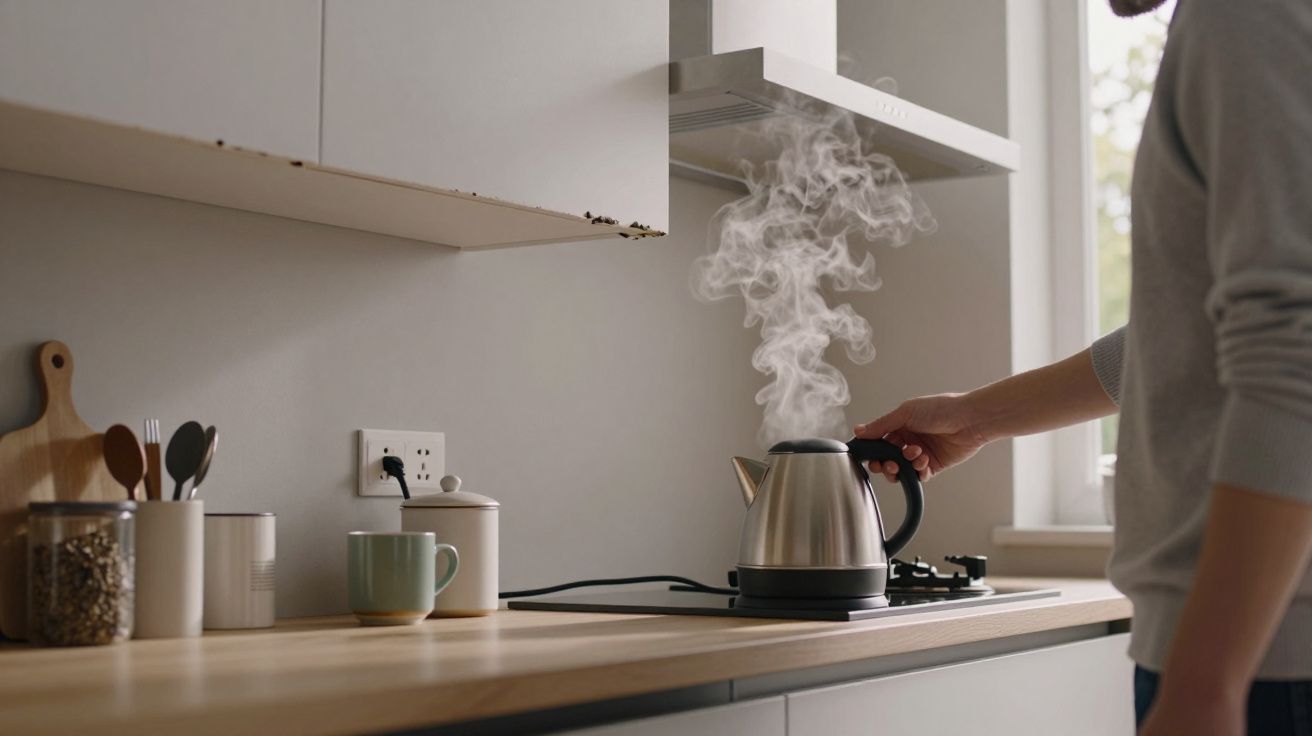
You flick the kettle on, lean against the counter for a minute and watch the plume of steam rise. It curls under the wall cabinet, fogs the underside, then disappears. Nothing drips, nothing cracks in front of your eyes, so you forget about it until one day the door feels swollen, the laminate lifts at the edge, and the hinges no longer sit straight.
The damage rarely arrives with a bang. It creeps in with every morning tea and mid‑afternoon coffee.
Why steam and cabinets don’t mix
Most fitted kitchens are built from chipboard or MDF wrapped in a thin skin: laminate, paint or a wood veneer. Those cores hate moisture. Boiling water turns to high‑temperature steam that rises fast, hits the nearest cold surface – often the underside of a cabinet – then condenses. Tiny droplets soak the edges and screw holes long before you see anything.
Dozens of these cycles a week act like a slow‑motion leak. The board swells, the protective layer starts to bubble or peel, and the glue holding edging strips and trim softens. By the time you notice obvious warping, the structure underneath is often too damaged to “dry back”.
Hidden leak in plain sight: a daily jet of kettle steam under a cabinet can age it by years in a few months.
How to tell your cabinets are already suffering
Look closely at the units above your kettle or hob. Early warning signs are easy to miss on a busy morning but very clear once you know where to look.
- Swollen or “puffy” edges on doors and shelves.
- Fine cracks or bubbles in the laminate or paint near the bottom of the cabinet.
- Darkened screw holes or flaky chipboard around hinges.
- Doors that no longer sit flush or need a shove to close.
- A faint musty smell when you open the cupboard above the kettle.
If you spot two or more of these, it is not just “ageing”; you are probably watching steam damage in real time.
The worst place to park your kettle
The trouble isn’t the kettle; it is what sits directly above it. Steam behaves predictably, so certain spots deserve a red flag.
- Under wall cabinets with no gap or shelf above.
- In corner units where steam gets trapped instead of dispersing.
- Beneath a framed pelmet or lighting strip that creates a low “ceiling”.
- Next to a tall fridge housing or pantry that forms a steam tunnel.
- Against a tiled backsplash that funnels steam straight upwards.
In rented flats and small kitchens, the worktop often feels like a jigsaw with no spare piece. The kettle ends up squeezed under a cupboard simply because the plug is there. Over a year or two, that convenient socket can translate into hundreds of hours of hot, damp air soaked into the same square foot of cabinetry.
Quick test: boil a full kettle in the dark and shine a torch – you’ll see exactly which surfaces are taking the hit.
Simple placement fixes that spare your cabinets
The goal is not to buy a new gadget; it is to change where the plume goes. A few small shifts protect years of use.
- Move the kettle to an open stretch of worktop with nothing directly above.
- Slide it in front of a window if the sill is high enough and the frame can cope.
- Angle the spout away from walls and cabinets so steam rises into open air.
- If space is tight, pull the kettle to the front edge of the worktop before you boil, then push it back when cool.
- In kitchens with an extractor hood, boil the kettle under the hood and run the fan on low.
These habits feel fussy for a week, then become as automatic as reaching for the mug. One of the cheapest “renovations” you can give a tired kitchen is simply to stop cooking the joinery with steam.
Little protections that actually help
If moving the kettle isn’t fully possible, you can still cut the impact.
- Fit a small metal or glass splash panel on the underside of the cabinet above.
- Seal raw chipboard edges and drilled holes with a suitable sealant or varnish.
- Replace peeling edging strips before the bare board is exposed.
- Wipe away condensation after heavy use, especially around corners and light fittings.
These are not excuses to keep boiling under a cabinet indefinitely, but they do buy time and slow further damage while you rethink the layout.
What steam does inside the cabinet structure
Each steam burst loads the surface with warm moisture that penetrates through joints, screw holes and any nick in the finish. The wood‑based core expands as it drinks this water, then shrinks as it dries. Repeated swelling and shrinking breaks down fibres and weakens glue lines.
Hinges and fixings rely on firm, dense board to hold their screws. Once that board crumbles, screws lose bite and start to wobble, which misaligns doors and puts more strain on everything else. In lacquered or painted kitchens, micro‑cracks let even more moisture in, speeding up the cycle.
If mould spores find a humid pocket in an unventilated cavity, they can spread behind the scenes. You may never see black spots, but you might notice rust on fixings or a persistent damp smell you cannot quite place.
How to rescue mild damage (and when to give up)
Not every swollen edge means a full replacement. Catching issues early can turn a slow disaster into a simple repair.
- Lightly sand and reseal small raised areas once they are fully dry.
- Tighten or move hinges into fresh material if the original holes have blown out.
- Add extra fixing plates or brackets where chipboard has weakened.
- Use colour‑matched fillers only after ensuring the board underneath is stable and dry.
When the swelling is severe, the laminate has lifted across a large area, or the cabinet base has bowed, replacement is usually the only sound option. Patching over rotten board is like taping a crack on a rusted pipe: it delays the leak rather than curing it.
Rule of thumb: if a screwdriver sinks easily into the exposed board, treat the panel as failed, not “tired”.
A quick placement checklist for a safer kettle spot
Use this short list to audit your current set‑up and make a better choice in ten minutes.
- Is there clear air at least 40–50 cm above the kettle?
- Does steam have a way to escape sideways or upwards without hitting wood?
- Is there a plug nearby so you are not tempted to keep it under a cupboard?
- Can you boil with the extractor on, or near an opening window?
- Are vulnerable edges and holes in nearby cabinetry sealed?
If you answer “no” to several of these, rearranging the worktop now is cheaper than calling a fitter later.
Small routine, big savings
Kettle steam damage is one of those issues that no one warns you about in the showroom. The kitchen looks pristine under bright lights, the salesman talks about soft‑close hinges and easy‑wipe doors, and no one mentions that parking your kettle in the wrong 30 cm square can shave years off the cabinets.
Shift the kettle, seal the weak spots, and keep an eye on the early signs. These small, boring moves save you from swollen doors, sagging shelves and the kind of repair bill that feels wildly out of proportion with “just making tea”.
Three seconds to slide the kettle into clear air now can spare you a four‑figure cabinet quote later.
FAQ:
- Does an integrated or “steam” kettle avoid this problem? Not really. Any appliance that vents hot steam into the same spot – including boiling water taps and tabletop steamers – can damage nearby joinery if it is too close and poorly ventilated. The fix is always about where the steam goes, not the brand of appliance.
- Are solid wood cabinets safer than chipboard? They cope slightly better with moisture and can often be sanded and refinished, but repeated steam exposure will still warp, crack and stain them. Treat them as something to protect, not test.
- Is it enough to open the cabinet door when I boil the kettle? Opening the door helps a little by letting moisture escape, but the underside and front edge still take the main hit. It is far more effective to move the kettle into open space while it boils.
- Will a dehumidifier or good ventilation stop damage? General ventilation reduces overall humidity but doesn’t stop the intense local blast of steam hitting one spot. Think of dehumidifiers as background support, not a shield for badly placed appliances.





Comments (0)
No comments yet. Be the first to comment!
Leave a Comment