The simple curtain trick that keeps heat in and street noise out, according to insulation experts
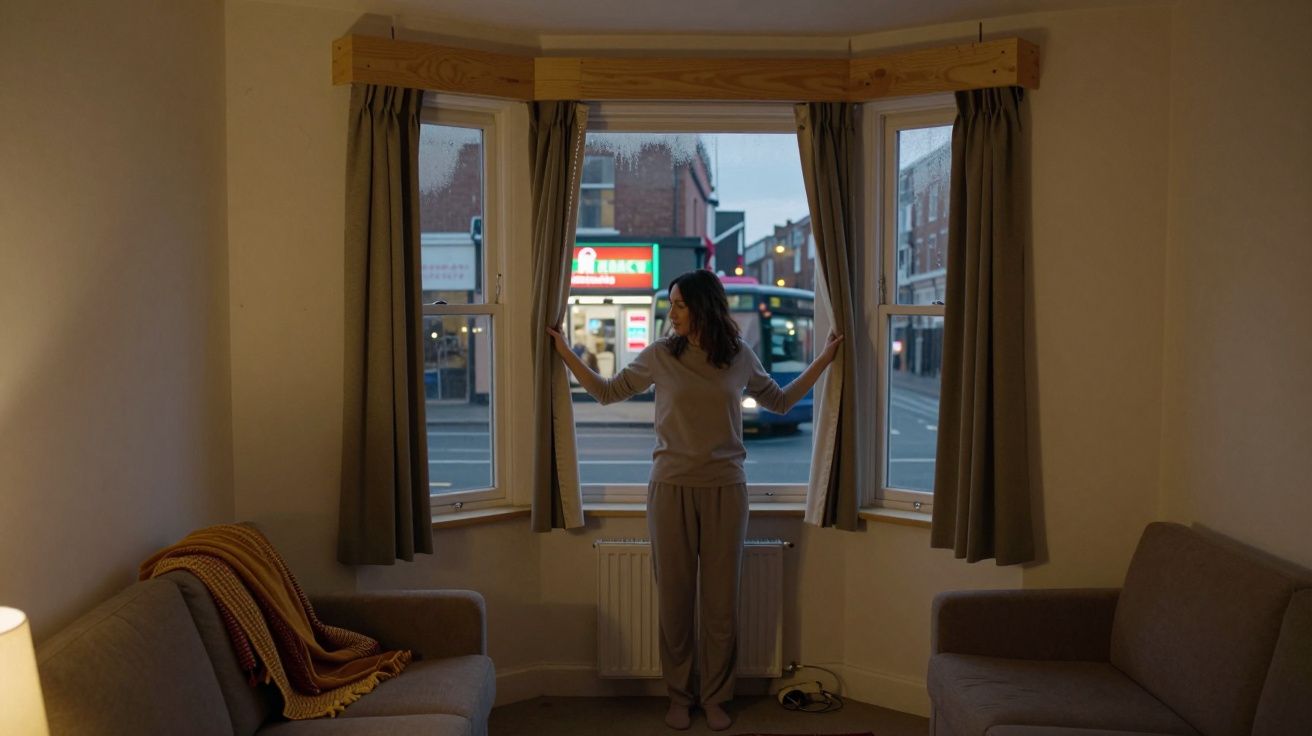
My neighbour across the landing lives above a bus route and opposite a kebab shop. Her living room window used to leak everything: diesel growls, late-night laughter, and a cold that crept in along the skirting boards. She didn’t have money for secondary glazing or fancy acoustic panels. What she had was a tape measure, a draughty bay window and a quiet determination to stop seeing her breath on January mornings.
The change started with curtains. Not new ones, at first glance-same rail, same colour, same view of the bus stop. But tucked behind the fabric, hidden in plain sight, was the trick insulation specialists keep repeating to anyone who’ll listen: turn your curtains into a sealed, padded wall, top and bottom. It looks like nothing from the sofa. It feels like someone finally shut the door on the street.
Why curtains are secretly serious insulation
We tend to treat curtains as decoration, not building fabric. Insulation experts don’t. A window, even double-glazed, is the weakest part of most external walls for both heat and sound. Glass leaks warmth; gaps around frames leak air; bare plaster under sills acts like a cold radiator. Thick curtains are already a step up-but only if they’re used like a barrier, not a scarf.
The science is simple. Sound and heat both travel easily through gaps and hard surfaces. When you create a deep, still layer of air in front of the window, and make it hard for that air to move, you blunt both. A heavy, lined curtain with no side, top or bottom gaps can cut heat loss through a window by around 15–20%, and knock several decibels off street noise. That doesn’t sound dramatic on paper; it feels dramatic at 2 a.m. when the bin lorry goes past and you barely hear it.
Glass alone can only do so much. The trick is turning an ordinary curtain set-up into something closer to a soft, flexible panel: sealed at the top, guided down the sides, weighted at the bottom, and padded in the middle. None of that requires ripping out windows. It does require looking at your curtain like a piece of kit, not a backdrop.
Think of your curtains as a second wall: the fewer gaps, the calmer, warmer the room becomes.
The simple trick: create a “curtain capsule” around your window
Insulation consultants often sketch the same diagram: a box around the window, with the curtain forming the front face. The goal is to trap a pocket of air and stop it washing in and out of the room. The practical version in a rented flat uses four quiet moves.
First, mount the rail or pole as high and wide as you can manage. Taking it 10–20 cm above the window and extending it 15–30 cm past each side lets the curtain overlap the wall, not just the glass. That overlap closes off the worst draught paths, especially around older frames where sealant has given up.
Second-and this is the heart of the trick-add a snug pelmet or a simple “curtain shelf” above the rail. It can be a proper box pelmet, a length of timber with a fabric cover, or even a dense strip of foam wrapped in cloth and fixed to the wall. The point is to block the warm air that rises from your radiator or room heater from slipping behind the curtain, chilling against the glass, then dropping as a cold waterfall onto your feet.
Third, guide the sides. A pair of discreet self-adhesive hooks or magnetic strips on the wall, lined up with the curtain edges, lets you “clip” the curtain in at night so it doesn’t bell out and leak air and noise. Some people sew in small magnets along the hem; others simply use tie-backs fixed not to each other, but to the wall. The curtain becomes a smooth, close-fitting front, not a waving flag.
Fourth, weigh the bottom. Sewing in a simple weighted tape or using a double hem so you can tuck in a chain or a row of coins in folded webbing adds just enough heft that the curtain hangs straight, kisses the sill or floor, and resists draughts. When you close it, you’re effectively sealing a soft box around the window: top blocked, sides guided, bottom anchored.
Heat and hush: what actually changes in the room
The first thing people notice isn’t silence; it’s stillness. That cold river you used to feel when you sat near the window-knees frosty, ankles complaining-goes slack. The air inside the curtain capsule warms a little, then stops moving. Your heating no longer has to fight a permanent, invisible down-draught.
Noise shifts next. Street sounds don’t disappear, but they move back a row in the theatre. High, sharp noises-motorbikes, trolley wheels, late-night laughter-are softened by the extra layers of fabric and the trapped air. Low rumbles from buses and bin lorries are dulled when they hit something soft before they reach your ears. It’s not recording-studio quiet. It’s “you can hear the radio at normal volume” quiet.
Thermally, the difference is often most obvious in the morning. Rooms with properly sealed curtains lose less heat overnight, so the radiator doesn’t have to work as hard to bring them back to comfort. If you touch the glass behind the curtain on a bitter day, it will still be cold. The point is that cold doesn’t reach your sofa as quickly.
Close the capsule at dusk, open it fully at dawn; you’re timing your curtains with your heating, not just your privacy.
The move in practice: small steps, real gain
- Extend your curtain rail above and beyond the window frame.
- Add a simple pelmet or shelf to block warm air escaping over the top.
- Use hooks, magnets or wall-fixed tie-backs to snug the curtain against the wall.
- Add weight to the hem so it sits flush with sill or floor.
- Pair with a thermal or acoustic lining for extra insulation from the same fabric.
Fabrics, linings and what experts quietly recommend
Insulation and acoustic specialists talk in layers. The curtain itself is only one. Behind it, a dense thermal or acoustic lining does much of the heavy lifting. In UK homes, that often means a standard curtain plus a clip-on or hook-on lining, rather than replacing everything.
Heavier, tightly woven fabrics-velvet, wool blends, thick cotton-block more sound and heat than light sheers. But you don’t have to live in a theatre. A medium-weight curtain with a decent thermal lining hung in a well-sealed capsule can out-perform a luxurious fabric left flapping with a gap at the top.
If you face a main road, an acoustic lining with a rubber or dense polyester core adds further noise reduction. Experts suggest focusing that spend on the noisiest, coldest room first: usually the bedroom or living room that faces the street. Bedrooms in particular benefit from darkness, muffled sound and stable temperature; your sleep quality often improves more than your gas bill.
There’s also a sustainability angle. Upgrading the way you hang and seal existing curtains, and adding a separate lining, beats sending them to landfill in favour of a new “thermal” set that’s hung badly. It’s the invisible carpentry, not just the cloth, that earns its keep.
Quick reference: what makes a curtain “insulating”?
| Feature | What it does | Why it matters |
|---|---|---|
| Pelmet or shelf | Stops warm air escaping over the top | Cuts heat loss and draughts |
| Side sealing | Reduces gaps around frame and wall | Lowers noise and cold leaks |
| Weighted bottom | Keeps curtain flush with sill or floor | Stabilises air pocket |
Common mistakes that waste all that fabric
The biggest error is leaving a fist-sized gap at the top of the curtain rail, especially above radiators. All your paid-for warm air simply loops behind the fabric and pours down the glass. In noise terms, that gap also acts like an open vent to the street.
The second mistake is stopping the curtain short of the sill or installing it inside a deep window reveal with no overlap. That layout turns it into a chilled lampshade wrapped around your coldest surface. You get the gloom and none of the gains.
The third is going narrow and pretty: curtains that just skim the window edges, with no wall overlap, and hang from flimsy poles that bow in the middle. They look tailored; they perform poorly. Without width and weight, they can’t create that calm, sealed pocket of air.
And finally, there’s how we use them. Leaving curtains half-open in the evening because of a pot plant, a chair or a habit keeps the heat and noise path wide open. The capsule only works when you actually close it-right to the sides, right to the sill.
The trick is not more curtain; it’s smarter curtain: same window, better behaviour.
A simple evening ritual that changes the feel of the house
What many people notice after making these tweaks is less about numbers and more about pace. You close the curtains fully at dusk, tuck them into their hooks, feel them touch the sill, and the room seems to move in a notch. Street glare fades, the hum outside softens, the temperature stops sliding quite so fast.
Pairing that tiny ritual with your heating schedule makes it more powerful. Curtains closed, thermostats nudged, draught excluders straightened-the house is cued for the night. In the morning, opening the curtain capsule in one smooth pull brings the light and the street back on your own terms.
None of this is grand design. It’s the domestic engineering insulation experts quietly rely on in their own homes: fabric, air, gravity and a refusal to waste comfort on preventable gaps. The window stays the same. The way it behaves does not.
FAQ:
- Will this help if I already have double glazing? Yes. Double glazing cuts a lot of heat and some noise, but the frame and surrounding wall still leak. A well-sealed curtain capsule adds another barrier, especially helpful on windy or very cold nights.
- Do I need special “thermal” curtains? Not necessarily. Medium to heavy curtains with a good-quality thermal or acoustic lining, properly sealed at top, sides and bottom, can perform as well as many branded thermal ranges hung loosely.
- Won’t sealing curtains trap condensation on the glass? It can if the room is very humid. Use trickle vents or brief daily airing, and avoid blocking any designed ventilation slots. Opening the curtains fully each morning lets moisture clear.
- Can I do this in a rented flat without drilling? Often, yes. You can use tension rods inside recesses, adhesive pelmet brackets, stick-on hooks and removable magnetic tape along the sides. Test adhesives on a small area first to protect paint.
- Does it work for noise as well as heat? It helps with both, especially higher-pitched and mid-range street sounds. For very loud roads or bars, combine the curtain capsule with sealing frame gaps and, if possible, adding secondary glazing film for best results.






Comments (0)
No comments yet. Be the first to comment!
Leave a Comment