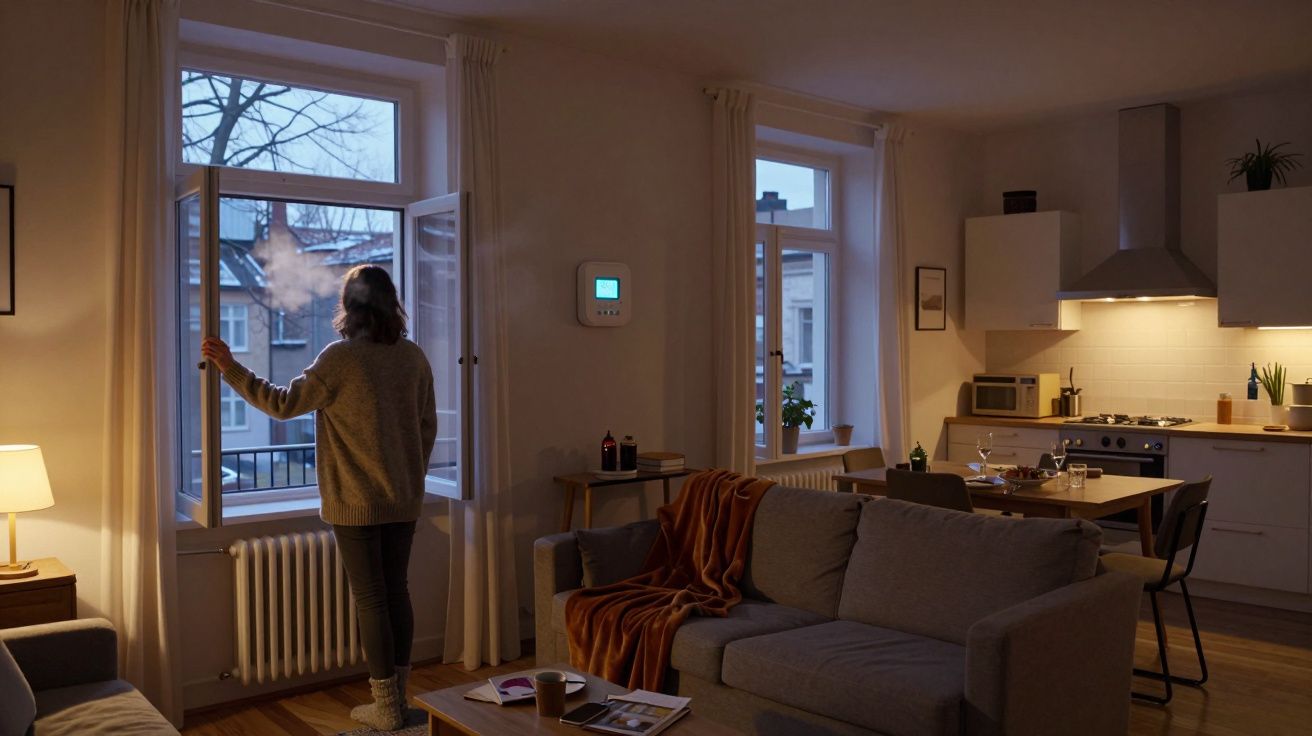
The window‑opening schedule that clears indoor air pollution without freezing the house
The air in most homes looks innocent. It smells fine, the windows don’t mist, nobody coughs on cue. Then you see a CO₂ graph from a cheap sensor after a dinner party and the line climbs like a bad stock market: 800 ppm, 1,200, 1,800 and up. Candles, cooking, cleaning sprays, gas hobs, scented diffusers, even our own breath stack up into an invisible fog. In winter the instinct is simple: shut everything, keep the warmth in, deal with the air “in spring”. That bargain turns out to be less cosy than it feels.
The good news is you don’t need a mechanical ventilation system or a renovation budget to fix most of it. You need a clock, a few habits and a little nerve to crack the windows for short, sharp bursts. Done right, you can flush a surprising amount of pollution without turning your living room into a bus stop.
Why “a bit of air sometime” doesn’t work
Most people open windows like they water plants: when they remember, or when the room feels stuffy. By the time your body complains - heavy head, slight nausea, a weird sleepy irritation - CO₂ and other pollutants are already high. The problem is that indoor air doesn’t mix and clear in a neat, even way. Stale pockets lurk in corners and closed rooms; warm air pools near the ceiling; bathrooms behave like small chemical factories.
Modern, well‑sealed homes make this worse. Good insulation keeps heat in and drafts out, along with the fresh air older houses leaked by default. Humidity from showers and drying clothes lingers, feeding mould in silent corners. Tiny particles from frying oil and toasters travel into bedrooms and stay there. Opening one small window for five minutes “whenever” barely dents that load. What works is short, regular, deliberate changes of air that use physics in your favour.
The 3–2–1 rule: a simple winter ventilation routine
Think of winter ventilation like brushing your teeth: small routines that prevent big problems. The 3–2–1 rule is a good starting point for most UK households without mechanical ventilation.
- Three times a day
- Two windows (or more) opposite or far apart
- Ten minutes, not two
You’re not trying to chill the bricks; you’re using cross‑ventilation to swap a chunk of indoor air for outdoor air quickly. Here is how that looks in practice on a cold weekday.
Morning: the moisture dump
The first opening is right after people get up and wash.
- Open wide a bedroom window and a window on the opposite side of the home (kitchen or living room) for 5–10 minutes.
- Leave internal doors open so the air can sweep through.
- If someone showers, open the bathroom window fully just after they finish, again for 5–10 minutes.
Cold air enters, pushes out the warm, humid, stale air, then you close everything. Walls and furniture barely cool in that short burst, but moisture and CO₂ levels drop fast. This is when you dump the night’s build‑up: breath, sweat, and any lingering fumes from cleaning products used the evening before.
Afternoon or early evening: the cooking sweep
The second opening is anchored to your main cooking time.
- If you have an extractor fan that actually vents outside, run it from the moment you start cooking until 10–15 minutes after you finish.
- As soon as you can after cooking (between courses if it’s a long meal), open the kitchen window wide and another window as far away as possible for 5–10 minutes.
- Close doors to rooms you want to keep warmer if needed, but keep the flow across the main living areas.
Frying, toasting and gas hobs all create fine particles and gases that hang around for hours if you don’t move them on. This short blast cuts the peak and clears the smell without leaving you in a coat at the table.
Late evening: the bedroom reset
The last opening happens 30–60 minutes before bed.
- Open the bedroom window wide for 5–10 minutes, plus another window or back door elsewhere to encourage flow.
- Close the bedroom door while you ventilate if the rest of the home is toasty and you’d rather keep that heat in.
- After closing, pull curtains or blinds to add a small layer of insulation.
You’re trading a bit of heat now for much better air overnight. People sleep more deeply and wake with fewer “sleep hangovers” when CO₂ stays lower. If that much cold air feels brutal, start with 3–5 minutes and build up as you get used to it.
Cross‑ventilation: using your home’s shape as a tool
Not all open windows are equal. A single window on tilt trickling cold air all day cools surfaces without really flushing the space. Two windows, widely spaced and fully open for a short period, do the opposite.
Imagine your home as a tube. Fresh air needs an entrance and an exit to move through it. The wider and straighter the path, the better the exchange. Here are a few simple patterns that work well in UK layouts:
- Terraced house: front room window + kitchen/back door.
- Flat with windows on one side only: bedroom + living room, doors open, use the stairwell or balcony door if safe.
- Semi‑detached: front bedroom + back bedroom, or upstairs window + downstairs back door.
If you’re on a noisy or polluted street, you can flip the strategy: crack the quieter side more often, and time brief front‑window openings for lower‑traffic moments. Ten minutes at 10 pm is cleaner than twenty at 8:30 am on a main road.
What about pollution from outside?
The UK’s winter air isn’t always fresh. Wood‑burning stoves, traffic, and in some areas agricultural burning all add particles. Opening a window can feel like inviting the problem in. The trick is comparing a short, controlled intake of outdoor air with constant indoor build‑up from everything you do inside.
Outdoor pollution peaks:
- On still, cold evenings when smoke and exhaust sit low.
- During rush hours on main roads.
- Near busy junctions and wood‑burner‑heavy neighbourhoods.
Indoor pollution peaks:
- While and after you cook or fry.
- During and after showers and drying clothes.
- When several people share a room for hours with windows shut.
You want to avoid overlapping the worst of both. If you live near a main road, shift your main window bursts to mid‑morning, early afternoon, and later evening after traffic drops. In wood‑burner country, ventilate hard before everyone lights up, then use shorter, more frequent cracks later.
For many streets, this balance still means that short, sharp ventilation wins. A brief spike of outside air is less harmful than a steady background of CO₂, moisture and indoor chemicals with nowhere to go.
Keeping the heat, losing the damp
The fear behind closed windows is simple: bills. Heating is expensive; nobody wants to pay to warm the garden. The physics offers some comfort. In a well‑insulated home, most heat is stored in walls, floors and furniture, not in the air itself. When you open windows for 5–10 minutes, you mainly swap air. The structures cool only slightly and re‑warm quickly once you close up.
You can help the balance along:
- Use curtains as lids. Open wide to catch any winter sun, close as soon as it fades and after each ventilation burst.
- Seal the obvious leaks (gappy letterboxes, unused chimneys, loose loft hatches) so the air change is on your terms, not random drafts.
- Shut doors to little‑used rooms during ventilation to keep the main heated space more stable.
- Avoid drying mountains of laundry in a closed living room; if you must, ventilate while you do it, even on very cold days.
If you have very old, leaky windows and genuine cold‑house issues, you may need to aim for more, shorter bursts (3–4 minutes, more often) rather than the full 10, watching what you and your heating system can tolerate.
How to tell if your schedule is working
You don’t have to become a hobby scientist, but a little feedback helps. Many people now buy low‑cost CO₂ sensors and discover that their “fine” bedroom spends the night above 1,500 ppm. If you do invest in a monitor, aim for:
- Under 1,000 ppm in living areas when occupied.
- Ideally under 800 ppm in bedrooms before sleep.
Even without gadgets, your body offers clues:
- Morning headaches ease or vanish.
- Condensation on windows reduces.
- The “old socks” or “musty towel” smell fades quicker after washing or exercise.
- Mould patches stop growing and eventually dry at the edges.
If you notice you’re still waking heavy‑headed, extend one of the openings by two or three minutes, or add a fourth shorter burst on busy days (lots of guests, long cooking sessions).
Special cases: kids, pets and shared houses
Life rarely follows lab plans. A strict timetable may not survive toddlers, late shifts or flatmates who love tropical heat. The aim isn’t perfection, it’s more good exchanges than bad days.
- Children’s rooms: Ventilate them well in the evening while they’re in the bath or reading elsewhere; close before they sleep to avoid chills.
- Pets: Most cats and dogs handle short temperature changes fine. If you worry, keep them in an inner room during the 5–10 minute bursts.
- Flatshares: Agree on “no arguments” slots - for example, 10 minutes after breakfast, after dinner, and before bed - so everyone knows when to grab a jumper.
If someone in the home has asthma or a chronic lung condition, coordinate with their care team, but the same principle holds: clean, slightly cooler air often beats warm, stale air for breathing comfort.
A winter habit that sticks
Over time, the window ritual stops feeling like an attack on your comfort and starts feeling like brushing your teeth. You notice when a room smells “old”, you time bigger tasks (cleaning, painting, DIY) around longer bursts, and you grow a quiet intolerance for grey, heavy air. The house still feels warm overall, but lighter.
Nobody hits every slot every day. The goal is not to earn a gold star from some imaginary ventilation inspector, it is to keep your indoor air from drifting into the range where headaches, mould and low‑level fatigue become normal. A simple schedule - morning moisture dump, evening cooking sweep, bedroom reset - gets you most of the way there.
FAQ:
- Won’t opening windows in winter waste all my heating?
Short, wide openings (5–10 minutes) mainly change the air, not the heat stored in walls and furniture. The space re‑warms quickly. Leaving a small gap all day tends to waste more energy for less fresh air.- Is it worth buying a CO₂ monitor?
It’s not essential, but it’s eye‑opening. A basic sensor can show whether your schedule keeps levels under roughly 1,000 ppm and help you adjust timings without guesswork.- What if I live on a very busy road?
Favour the quieter side of the building, ventilate during off‑peak hours, and keep bursts short and decisive. For very bad locations, consider adding a HEPA air purifier for days when outdoor air is clearly poor.- Can I just use an air purifier instead of opening windows?
Purifiers help with particles, not with CO₂ and excess humidity. They are a complement, not a full replacement. You still need some form of actual ventilation.- How cold is “too cold” for window bursts?
There’s no magic number. Even on freezing days, 3–5 minutes of cross‑ventilation is usually better than nothing. Start small, see how your home and your bills react, and adjust the duration rather than skipping it entirely.


Comments (0)
No comments yet. Be the first to comment!
Leave a Comment