
What your favourite chair position says about your stress level, body-language experts explain
Around kitchen tables, in open‑plan offices and on sagging sofas, people insist they are “fine”. Their chairs disagree. The way someone occupies a seat often reveals more about their stress levels than anything they say out loud.
Body-language specialists argue that posture and chair habits show how safe, overloaded or defensive we feel in a space. Unlike rehearsed words, they slip out automatically. Once you know what to look for, the patterns are difficult to unsee.
Your nervous system sits in the chair before your conscious mind has caught up.
Why chairs expose tension more than faces
Most people manage their facial expressions carefully. They smile for clients, keep a neutral look in meetings or practise a “photo face” for social media. Shoulders, hips and feet receive far less attention. They react directly to stress hormones, fatigue and threat perception.
When we feel relaxed, our body tends to spread and settle. Under strain, we shrink, brace or hover. The body chooses either to anchor and rest, or to stay poised for flight. Chairs amplify this choice.
Posture is not about “good” or “bad” manners; it is a live status report from your nervous system.
Three broad stress “zones” in the way you sit
Experts often group chair behaviour into three clusters:
- Settled: stable contact with the backrest and seat, even weight through both feet.
- On alert: leaning forward or perched, muscles slightly held, feet ready to move.
- Withdrawing: twisting away, crossing tightly, or making yourself smaller.
Most people move between these zones during the day. The question is not whether you ever perch on the edge, but where you spend most of your time without noticing.
Perched on the edge: the “always on” sitter
Some people never quite land in the chair. They sit on the front few centimetres, back untouched by the backrest, hands hovering near a keyboard or phone. The posture looks engaged and efficient. Long term, it often signals something else.
From a stress perspective, edge‑sitting resembles a runner waiting for the starting pistol. The body keeps muscles slightly switched on. Breathing stays shallow and high in the chest. Over time, this “almost ready” stance can become the default, even when no emergency is present.
Perching tells the body that the next demand is moments away, all day long.
What it often says about your stress
Body-language readers associate chronic edge‑sitting with:
- Persistent work pressure or deadline culture
- Difficulty feeling “off duty” in shared spaces
- Fear of being judged as lazy or disengaged
- A habit of scanning for the next task rather than finishing the current one
In offices, these people are often praised as keen and focused. Yet when asked privately, many describe headaches, jaw tension and trouble switching off after work.
Micro‑adjustments that help you actually land
You do not need a new chair to calm this posture. Start with small physical cues:
- Slide your hips 5–10 cm further back than feels natural.
- Let your shoulder blades make brief contact with the backrest, even for a minute.
- Place both feet flat and notice the weight through heels and toes.
- Set a timer to nudge you every 45–60 minutes to lean back fully twice, then return to work.
These pauses teach the body that it is safe to rest between demands, not just when the day is over.
Curled up and folded: the “hide and protect” sitter
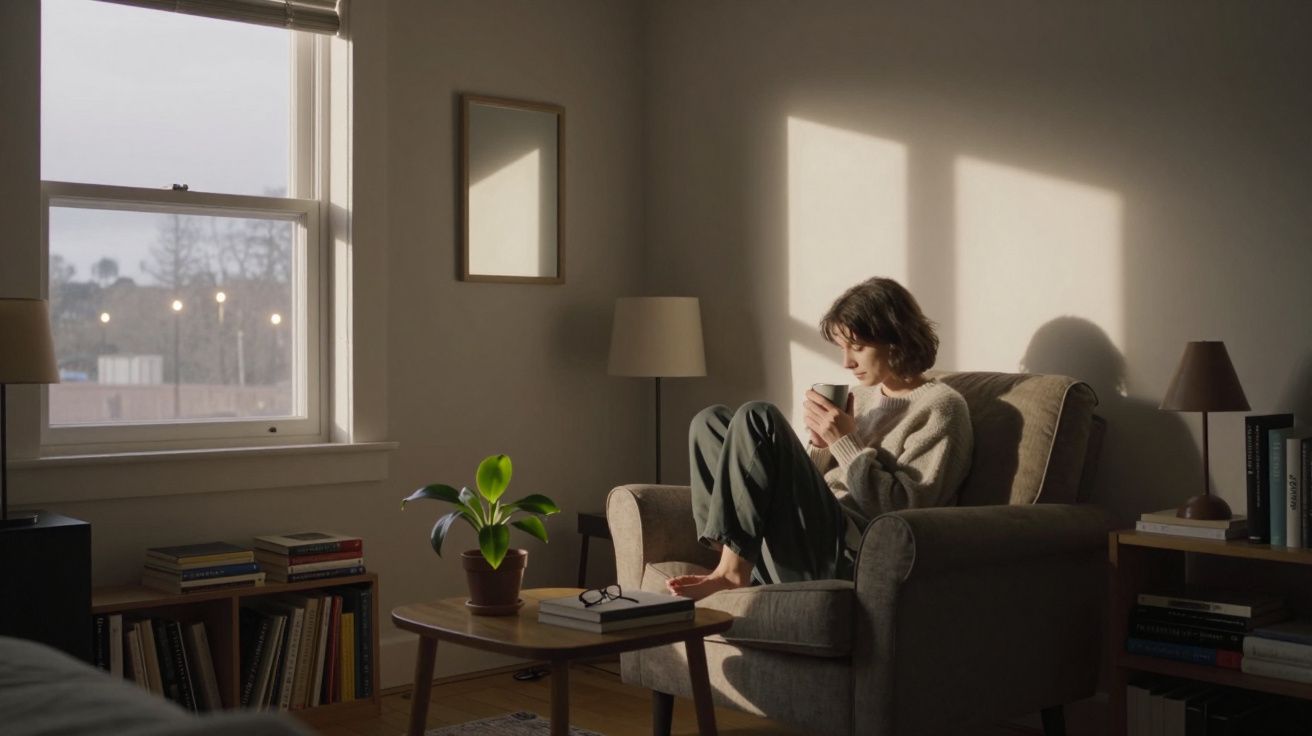
At home, many people choose the opposite pattern: legs tucked under, arms wrapped around knees, shoulders rounded. On a cold evening with a blanket and a film, this shape can simply mean comfort. When it becomes the default way of sitting in every chair, it often indicates emotional overload.
From a biological angle, curling in protects vital organs. The spine flexes, the chest narrows, the head dips. The posture broadcasts a wish to be smaller and less visible. It crops up frequently in people who feel scrutinised, criticised or emotionally exhausted.
Repeatedly folding yourself up in a chair can be an unspoken “do not disturb” sign.
Emotional signals behind the curl
Specialists link chronic curled-up sitting with:
- Social fatigue and a need for distance, even from loved ones
- Worry about conflict, criticism or unexpected demands
- A sense of carrying heavy emotional load without much space to express it
- Old habits from times when being less visible felt safer
The same person may appear outgoing and articulate when standing or moving, but retreat into a compact ball as soon as they sit down.
How to keep comfort without disappearing
The goal is not to ban cross‑legged lounging, but to give the body alternative resting shapes:
- Experiment with sitting back against cushions while keeping feet on the floor or on a low stool.
- If you curl up, occasionally unfold one element – uncross arms, then later lower the feet.
- Arrange the room so you feel less exposed: a high‑back chair, a wall behind you, or softer lighting.
Changing the environment can reduce the impulse to vanish inside the chair.
Leaning back hard: the “I need distance” sitter
In some settings, people push their chairs as far back as possible and lean away from the table. Hands retreat to the lap, eyes wander, chin lifts slightly. On paper, it looks casual. In context, it often marks a wish for more emotional or conversational space.
Leaning back increases the distance between your core and the other person. It can also reduce the intensity of eye contact. During tense conversations, the body may use this position to regulate overwhelm. In a meeting, it can signal quiet disagreement, boredom or protective detachment.
When tension rises, some bodies step back without standing up.
Stress clues in the recline
Experts note several stress‑related patterns:
- The lean intensifies when a specific person speaks or a sensitive topic appears.
- One ankle might cross over a knee, creating an extra barrier between you and others.
- Hands may grip the armrests or the side of the seat briefly during difficult moments.
This posture does not always mean hostility. In many cases, it is a way to keep participating without feeling swallowed by the situation.
Using the lean as information, not armour
If you notice yourself pinning the chair backwards whenever a certain theme comes up, you have useful data:
- Ask internally: “What about this topic makes me want more distance?”
- Practise small shifts forwards when you choose to engage, such as asking a clarifying question.
- In one‑to‑one conversations, say out loud if you need a pause rather than just leaning away and going quiet.
For observers, a colleague’s sudden lean‑back can be a cue to slow down, clarify or ask for their view rather than pushing on.
Constant fidgeting: the restless sitter
Some people rarely keep still in a chair. They swivel, bounce one leg, tap the armrest, adjust the cushion, then start again. On video calls, the motion can be distracting. Inside the person’s body, it often reflects a nervous system looking for release valves.
Not all fidgeting equals distress. Mild movement helps concentration for many brains, especially neurodivergent ones. The signal turns more concerning when the movement is sharp, repetitive and tied to specific triggers, such as emails from a manager or difficult topics.
Restless legs often carry the tension that words never quite name.
When movement becomes a stress barometer
Body-language readers pay attention to:
- How quickly fidgeting ramps up in response to stressors
- Whether the person can pause the movement briefly when they feel heard or safe
- Complaint patterns like “I can’t relax anywhere” or “I’m exhausted but wired”
This profile often appears in people juggling multiple roles, living with chronic anxiety, or adapting to unpredictable environments.
Channel, do not crush, the energy
Trying to sit perfectly still can actually increase stress. A more realistic approach is to guide movement:
- Swap sharp, jarring motions for smoother ones, such as slow rocking or gentle ankle circles.
- Use small, quiet fidgets (a textured stone, a soft band) that soothe rather than agitate.
- Build short standing breaks into long seated stretches, even if only for 60 seconds.
By designing movement on your own terms, you reduce the sense of being controlled by restless energy.
Upright and open: the genuinely relaxed sitter
Occasionally, you meet someone who seems quietly at ease in most chairs. Their feet rest evenly, their back is supported without stiffness, their shoulders drop rather than hunch. They can lean forward to speak and lean back to listen, without getting stuck in either extreme.
This posture does not mean the person has no stress. It usually means they have enough safety in that setting, and enough self‑awareness, to let the body move through the full range of positions.
A flexible sitting style often reflects a flexible stress response.
Signs your nervous system feels “held”
Researchers and therapists notice common themes in these sitters:
- They can notice discomfort and adjust the chair or their position without apology.
- Their posture changes with task – focused forward for detail work, relaxed back for listening – then returns to neutral.
- They are more likely to name stress directly instead of only showing it physically.
The chair becomes a tool rather than a battleground.
Small habits that move you towards ease
You do not need perfect core strength or an ergonomic budget to edge closer to this pattern:
- Check in with three points of contact: feet, hips and back. Adjust until all three feel supported.
- Let your exhale be slightly longer than your inhale for a few breaths while seated.
- Notice one small cue of safety around you – a warm drink, a familiar object, a friendly face.
Over time, these simple check‑ins help the body associate chairs with rest as well as work.
How your environment quietly shapes your posture
It is difficult to sit calmly in a chair that cuts into your thighs or wobbles on one leg. Furniture, light, noise and social rules all influence how safe or tense you feel while seated. Many “bad” postures disappear when the surroundings change.
A narrow plastic seat in a busy waiting room almost forces you into defensive bracing. A deep sofa with cushions that swallow you may nudge you into constant slouching. In both cases, the posture reflects the environment as much as your emotional state.
Before blaming your body, check what the chair and the room are asking it to do.
Simple tweaks that lower stress without therapy
You can often reduce chair‑related tension with practical changes:
- Adjust height: knees roughly level with hips reduces strain and fidgeting.
- Support the lower back: a small cushion can prevent collapse and fatigue.
- Claim your angle: if possible, sit where you can see the door without being directly in its path.
- Soften the setting: warmer light and fewer visual distractions calm the nervous system.
These tweaks are not vanity. They signal to the body that it does not need to stay on guard every second it is seated.
Reading others without jumping to conclusions
While chair positions offer useful clues, they are not lie detectors or diagnostic tools. Culture, habit, injury and personality all influence how someone sits. A teenager slumped across a sofa may be relaxed, not depressed. A colleague perched on the edge might simply have a tight belt.
Body-language experts stress the importance of patterns and context over single moments. Watch how someone’s posture changes across topics, rooms and days. Listen to what they say about their energy, sleep and mood. The chair becomes one piece in a much larger puzzle.
Use posture as an invitation to curiosity, not as a verdict.
If you notice repeated signs of strain – constant perching, extreme curling, visible bracing – kindness goes further than analysis. A quieter room, a proper break or a sincere “How are you really coping?” may shift someone’s body language more than any clever insight.
FAQ:
- Does one chair position always mean the same thing? No. The same posture can signal comfort in one person and distress in another. What matters is the broader pattern over time and the context in which it appears.
- Can I “fix” my stress by just sitting differently? Adjusting posture can help your body feel safer and reduce some physical tension, but it does not replace addressing workload, relationships or mental health directly.
- Is it rude to notice how colleagues sit? Observation is natural; judgment is optional. Use what you see to adjust the environment – offering a better chair or a real break – rather than to label people.
- When should chair behaviour worry me? If you or someone close seems unable to relax in any seat, reports constant exhaustion, or pairs rigid or collapsed postures with low mood or panic, it may be time to seek professional support.


Comments (0)
No comments yet. Be the first to comment!
Leave a Comment