Why folding clothes vertically in drawers really does save time, according to busy parents
The baby is finally asleep. There are dinosaur socks under the coffee table, yesterday’s PE kit on the back of a chair, and three half‑folded piles of laundry slumped on the sofa. You open a drawer to “just quickly” put away the clean clothes – and everything inside avalanches towards you in a crumpled wave.
Tomorrow morning’s chaos is already rehearsing itself: someone will shout “Mum, I can’t find my leggings!”, another small person will insist there are “no pants left”, and you’ll stare at a drawer packed to the brim, wondering how it can be so full and yet somehow contain nothing you need.
This is the quiet moment where a lot of parents discover vertical folding.
It doesn’t look glamorous. It’s not a special system with branded boxes and pastel labels. It’s just clothes stood up instead of stacked. Yet in home after home, parents who’ve switched describe the same thing: fewer frantic searches, faster mornings, and a little less shouting over socks.
The small shift that stops drawers behaving like black holes
For decades, the default way to put clothes away has been simple: fold into rectangles, stack in piles, shut drawer. Neat for about five minutes. Then real family life happens. A child rummages for their favourite T‑shirt, someone pulls a jumper from the middle of the pile, and the entire tower tilts, slumps, and quietly turns into sedimentary layers of cotton.
Horizontal piles have a built‑in problem: you only really see the top few items. Everything underneath becomes “out of sight, out of mind”, which in a family translates to “never worn until discovered three sizes later”.
Vertical folding flips that logic.
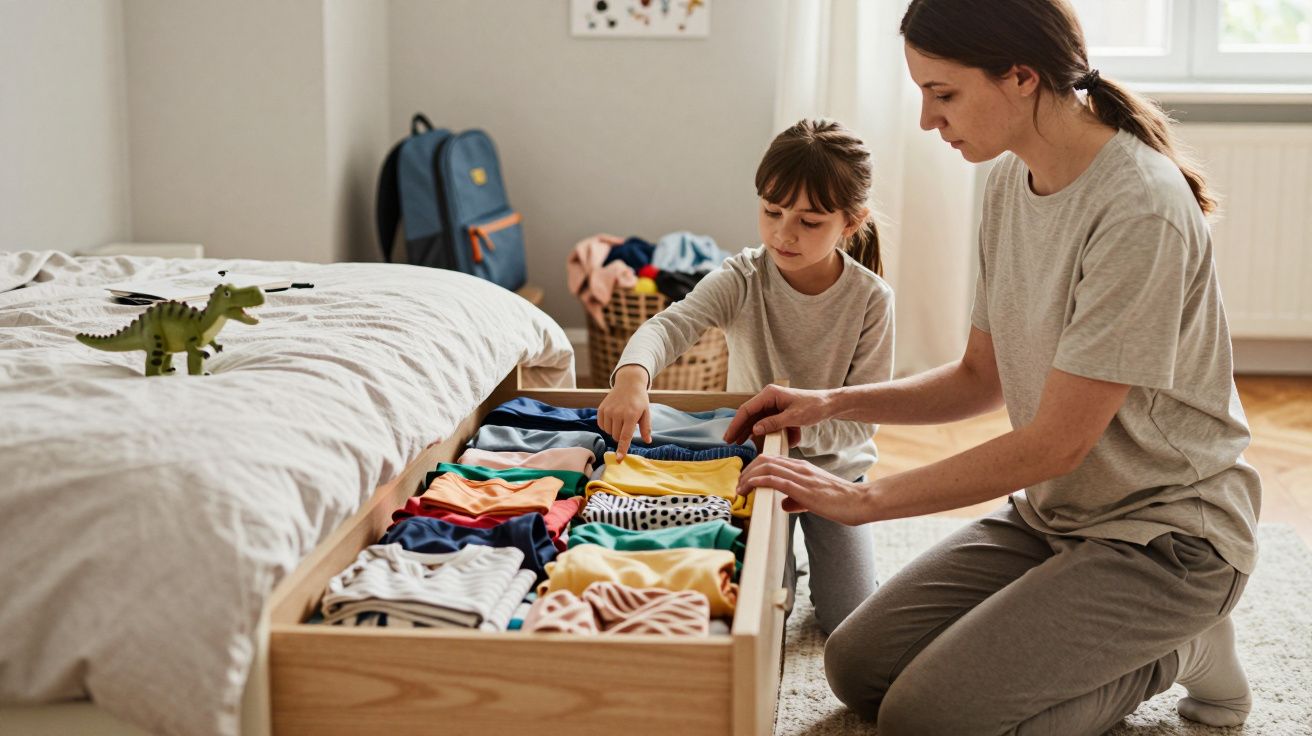
Instead of piling clothes on top of each other, you fold them into firm rectangles and file them side by side like books on a shelf. Open the drawer and you see the spines of every T‑shirt, pair of pyjama bottoms or school jumper in one glance. No digging. No lifting ten things to reach the eleventh.
When researchers in consumer behaviour labs look at how people use cupboards and drawers, they find the same pattern again and again: if you can see an item clearly and reach it with one hand, you’re far more likely to use it regularly and put it back in roughly the right place. That tiny reduction in friction is what eventually shows up as “less mess” and “more time”.
In family life, where mornings are often timed in minutes, not hours, that difference isn’t abstract. It’s the line between a drawer opened once and a drawer raided three times, each search leaving it a little more chaotic.
How vertical drawers quietly buy back minutes every day
On a Tuesday school run in Leeds, Adam, 39, used to spend five to ten minutes just finding outfits for his two children. “The clothes were all clean and technically away,” he says, “but I had no idea what was actually in the drawers. I’d pull out four wrong T‑shirts before I found the one they wanted.”
One Sunday, after yet another morning argument about socks, he cleared a single drawer and tried vertical folding for his son’s clothes. T‑shirts in one row, shorts in another, pyjamas in a third. It took about twenty focused minutes, including refolding a few items to make them stand up neatly.
The next morning, something small but important happened. He opened the drawer, saw every T‑shirt at a glance, picked one, shut the drawer. No rummaging. No collapsing piles. “It was such a non‑event that I noticed it,” he laughs. “I didn’t have a mini argument with the drawer.”
Over a week, those “non‑events” added up. No more refolding half a pile after one rushed grab. No more tipping the contents of the drawer onto the bed to find the one missing school polo. He estimates he saves at least five minutes most school mornings. That’s over twenty hours a year, reclaimed from the black hole of children’s drawers, without getting up earlier or being more “disciplined”.
There’s also a mental effect parents keep mentioning: decision fatigue goes down. Being able to see all the options at once makes choosing faster, especially for children. When a seven‑year‑old can open their own drawer, point to a T‑shirt and pull it out without demolishing everything else, you’ve quietly handed them a slice of independence and taken one micro‑task off your own plate.
It’s not magic. It’s visibility and access, repeated hundreds of times a year.
Why vertical beats horizontal when life is messy
To understand why vertical folding survives real family life better than classic piles, you have to look at how drawers actually get used, not how they look after a perfect folding session.
Classic horizontal piles assume that you’ll always take from the top and put back neatly on top. That might work in a quiet hotel wardrobe. It collapses the second:
- a child goes digging for the blue dinosaur T‑shirt “with the big T‑rex, not the small one”
- you’re half asleep grabbing a clean vest in the dark
- someone else helps put washing away and doesn’t know where things “belong”
Piles are unstable by design. One clumsy grab and the whole structure shifts.
Vertical folding, done properly, is more forgiving. Each item has its own little slot. You pull one out; the two on either side shuffle slightly to fill the gap, and the overall order more or less holds. Put something back roughly in the same area and the system recovers.
Parenting researchers often talk about “good enough” routines: systems that work even when everyone’s tired and nobody is at their most careful. Vertical drawers fall into that category. They don’t rely on perfection. They rely on a small amount of initial setup and a layout that naturally resists chaos.
They also do something subtle for kids: they turn clothing into a visual menu. Instead of “The drawer is full of shirts, trust me,” they see a line‑up of colours and prints. It’s easier for them to choose, and easier for you to set gentle limits (“School T‑shirts on the left, fun ones on the right”).
That visual clarity is a big reason why parents of neurodivergent children, in particular, often report that vertical folding reduces morning battles. The environment does part of the explaining, so you don’t have to.
A simple way to try it in one drawer (without buying new furniture)
The idea of refolding every item your family owns can feel overwhelming. Soyons honnêtes : personne ne fait vraiment ça tous les jours.
The parents who stick with vertical folding tend to start very small: one drawer, one category, one afternoon.
A basic setup looks like this:
- Pick one high‑stress drawer. Often it’s children’s T‑shirts, school uniforms or pyjamas – anything you grab in a rush.
- Empty it completely. This is the only messy bit. Sort out any outgrown or damaged items while they’re in full view.
- Fold items into firm rectangles. Aim for roughly the width of your hand, so they can stand up. Many people use a simple “thirds” fold: in at the sides, then in half, then in half again.
- File them upright, front to back. Place them vertically so you see their top edge when you open the drawer, not their full front. Think record collection, not paper stack.
- Group by type or child. You might have one row for school tops, another for weekend tops, or divide the drawer visually between siblings.
If your drawer is very deep, you can use cheap cardboard boxes or cut‑down shoebox lids as dividers to keep rows from falling over. If it’s shallow, the clothes themselves will often hold each other up once the drawer is reasonably full.
The key is to test it under real conditions: let your child use that drawer for a week, or use it yourself during your busiest mornings. Notice how often you have to refold the whole thing (usually rarely) and how it feels to find what you need.
If it genuinely saves you time in that one drawer, you’ll know it’s worth spreading slowly to others. If it doesn’t, you’ve lost an hour at most, not reorganised your entire house on a theory.
“We started with my daughter’s leggings drawer,” says Priya, 36, from Bristol. “After a week of no more ‘Mum, where are my black ones?’, we did pyjamas and school polos. I still don’t fold towels vertically. This is not a religion. It’s just one more tool.”
Teaching kids to use it (so you’re not the only one maintaining it)
A system that only one exhausted adult understands won’t last long in a busy home. The good news is that vertical drawers are surprisingly easy to explain to children.
Instead of complicated labels, you can lean on simple, visual rules:
- “This row is school tops; this row is weekend tops.”
- “Pyjamas live in this drawer and they all stand up like books.”
- “When you put something back, it stands up, not lies down.”
Younger children can help with the last step of folding – turning a long rectangle into a little block and “posting” it in its place. Older ones can learn the whole fold. It won’t be perfect. It doesn’t have to be. The point is to make them part of the system, not just confused users of it.
Parents who involve their children early often find another bonus: kids become more aware of how many clothes they actually have. When everything is visible, it’s easier to say, “You already have five T‑shirts that fit; let’s pick one to give away before we buy another.”
In a culture where stuff easily outpaces storage, that small awareness may be as valuable as the saved minutes.
When vertical drawers aren’t the answer – and what to do instead
Vertical folding isn’t a magic fix for every storage problem. There are a few situations where parents find it less helpful:
- Very tiny baby clothes. Newborn vests and babygrows can be so small that standing them up just turns into clutter. For the first months, shallow baskets or simple piles may be more practical.
- Deep wardrobes with no drawers. Stacking vertically on a deep shelf often ends with items falling backwards out of sight. In that case, adding baskets or cheap drawer inserts can mimic the effect.
- Bulky jumpers and jeans. Heavy items can stand vertically, but too many in one drawer can make it hard to pull anything out. Some families prefer to hang these or keep them in shallower stacks.
The underlying principle still holds, though: aim for visibility and easy access. If standing clothes up in that specific space doesn’t give you both, adjust the method, not your entire life to match somebody else’s system.
The most sustainable home routines are the ones that respect your actual house, your actual children and your actual energy levels.
Rethinking “tidy” as “less wasted time”
Once you’ve lived with a well‑organised vertical drawer or two, it becomes harder to romanticise the old piles. Those stacks of carefully folded shirts – so satisfying for ten minutes – start to look like booby traps for your future self.
On a practical level, vertical folding is modest. It doesn’t need new furniture, a full declutter of the house or an aesthetic makeover. It’s just a different way of placing the same clothes in the same drawers.
On a human level, it quietly changes the script. Drawers stop being small sources of daily failure (“Why is this always a mess?”) and become tools that more or less cooperate with you. Children open them and see options instead of fabric rubble. You spend fewer minutes each week hunting for things you already own.
For parents, time is the one resource that never quite stretches enough. Anything that gives a little back – without demanding perfection or a personality transplant – deserves more attention than it gets.
The next time you’re staring at an overstuffed drawer insisting there are “no clean socks”, you might not need a new storage system or a big clear‑out. You might just need to stand things up, not stack them, and let gravity finally work in your favour.
| Key idea | What it means in practice | Why knackered parents care |
|---|---|---|
| File, don’t stack | Fold clothes into blocks and stand them upright in drawers | Faster to see everything, less rummaging and refolding |
| Start with one drawer | Test the method where mornings hurt most | Saves time without a huge re‑organisation project |
| Involve children | Simple visual rules and easy folds | Builds independence and reduces “Muuum, where is…?” moments |
FAQ:
- Do I have to refold my entire house to see a benefit? No. Most parents see real gains from changing just one or two high‑traffic drawers, like school uniforms or kids’ T‑shirts.
- Won’t vertical folding take longer on laundry day? The folding itself can take a few extra seconds per item at first, but you usually win that time back – and more – by not constantly re‑tidying exploded drawers.
- What if my family just shoves things in anyway? That happens. The system is still more resilient than piles; a quick reset takes minutes, not an hour. Involving others in the setup helps them respect it more.
- Do I need special organisers or boxes? Not necessarily. Standard drawers work fine; cheap cardboard boxes or dividers can help in very deep or wide drawers but aren’t essential.
- Is this just a trend that will fade? The aesthetics might come and go, but the underlying principle – more visibility and easier access equals less wasted time – has stood up in households long after the novelty wore off.


Comments (0)
No comments yet. Be the first to comment!
Leave a Comment