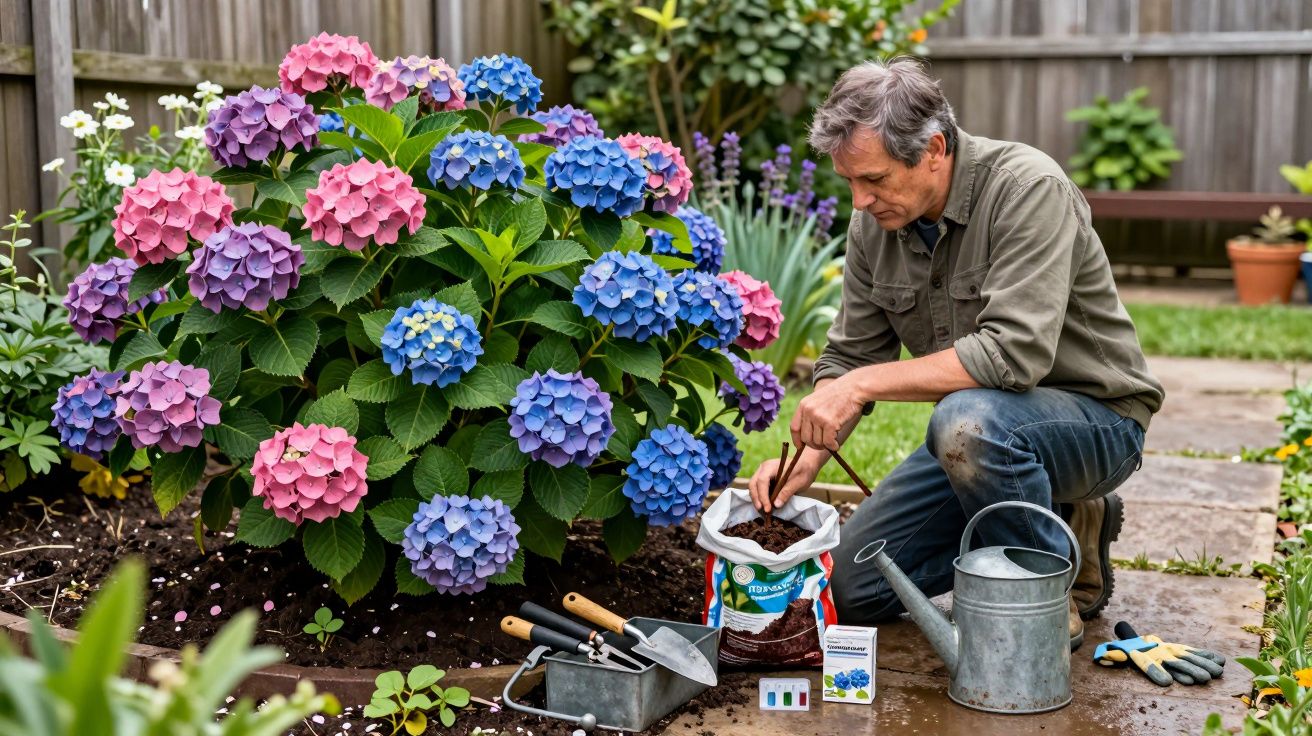
Why gardeners are burying rusty nails near hydrangeas – and what soil experts really think
The idea sounds like something from a grandparent’s notebook rather than a gardening manual. You tuck a few rusty nails into the soil near a hydrangea, wait a season, and the flowers are meant to blush from pink to blue. No soil kit, no chemistry set. Just old hardware and patience.
The trick has travelled quietly through allotments, village shows and online forums. Some swear the colour shift was dramatic. Others saw nothing at all. Between folklore, faint rust and very real plant science, the story is more nuanced than a simple “yes, it works” or “no, it’s nonsense”.
Where the rusty nail myth comes from
Hydrangeas have always fascinated gardeners because they seem to change their minds. On some soils, the mopheads and lacecaps flower candyfloss pink. In others, exactly the same variety turns a cool, seaside blue. That colour change is not magic; it is chemistry. It depends largely on soil pH and how available aluminium is around the roots.
For decades, small-town advice linked metal with “stronger” colour. Old iron buckets, horseshoes and nails were buried as a kind of tonic. Rust stains feel like proof that something is happening. If iron can mark concrete and shirts, the logic goes, why not petals?
In truth, the jump from “metal rusts” to “metal colours flowers” is generous. The nails are only one part of a much wider picture in the soil. Most of the work is done by acidity and minerals already present, not by a scattering of old screws.
What actually controls hydrangea colour
Most bigleaf hydrangeas (Hydrangea macrophylla) can swing between pink and blue. White varieties are the exception; they tend to stay white whatever you do. The lever you can realistically pull at home is pH, a scale that measures how acidic or alkaline the soil is.
- On acidic soils (roughly pH 5.0–5.5), aluminium in the ground dissolves into a form roots can absorb. The plant traps that aluminium in its flower tissues and the blooms appear blue to violet.
- On neutral to alkaline soils (around pH 6.5–7.5 and above), aluminium stays locked in the soil particles. The plant cannot take it up, and flowers lean pink, lilac or even red.
Iron, the element in your nails, is important for leaf greenness and general health. It does not directly decide whether a hydrangea is pink or blue. A deficiency in iron shows up as yellowing between veins on young leaves. That is a separate problem from flower colour, even if both trace back to soil conditions.
Do rusty nails really change the colour?
From a soil chemist’s point of view, a few rusty nails in the border are more theatre than tool. Iron oxide – the orange-brown rust you see – is not very soluble in normal garden conditions. It releases iron only very slowly, and usually in tiny amounts compared with what is already present naturally.
If your soil is already on the acidic side and naturally contains aluminium, the plant may drift blue over time whether you add nails or not. The nails then feel like the hero of the story, when they were really just a prop. In more alkaline ground, the nails will still rust quietly, but the pH and aluminium availability barely move.
There is also the matter of scale. A hydrangea’s root zone can cover a square metre or more. A handful of screws hidden around one side is like adding a teaspoon of salt to a swimming pool and expecting seawater. Visible rust can be misleading; what matters is what is dissolved and moving in the water film around the roots.
“Nails don’t add the right element in the right form,” notes one soil consultant. “You need acidity and available aluminium, not a rusty pocketful of wishful thinking.”
What works better than nails if you want blue blooms
For gardeners chasing a true blue, proven methods are more predictable than rummaging in the toolbox. They focus on gently lowering pH and providing aluminium the plant can access. The key word is gently; sudden, heavy-handed changes can stress roots and nearby plants.
Step-by-step, with fewer myths
- Test your soil. A simple pH kit from a garden centre will tell you if you are acidic, neutral or alkaline. Note the reading near the hydrangea, not at the far end of the lawn.
- Add ericaceous compost. Mulching around the shrub with compost formulated for acid-loving plants shifts conditions slowly in the right direction.
- Use aluminium sulphate or a specialist hydrangea “blueing” product. Applied as directed, these supply the aluminium in a soluble form and nudge the pH down.
- Water wisely. Hard tap water, rich in calcium, can push soils more alkaline over time. Collected rainwater is gentler for pH-sensitive shrubs in pots and small beds.
The change is not overnight. Hydrangeas need a season or two under the new regime before the colour fully responds. The result is more stable than anything you will achieve by burying chance bits of metal, and you will have a clearer sense of why it worked.
When rusty nails can still make a kind of sense
Just because nails are not blue-making wands does not mean they are always useless. Iron is a micronutrient, and a chronic lack of it does weaken plants. In very sandy, leached or heavily limed soils, iron can be short on supply. Over many months and years, a slow trickle of iron from decaying metal can contribute a little.
Old gardeners also used what they had. Before bottles of iron chelate and soluble feeds, a rusting spade or horseshoe was a pragmatic way to return metal to the ground, especially in kitchen plots where leafy vegetables tired quickly. In that context, nails were one more recycled resource, not a targeted hydrangea hack.
Even so, modern soil experts would point you towards more reliable sources: iron sulphate, balanced feeds, composts rich in organic matter. These offer trace elements in forms roots can actually reach, without making you dig through sharp metal if you later replant.
Risks and reasons to be cautious
Burying steel from around the house is not automatically benign. Modern nails, screws and scraps may be coated or alloyed with metals you do not want concentrated in a flower bed, especially where children play or vegetables grow. Zinc or copper at appropriate levels can be beneficial, but at higher doses they upset soil life.
There is also a simple practical hazard. Forgotten metal near the surface can damage tools, puncture gloves or injure someone kneeling or weeding. Over years, a bed peppered with hidden hardware is harder and less pleasant to work.
Soil scientists tend to favour clarity: if you are correcting a deficiency, know which element is missing, choose a clean product, dose lightly and check again. Guesswork with grab-bags of metal rarely fits that pattern.
A realistic plan for hydrangea lovers
Instead of chasing a single trick, it helps to decide what you actually want from your shrub: a stable, gentle blue, a warm pink, or a natural mix that drifts with the seasons. Each path calls for slightly different habits.
- For cooler tones: lean into acidity with ericaceous compost, rainwater and aluminium sulphate used sparingly.
- For pink shades: avoid “blueing” products, and do not fight a naturally alkaline soil. A top-dressing of garden lime every few years can hold the line.
- For mixed, cottage-garden charm: accept some variation. Let soil do what it does, and focus on health – mulch, water in dry spells, prune correctly.
The quiet truth is that a vigorous hydrangea on a soil it likes will always look better than a stressed plant nudged towards an unnatural colour. Rusty nails cannot fix poor drainage, cramped roots or chronic drought.
| Question | What matters most | Practical takeaway |
|---|---|---|
| Can nails turn pink to blue? | Soil pH and aluminium availability | Nails alone are rarely enough |
| Is iron useful at all? | Leaf health and chlorophyll | Use tested iron supplements if needed |
| What is safest? | Clean inputs and clear aims | Prefer known soil amendments over scrap metal |
Keep the charm, lose the guesswork
There is a certain romance in old tricks, and gardening has always mixed observation, superstition and science. Burying a rusty nail near a hydrangea will not wreck your border, and it may satisfy a curiosity inherited from a relative. It simply is not the lever that modern soil knowledge tells us you need to pull.
If you enjoy experiments, treat the nails as a side note, not as your main strategy. Keep a simple notebook with pH readings, products used and the colours that follow from year to year. Over time, those quiet records become more powerful than any passed-down tip.
In the end, healthy soil, thoughtful watering and a light hand with amendments shape hydrangeas far more than concealed hardware ever will. The petals respond to chemistry whether you see it or not. Once you understand that, the real magic begins at the root zone, not the toolbox.
FAQ:
- Will rusty nails harm my hydrangeas? In small numbers, plain steel nails are unlikely to hurt, but they also bring little benefit. Painted or coated metal should be avoided because of possible contaminants.
- How long does it take to change hydrangea colour with proper methods? Usually one to two growing seasons. The buds that form under new soil conditions show the clearest shift the following year.
- Can I make a white hydrangea turn pink or blue with soil changes? Most true white hydrangeas stay white regardless of pH. You may see a faint tint at the edges, but not a full colour transformation.
- Is coffee grounds mulch a better idea than nails? Used sparingly, coffee grounds can contribute to organic matter and a slight acidifying effect, but they are not strong enough on their own to guarantee blue flowers. Combine them with other acid-loving composts.
- Should I remove old nails I find when digging? Yes. It is safer for you and your tools, and you can replace any theoretical nutrient role with clean, purpose-made soil conditioners.

Comments (0)
No comments yet. Be the first to comment!
Leave a Comment