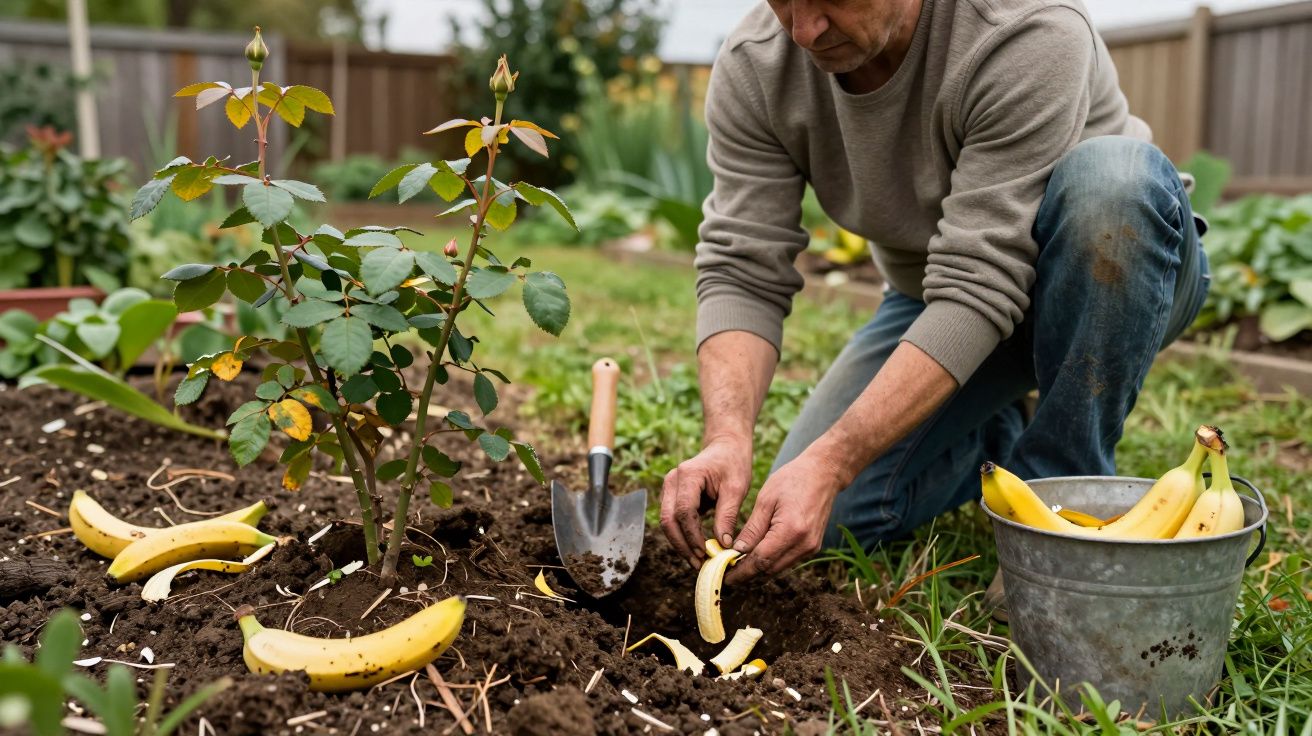
Why gardeners tuck banana peels around roses – and the one mistake that can attract rats
There’s a particular kind of guilt that lives at the bottom of the fruit bowl. The bananas have gone from cheerful yellow to freckled, then blotchy, then… let’s call it “banana bread candidate”. You peel one, wince at the mushy bits, and the skin dangles over the bin for a second while you hesitate. Somewhere in the back of your mind you remember reading that gardeners keep these. Something about roses. Something about nutrients. You hover. Then you shrug and drop it in the rubbish.
Now imagine instead: you walk outside, peel in hand, and tuck it into the soil beneath a rose that’s been sulking all summer. The petals have faded faster than you hoped, the leaves look like they’ve seen better days. It feels almost too simple – banana skin in, better blooms out. But over the next few weeks, the leaves deepen in colour, new buds appear, and you start wondering if that throwaway tip from a gardening forum actually had a point.
It did. But like most “clever hacks”, there’s a line between quietly useful and low-key disgusting. Cross it, and you’re not just feeding roses. You’re inviting rats to dinner.
What banana peels actually do for roses
Banana peels aren’t a miracle fertiliser. They’re a slow, scruffy source of a few things roses like: potassium, a bit of phosphorus, tiny traces of calcium and magnesium, plus organic matter that feeds soil life as it breaks down. Nothing glamorous, just steady background nutrition.
Potassium, in particular, is the bit gardeners get excited about. It helps with strong stems, better disease resistance and more resilient blooms. When you bury chopped peels in the top layer of soil, microbes and worms get to work, nibbling and dragging the pieces deeper. Over weeks, those nutrients seep into the root zone like a quiet drip feed.
The peel itself also softens the soil around a rose that’s been compacted by rain or heavy feet. As it decomposes, it leaves microscopic channels for air and water. You don’t see that from above, but the roots do. They find those pockets and start to explore, which is exactly what you want from a plant that’s meant to flower its heart out for months.
How to use banana peels without turning your border into a buffet
If you picture a ring of yellow skins draped around the base of a rose, you’ve already found the main problem. Left whole and exposed, peels take longer to break down, smell sweet as they start to rot, and send a very clear message to anything hungry in the vicinity: free food, help yourself.
Go simple and discreet instead:
- Chop the peel into small pieces – roughly 2–3cm strips or squares.
- Dig a shallow trench in the soil around the rose, about 10–15cm from the stem and a few centimetres deep.
- Scatter a small handful of peel pieces in the trench.
- Cover completely with soil, firming it back down so nothing is visible.
Two or three peels per established rose every month or so in the growing season is more than enough. More isn’t better; it’s just more decomposing matter for local wildlife to investigate. Think of it as a supplement, not a full meal. Your roses still appreciate a balanced rose feed in spring and early summer.
If you’re squeamish about burying food scraps, you can dry peels on a sunny windowsill, then crumble them up and blend the flakes into the top layer of soil. The scent is far less noticeable, and they disappear faster into the earth.
The one mistake that really does attract rats
Rats will eat almost anything that offers easy calories. A pile of soft, sugary banana skins left sitting on the surface of a border, or heaped on a compost heap that’s more “cold storage” than active, steamy composting, is basically an open invitation.
The mistake isn’t using banana peels. It’s using them in a way that leaves them:
- Exposed on the soil surface.
- All in one place, making a concentrated food source.
- Close to fences, sheds or walls where rats already feel safe.
Once they realise there’s a reliable snack spot, they’ll keep checking back, and you’ll start seeing tell-tale signs: small burrows near structures, gnawed stems, droppings in hidden corners of the bed. At that point, no amount of rose foliage is worth the trade-off.
Reduce the risk by:
- Always burying or thoroughly composting peels – never just tossing them on top of the soil.
- Spreading small amounts across different plants rather than creating one rich patch.
- Avoiding peel use near known rat runs, compost heaps that aren’t secure, or under dense decking and sheds.
If you garden in a city or terrace with obvious rodent activity, err on the cautious side. Use well-made compost, pelleted feeds or liquid fertilisers for your roses, and keep kitchen scraps firmly out of the beds.
A quick guide: safe ways to “feed” roses with bananas
You don’t need a complex system. Just pick the route that matches your tolerance for faff and your local wildlife situation.
| Method | How it works | Best for |
|---|---|---|
| Chopped & buried peels | Small pieces dug into soil around the root zone | Most gardens with low rat pressure |
| Fully composted peels | Peels added to a hot, secure compost then used as mulch | Urban gardens, rat-prone areas |
| Dried & crumbled peels | Dehydrated then crushed and mixed into topsoil | Balcony pots, gardeners who dislike fresh scraps |
Whatever you choose, treat it as a slow, background bonus. Roses respond best to a combination of good soil, regular watering at the roots, mulch to keep moisture in, and a balanced rose fertiliser applied as directed. Banana peels nudge things in the right direction; they don’t carry the whole show.
When banana peels make sense – and when to skip them
There’s a quiet satisfaction in stepping outside with something that was heading for the bin and turning it into a small act of care. You fold the peel into the soil, brush your hands together, and feel faintly like the kind of person who “uses everything”. Over the season, you notice tougher stems, slightly shinier leaves, and the odd flush of extra buds. It’s subtle, but it registers.
Use banana peels if:
- You already have reasonably healthy roses and want a gentle, low-cost boost.
- You have access to bare soil around the base, not weed membrane or deep gravel.
- Your local rat activity is low and you can bury scraps properly.
Skip or limit them if:
- You garden in an area where rats are a known, ongoing problem.
- Your roses grow in pots with very limited surface space to dig into.
- You’re not realistically going to chop and bury – in which case, standard fertiliser is safer.
There’s no medal for “most inventive use of fruit waste”. There is real value, though, in choosing the neat, quiet option that feeds plants without feeding anything else.
FAQ:
- Do banana peels replace proper rose fertiliser? No. They add some potassium and organic matter but not the full balance of nutrients roses need. Treat them as a supplement alongside a dedicated rose feed.
- Can I just throw peels on the compost heap? Yes, if your compost bin is secure and active. Bury them within the heap and keep the lid closed. A hot, well-managed heap is far less attractive to rats than a cool, open pile.
- Is it safe to use banana peels on container roses? In small pots, fresh peels can turn slimy and mouldy very close to the roots. If you want to use them, go for dried and crumbled peel mixed lightly into the top layer of compost.
- Will banana peels make my garden smell? Properly buried in soil, they break down with minimal odour. Smell becomes an issue only when peels are left exposed, piled together, or added faster than the soil or compost can process them.
- Are shop-bought bananas with pesticides a problem? Most residues are on the skin, and once peels are buried they break down like other organic matter. If you’re concerned, rinse peels briefly before chopping, or rely more on standard fertilisers and well-rotted compost.


Comments (0)
No comments yet. Be the first to comment!
Leave a Comment