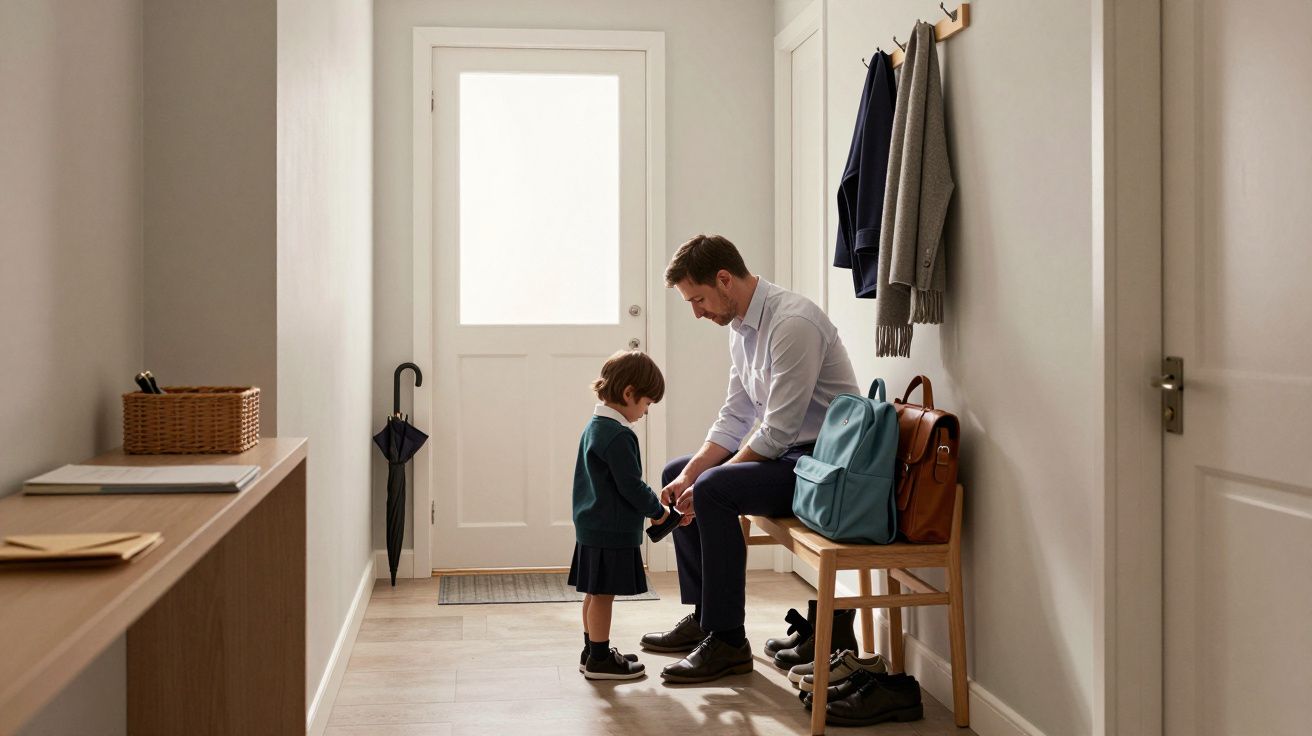
Why keeping a chair in the hall can make leaving the house calmer, say decluttering experts
There is a tiny moment every morning when the whole day can tilt. You are halfway through the door, keys in your mouth, bag slipping off your shoulder, one shoe on, and suddenly you cannot find the other. The post lands on the mat, someone yells that they have misplaced their PE kit, and your heart rate spikes before you have even locked up.
Decluttering experts argue that the problem is not you being “disorganised”. It is the way your hallway is set up. One low‑tech object keeps coming up in their plans: a simple chair.
The hallway is a decision bottleneck
Hallways work hard. They take shoes, coats, bags, parcels, muddy football boots, school letters and umbrellas, then try to funnel everyone through the same narrow strip of floor. When that space is just a corridor, every small delay feels bigger. There is nowhere to put things down and nowhere to pause.
Professional organisers see the same pattern over and over. People add hooks, baskets and more shelves, but they still leave the house stressed. The missing element is often a place to sit, sort and breathe for thirty seconds. A hallway without a perch forces you to juggle everything in mid‑air.
A hallway chair turns a stressful choke point into a small “prep station” where you can finish getting ready without feeling rushed.
Instead of hovering while you put on boots, you sit. Instead of dropping a bag on the floor, you set it on the seat, check the contents and go. That micro‑shift matters more than it sounds.
Why one chair can calm the morning rush
It sounds almost too simple: add a chair, feel calmer. Yet organisers report that this single tweak changes how people move through their homes. The chair becomes a cue to slow down for a moment instead of sprinting straight out of the door.
Here is what it quietly fixes:
- You can put things down at waist height instead of balancing them or bending over the floor.
- You have a stable spot to tie laces, zip boots and adjust layers without wobbling.
- Children can sit while you help them with shoes or coats, instead of chasing them along the corridor.
- You get a natural “final check” pause: keys, phone, wallet, bag, all in reach.
Think of it like adding a little table next to your front door, but one you can sit on. That sit‑down tends to soften the mood. You catch your breath, mentally run through the next hour, and spot what is missing before you are out on the pavement.
For many families, the hallway chair becomes the unofficial “launch pad”: bags land there the night before, shoes underneath, coats above.
Choosing the right chair for your hallway
Not every chair belongs in a hall. Space is tight and traffic is constant. Decluttering experts recommend treating it as a piece of kit rather than pure decoration. It needs to earn its footprint.
What to look for
- Compact footprint: slim legs, no arms, and a seat you can tuck close to the wall.
- Stable and solid: no wobbly folding chairs that feel risky when you lean to tie shoes.
- Wipeable surface: wood, metal, or washable upholstery that does not mind wet coats and muddy bags.
- Straight, open legs: space underneath means you can slide baskets or shoes there without creating clutter.
Hall benches with built‑in storage can work, but organisers warn they are easy to overfill. When the lid is buried under post and bags, nobody opens it, and clutter simply migrates. A simple chair makes it obvious if you are stacking too much.
| Type | Best for | Watch out for |
|---|---|---|
| Simple dining chair | Narrow British hallways | Fabric that stains and legs that wobble |
| Small bench | Families with children | Deep lids that hide forgotten clutter |
| Stool with shelf | Flats and rentals | Tops that are too tiny to sit on comfortably |
The rule of thumb: if you would happily sit on it to read a message or lace boots, it will work. If it feels like a plant stand, go larger.
Where to put it so it actually helps
Placement matters more than style. A well‑placed plain chair beats a beautiful one that blocks the door. You want the seat close enough to reach as you arrive and leave, but not in the way of the door swing.
Organisers suggest three common spots in British homes:
- Opposite the front door, against the longest wall, leaving a clear walking strip.
- Beside the door frame, with the back of the chair to the wall, if your hall is short.
- At the start of the hall, near the first clear wall if the entrance opens straight into a living room.
Sit in the chair and do a pretend “leave the house” drill. Stand up, put on a coat, shoulder a bag, open the door and step out. If you bang into anything or have to shuffle sideways past it, nudge the chair or choose a slimmer option.
The goal is a clear line from bedroom to front door, with the chair as a brief stopping‑off point, not a new obstacle.
How a chair supports decluttering, not more clutter
There is a fair concern: will a hallway chair just become another dumping ground? Decluttering experts see it differently. They use the chair to make clutter visible and temporary rather than hidden and permanent.
They suggest two simple rules:
- Same‑day rule: nothing is allowed to “live” on the chair overnight.
- One bag, one job: at leaving time, the chair holds only what is about to go out of the door with you.
During the week, the seat becomes a working surface. Post lands there for you to sort standing up. School letters sit there for you to sign. Packages rest there until you open them. At the end of the day, you clear it as a quick ritual.
If the chair disappears under layers of stuff, that is your signal that the hall is holding more than it can reasonably handle.
That visible pile prompts action: a shoes‑only basket by the door, a wall hook for each person, or a proper home for tote bags. The chair then returns to its main job: helping people, not storing things.
Making mornings smoother with a “launch pad” habit
Once the chair is in place, the real gains come from the habit that forms around it. Organisers often talk about a “launch pad”: a small, consistent spot where tomorrow’s essentials gather.
A simple evening routine works well:
- Put tomorrow’s bag on the chair; slip keys, wallet and travel card inside.
- Place shoes for each person directly under the seat.
- Hang relevant coats and scarves on hooks above or beside the chair.
- Add any “must‑leave” items (library books, parcels) on the seat edge.
In the morning, you sit, put on shoes, pick up the prepared bag and go. Children learn quickly: if it goes on the chair in the evening, it comes with them in the morning. This cuts down last‑minute searches that start with “Has anyone seen my…?”
Over time, the chair stops being just furniture and becomes a visual checklist. An empty seat at night means you are not ready. A ready‑to‑go bag there means you are.
Small change, outsized impact
You probably will not get compliments on a plain chair in your hall. Guests may barely notice it. Yet many people who try it report the same quiet shift: fewer arguments over lost shoes, less shouting, more predictable exits.
Decluttering is not only about getting rid of things; it is about making daily life smoother. A hallway chair is a small, concrete way to do that. It costs far less than fitted storage, fits into most British homes, and takes minutes to install.
You do not need a perfect hall. You need a place to sit, sort and pause on the way out of the door. The chair does the rest.
- Will any spare chair do? Almost, but choose one that is stable, easy to wipe and slim enough that you can still walk past comfortably.
- What if my hallway is really narrow? Try a small backless stool tucked under a shallow shelf, or a wall‑mounted flip‑down seat used in bathrooms.
- How do I stop it becoming a dumping ground? Give the chair a clear rule: it only holds items for the next trip out and is cleared every evening.
- Can a bench replace shoe storage? Yes, but keep baskets or boxes underneath for everyday pairs and declutter seasonally so it does not overfill.


Comments (0)
No comments yet. Be the first to comment!
Leave a Comment