Why keeping your phone in your trouser pocket all day may irritate sensitive nerves
Most of us do it without thinking: phone in the front pocket, tap it to check it’s there, get on with the day. By lunchtime it’s warmed a neat rectangle against your thigh. By evening you notice a faint ache, a fizzing patch of skin, or a line of tenderness when you sit. You shift the phone to the other leg and tell yourself it’s nothing.
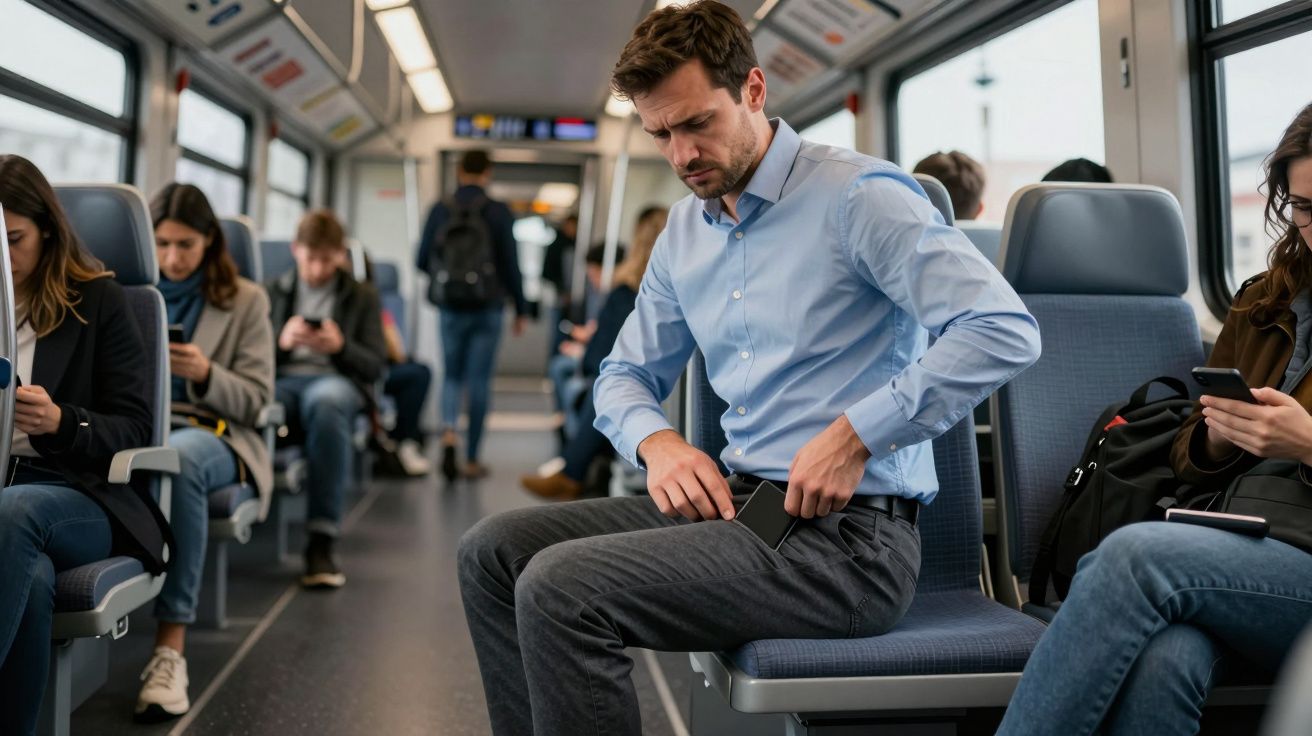
A commuter on the 7:42 folds himself into a seat, suit tight across his hips, phone pressed against the crease where thigh meets groin. The train rocks; the phone doesn’t move. An hour later, at his desk, there’s a ghost buzz against the same spot. No notification. Just a dull, insistent awareness that something is pressing, rubbing, humming, all day long.
It feels like a small thing, too small to matter. But nerves specialise in small things repeated often.
The quiet anatomy inside your pocket line
Slide a hand along the side seam of your trousers and you’re mapping out a busy corridor of tissue. Just under the skin sit branches of the lateral femoral cutaneous nerve and friends-delicate sensory lines that carry signals about touch, temperature and pain from your outer thigh towards the spine. Deeper in, near the groin, larger nerves feed muscles and skin, weaving past blood vessels that don’t love tight pressure either.
Now add a flat, hard rectangle. It pushes against that corridor whenever you sit, climb stairs, bend to tie a shoe. In slim jeans or fitted workwear, the fabric pins phone to flesh, so the pressure concentrates into the same few square centimetres. Nerves do not snap instantly under this kind of load, but they do complain. First as mild numbness, then as tingling or burning, sometimes as a mysterious patch of altered feeling that’s hard to describe but impossible to ignore.
Think of it as low-level “phone elbow” for your leg. Rest your elbow on a desk edge long enough and the ulnar nerve sparks protest into your fingers. A front-pocket phone can, for some people, nudge thigh nerves in a similar way.
How a phone becomes a nerve irritant
A phone doesn’t weigh much, and it doesn’t need to. The trick is in time and angle. When you sit, your hip flexes and the pocket line creases. The top edge of the phone can dig into the inguinal area, where key nerves pass from pelvis to leg. The side edge can ride exactly over the lateral femoral cutaneous nerve as it curves towards the outer thigh. Add a tight waistband, a belt, or a car seat edge, and you’ve made a clamp.
Nerves are wrapped in a protective sheath and cushioned by soft tissue, but they’re sensitive to compression and friction. Constant pressure can disturb blood flow to the nerve and alter how it fires. At first you might get occasional pins and needles when you stand up quickly. Over weeks or months of the same habit, some people develop more persistent symptoms: a band of numb skin, electric zaps when they twist, or a deep, tender ache along the pocket line.
This isn’t about radiation or 5G conspiracies. The main suspect is mechanics: shape, pressure, heat. Prolonged local warmth from a device running hot might add to the discomfort by making tissues more irritable, much as a laptop on bare thighs can do. The pattern tends to calm down when the trigger-phone in the same spot, all day-is taken away.
Recognising the “pocket nerve” pattern
You don’t need a textbook to notice when your leg feels off. What helps is recognising the pattern so you can change the setup before it becomes a fixture.
Common clues people report:
- A narrow area of numbness or reduced sensation on the front or outer thigh.
- Tingling, buzzing or burning exactly where the phone sits.
- Discomfort that’s worse after driving, long meetings, or cinema seats.
- Relief when trousers are looser or the phone lives elsewhere for a few days.
Symptoms usually stay on one side-the side that hosts the phone. They may flare with certain trousers or belts and fade with softer fabrics or a day in joggers. That on‑off quality is a hint: your nerves are reacting to how they’re being treated, not failing by themselves.
If pain is severe, spreads below the knee, or comes with weakness, bladder changes or back pain, that’s a different story and a medical one. Pocket tweaks won’t solve that; a clinician should see you.
Simple ways to give those nerves a breather
You don’t have to abandon your phone or buy a utility vest. Small shifts in where and how you carry it can unload the pressure without turning your routine inside out.
Try a few of these:
- Move the phone up or out. A jacket pocket, shirt pocket, or small crossbody bag shifts pressure away from key nerve paths.
- Use the back pocket sparingly. Better than the front when you’re standing, but take the phone out before you sit to avoid loading your lower spine and sciatic region.
- Loosen the squeeze. Slightly looser trousers, a notch looser on the belt, or choosing fabrics with a bit more give can reduce clamping.
- Swap sides regularly. If you must use a front pocket, alternate legs so one nerve isn’t always on duty.
- Give your leg “phone‑free” hours. Desk time and long drives are perfect for parking the phone on the table or in a bag instead of on your body.
Think in days and weeks, not minutes. Nerves like consistency. Repeatedly taking pressure off teaches them that the environment is safer, and symptoms often ease in parallel.
What might really be happening when your thigh feels odd
Several threads likely braid together. First, direct compression: the phone acts like a small, firm wedge against nerves running near the surface, especially where fabric pulls tight. Second, posture and joint angle: modern sitting-hips flexed, torso bent-already narrows spaces where nerves travel; the phone just finishes the jam. Third, local heat and micro‑movement: a warm, slightly shifting rectangle can keep surrounding tissue mildly irritated all day.
For most people this adds up to transient neurapraxia-a reversible irritation rather than permanent damage. Shift the conditions and the nerve calms down. For a smaller group, especially those who are heavier, wear very tight clothing, or sit for long hours, the pattern can echo conditions like meralgia paraesthetica, where the lateral femoral cutaneous nerve is chronically compressed.
None of this replaces a proper assessment if your symptoms are strong or worrying. But it does offer a practical, low‑tech experiment: change where the phone lives for a fortnight and notice what your leg says.
| Factor | What’s going on | Why it matters |
|---|---|---|
| Local pressure | Phone edge and tight fabric compress superficial thigh nerves | Can trigger numbness, tingling or burning in a narrow band |
| Hip position | Sitting flexes the hip and narrows nerve pathways | Makes nerves more vulnerable to even small added pressure |
| Habit over time | Same pocket, same clothes, every day | Turns a minor irritant into a persistent pattern |
An easy tweak you can start today
You don’t need a specialist appointment to move a phone. You just need permission-from yourself-to treat those small thigh sensations as information, not imagination. Put the phone on the desk while you work. Slip it into a coat pocket for the commute. Notice whether the ghost buzzes and odd patches of feeling start to fade.
There’s a broader mindset shift here. You’re not being fragile by listening to your nerves. You’re acknowledging that bodies notice design choices-tight seams, hard edges, long sits-and answer back. Phones got thinner and trousers slimmer; your anatomy didn’t relocate to accommodate them. A few thoughtful adjustments can keep technology convenient without turning your pocket into a pressure test.
You’ll know it’s working when you stop thinking about your thigh at all.
FAQ:
- Is it the phone’s radiation that’s affecting my nerves? Current evidence points much more strongly to mechanical pressure and posture than to radiofrequency exposure in this context. The symptoms tend to match where the phone presses, not where signals travel.
- Can this cause permanent nerve damage? In most everyday cases, no-symptoms ease when pressure is removed. Long‑standing, severe compression can cause more lasting issues, which is why it’s worth changing the habit early and seeking medical advice if symptoms persist.
- Does pocket side or phone size matter? Yes. Larger, stiffer phones and heavily loaded cases create more pressure, and one side used constantly is more likely to complain. Alternating sides and lightening the case can help.
- What if I need my phone on me for work? Consider a belt holster, lanyard, or workwear with dedicated phone pockets positioned away from main nerve routes. Even short “off‑leg” breaks during sitting can make a difference.




Comments (0)
No comments yet. Be the first to comment!
Leave a Comment