Why relationship therapists pay close attention to how couples talk about the washing‑up
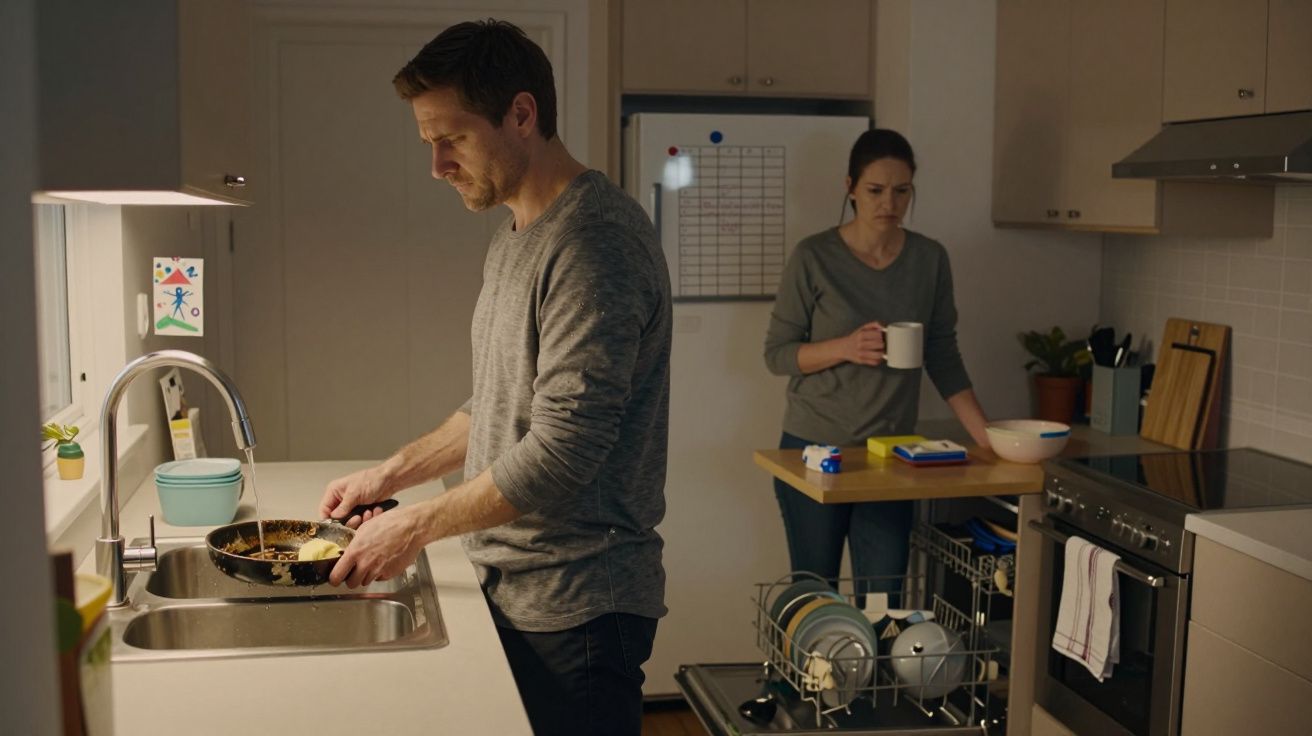
The bowl is still greasy at the rim. The sponge smells faintly of last night’s curry. A single mug sits in the sink even though the dishwasher is empty and wide open. No one ends a marriage over a pan left to “soak”, and yet relationship therapists lean in whenever washing‑up stories appear in the room. They know the sink is rarely about soap. It is about fairness, respect, and how two people handle the tiniest frictions of daily life.
On paper it looks trivial: who rinses, who stacks, who forgets. In the consulting room, the air changes when one partner says, “I always do the dishes,” and the other replies, “That’s not true.” Shoulders square. Voices tighten. The argument is not about plates any more. It is about whether one person’s effort is seen at all. A saucepan can become a scoreboard in under a minute.
The tiny chores that carry huge meanings
Therapists listen to the grammar of dish talk. “You never clean properly” lands differently to “I feel I’m doing more than my share.” The first pins blame to a person, the second names an experience. When couples argue about chores, they are often asking three questions underneath the foam: Do you notice me? Do you value me? Will you show up for boring things as well as big ones?
The vocabulary matters. A partner who says, “I help with the washing‑up,” signals, without meaning to, that dishes belong to the other person by default. Someone who jokes, “You’re better at it than me,” may be hiding a quiet expectation that the other will pick up the slack. Therapists will often pause here and ask, “When you say ‘help’, what do you mean?” That tiny word can hold years of unspoken assumptions.
Time is folded into every plate. One person might barrel through the washing‑up in ten brisk minutes; the other may spend the same time wiping the table, packing tomorrow’s lunches, chasing a child into pyjamas. If only the clink of plates in the sink “counts” as work, resentment has already started to accumulate. The way a couple narrates the evening routine reveals whether the household is run as a joint venture or a quiet hierarchy.
What therapists actually listen for
In sessions, the sink often enters as a side note. “It blew up over the washing‑up, but really it was about…” A good therapist does not skip that sentence. They ask each partner to replay a recent scene in detail: the words, the tone, the thoughts that flashed past. Not to allocate blame, but to tune into a few key signals.
They notice whether partners speak in absolutes: “always”, “never”, “every single time”. Those words close doors. They flatten any exception that might give the relationship some breathing space. They also listen for invisible labour: the planning, remembering, and checking that no one sees. “You only see the moments I complain, not the ten times I quietly do it,” is a classic line, and a lonely one.
Another clue is humour. Some couples tease each other about the washing‑up in a way that feels warm and safe. Others weaponise the same jokes. “Shall I frame the sponge for you?” can be affectionate, or a small, barbed reminder that someone has failed again. The joke itself is less important than what happens next: do both people laugh, or does one person go quiet and smaller in their chair?
Common patterns behind dish arguments
- The “competence trap”: One partner is labelled the “only one who does it properly”, then feels trapped doing it.
- The “ghost parent”: One person repeats their childhood script, scolding their partner as if they were a messy teenager.
- The “tired accountant”: Every plate becomes a unit of effort to be tallied and traded, rather than a shared responsibility.
Therapists are not just counting chores. They are mapping how power and care flow through a life lived in teaspoons and tea towels.
How to talk about the washing‑up without starting a war
The aim is not a perfectly even rota pinned to the fridge, although that can help. It is a way of speaking that turns the sink into a problem you hold together, not a weapon you wield against each other. Small shifts in language and timing change the entire tone.
Pick your moment. Mid‑row, when plates are clattering and one of you is already flooded, is the worst time to discuss fairness. Therapists often suggest a neutral slot: Sunday afternoon, a short walk, a coffee at the table with no dishes in sight. Start with observations, not indictments. “I’ve noticed I’m often still in the kitchen when you’re already on the sofa,” lands more softly than, “You just swan off and leave everything to me.”
Swap blame for impact. Instead of “You’re lazy”, try “When I see the sink full after I’ve cooked, I feel taken for granted.” The first invites defence; the second offers information. Then move swiftly to requests: “Could we agree that whoever doesn’t cook handles the washing‑up that night?” or “Can we both aim to leave the sink clear before bed three nights a week?”
A few simple guidelines help keep the water calm:
- Talk about the task, not the person’s character.
- Use “I feel / I’d like / Can we” more than “You always / You never”.
- Include the hidden jobs (loading, soaking, wiping, putting away), not just what is noisy or visible.
From plates to partnership: sharing the mental load
What frustrates many partners is not the physical act of scrubbing, but the mental list that never closes. Remembering to buy washing‑up liquid, noticing the growing stack, deciding whose turn it is. Therapists will often ask, “Who holds the list in their head?” The answer is rarely fifty‑fifty.
When one person carries the mental load, their world shrinks to logistics. Their partner may genuinely believe things are “fine” because crises are averted before they notice them. A calmly stacked dish rack hides the labour that made it so. Naming this imbalance is not an attack; it is a precondition for change.
One practical move is to externalise the list. A small notebook, a shared app, or a whiteboard on the fridge turns “your job” and “my job” into “our jobs on the wall”. The point is not to micromanage each other, but to let both brains rest. Tasks become visible, negotiable, and much harder to quietly dodge.
| Focus | What changes | Why it matters |
|---|---|---|
| From blame to impact | “You’re lazy” → “I feel alone with this” | Lowers defensiveness, opens dialogue |
| From help to ownership | “I help” → “I share this job” | Signals equal responsibility |
| From memory to shared list | Tasks in one head → tasks on paper | Lightens the mental load for both |
Why therapists care about the sink so much
A sink that resets quickly at the end of the day often signals more than good products and a strong wrist. It suggests a quiet, repeated agreement: we will both do the boring, invisible work that keeps this life running. It is not glamorous. No one posts a photo of a fairly divided rota. Yet the couples who manage it tend to argue less about “respect” and “effort” because those values are already being expressed in small, concrete ways.
Relationship therapists are not secretly obsessed with sponges. They are interested in proof. Anyone can say “we’re a team” in a speech or a wedding vow. The washing‑up shows whether that sentence survives fatigue, distraction, and the lure of the sofa. Over time, how you talk about the dishes becomes a shorthand for how you handle disappointment, adjust expectations, and repair after tiny hurts.
The good news is that it rarely takes a grand overhaul. A small change in timing, a different turn of phrase, a shared list on the fridge, an honest “I didn’t realise how much this mattered to you, let’s rethink it” – these are the relationship equivalents of switching to a better‑designed dish rack. The water, the plates, the people stay the same. What changes is the way things dry out after the splash.
FAQ:
- Is it normal to argue about chores this much? Yes. Chores are one of the most common flashpoints in long‑term relationships because they bundle time, fairness and recognition into one small arena. The goal is not never to argue, but to argue in a way that leads to clearer agreements.
- What if my partner refuses to talk about it? Start with your own side: name your feelings, set gentle but firm boundaries (“I won’t clear up alone every night”), and suggest one small experiment rather than a full overhaul. If stonewalling continues, a couple therapy session can help break the pattern.
- Should everything be split 50/50? Not necessarily. Therapists focus less on strict equality and more on felt fairness. Health, working hours, and temperament all play a role. What matters is that both partners agree the arrangement is fair and adjustable over time.
- How do we stop keeping score? Move from tallying past effort to planning future tasks together. A weekly check‑in-ten minutes to look ahead and divide chores-can replace the running mental ledger with clear, shared plans.
- When is a sink argument a warning sign? If every small request turns into a major row, if contempt and name‑calling creep in, or if one partner feels consistently unheard or afraid to speak, it is worth seeking professional support. The dishes are then signalling deeper cracks that deserve attention.





Comments (0)
No comments yet. Be the first to comment!
Leave a Comment