Why starting decluttering with the bathroom is easier for the brain than tackling the loft
You imagine yourself standing in the loft: boxes tilting, old paperwork in leaning piles, a suitcase with a broken zip, childhood toys smiling at you from the dark. Your shoulders rise before you’ve touched a thing. It feels big, emotional, and strangely foggy.
Now picture a bathroom. Four walls, one small cupboard, a shelf, a laundry basket. Limited square footage, fewer decisions, door that shuts. Same house, very different feeling in your body. That isn’t laziness. It’s your brain trying to protect you from overload.
Starting with the bathroom is not about ignoring the “real mess”. It’s about choosing the simplest room for your nervous system, so you can actually finish something and trust yourself to keep going.
Why your brain panics in the loft
The loft is clutter on hard mode. It’s where we store “I’ll deal with that later”: grief objects, half-finished hobbies, tax folders, the wedding dress in a dry-cleaner bag. Every box represents a decision you postponed once already. Your brain remembers that.
Up there, you face three kinds of load at once: physical (lifting, dust, heat), cognitive (hundreds of tiny choices) and emotional (memories, regret, guilt). That triple stack is what makes you stall at the hatch, then go back down for a cup of tea and a scroll. You’re not weak. You’re over-stimulated.
Bathrooms rarely hold deep history. Nobody keeps their school reports by the toilet. Most objects are low-sentiment and high-practical: out-of-date sun cream, three half-used shampoos, seven hotel miniatures. Your brain can categorise them quickly-keep, bin, donate-without visiting your past life in the process.
The bathroom is a “small win” laboratory
Your brain loves closure. It hates open loops. A finished room, even a modest one, gives you visible evidence that change is possible. The bathroom is perfect for this because it has clear edges and a short list of categories.
You can usually:
- Remove everything from one cupboard in five minutes.
- Decide what’s safe or in date using a label, not your emotions.
- Wipe a shelf and put back only what you actually use.
That contained cycle-empty, decide, clean, reset-teaches your brain a new story: “When I start, I finish, and it feels better at the end.” You need that story before you tackle a chaotic loft that has no natural finish line in sight.
Bathrooms also reward you fast. One bin bag out, a tidy shelf, clean tiles and suddenly the whole room looks like a hotel instead of a chemist’s clearance bin. Your senses calm down: fewer colours, fewer labels, less visual noise. That calm is data your nervous system can trust.
Decision fatigue: cotton buds are easier than baby clothes
Decluttering is mostly decisions. The problem isn’t making one hard decision; it’s making your two hundred and seventeenth in a row. That’s decision fatigue. It’s the mental sludge that shows up as “I’ll just leave this here for now”.
Bathroom decisions are mostly functional:
- Is this in date?
- Do I like using it?
- Do I need this many duplicates?
You don’t have to weigh up what Grandma would think if you donated the soap she gave you in 2004. You don’t need to consult anyone else about a rusty razor. Your brain gets to stay in practical mode, not emotional arbitration.
Up in the loft, almost nothing is neutral. Baby clothes, inherited ornaments, notebooks from your twenties-each one is wired to a feeling. Every object quietly asks, “What does this say about who you are?” That question is not decluttering; it’s identity work. Useful, yes, but exhausting if you start there.
When you begin with an emotionally light room, you conserve mental energy and prove your sorting muscles on low-stakes items. By the time you meet the baby clothes, you’ve had practice saying, “Thank you, and goodbye,” to things that clearly no longer serve you.
Clear boundaries: four walls beat a void
Lofts are ambiguous spaces. Where does “loft” end and “storage cupboard” begin? Does this box belong up here or downstairs? The edges are fuzzy-your brain hates fuzzy. It doesn’t know when to feel “done”.
Bathrooms come with built-in boundaries: door frame, four walls, a small number of zones (sink, shower, loo, storage). You can literally stand in the doorway, look around, and say, “This whole space is under my care today.” That clarity is powerful.
It also makes timing realistic. A single bathroom drawer might take ten focused minutes. A full bathroom, ninety at most, including a wipe-down. You can block that out on a Sunday morning or a Tuesday evening and keep your promise to yourself.
The loft doesn’t offer that kind of container. “Declutter the loft” is not a task; it’s a multi-session project. Tackling it without smaller wins under your belt is like deciding your first jog will be a marathon. No wonder your brain suggests you reorganise the spice rack instead.
What to actually do in the bathroom (step by step)
Treat the bathroom like a training ground, not a punishment. You’re rehearsing skills you’ll need later in tougher rooms.
Pick one zone.
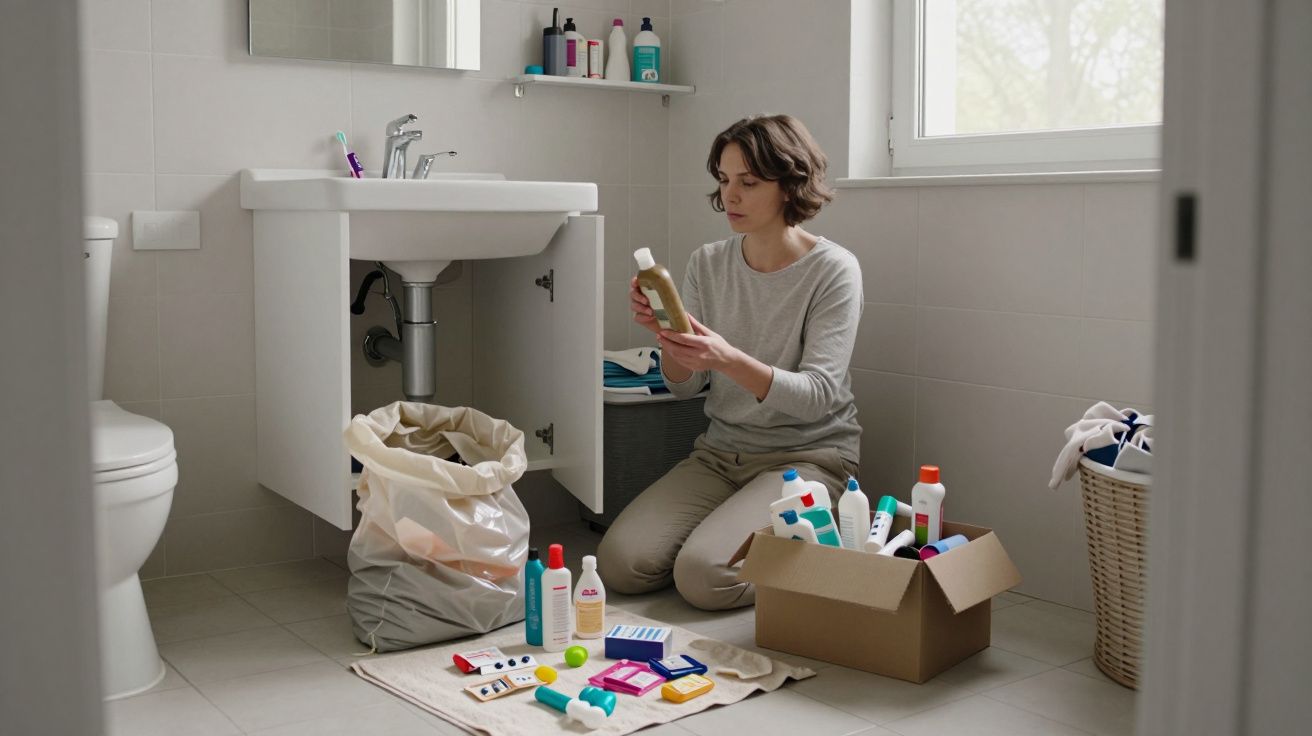
Start with the easiest: medicine cabinet, under-sink cupboard, or one shelf. Not the whole room at once.Empty completely.
Put everything on a towel or in a washing basket. Seeing the empty space resets your brain: this cupboard is not “full by default”.Sort fast, not perfectly.
Make four piles:- Keep and use
- Bin (out of date, broken, unhygienic)
- Pass on (unopened duplicates, wrong shade, spare toiletries)
- Not sure (very small pile, to revisit once your brain has warmed up)
Clean the space.
Quick wipe, dry, maybe a fresh liner. The physical reset signals “new rules” for this cupboard.Put back with intention.
Everyday items at eye level, back-ups together, rarely used things up high or in a labelled box. Avoid burying anything behind a second row if you can.Finish properly.
Take the bin bag out. Put donation items straight in a carrier bag near the front door. Decide on a date to drop them off, not “sometime”.
We’ve all had that moment when you move bottles around for half an hour and nothing really leaves the room. Pause. Touch each item and ask, “If this disappeared tonight, would I actually replace it?” If the honest answer is no, it’s a candidate to go.
Using the bathroom win to unlock the rest of the house
Once one bathroom is done, don’t rush straight to the loft. Let your brain absorb the win. Use that tidy, easier space for a week. Notice how much simpler mornings feel when you’re not hunting for plasters behind three expired moisturisers.
Then, stack the next-level challenges:
- Another bathroom or WC, if you have one.
- A single kitchen cupboard.
- One wardrobe rail, not the whole bedroom.
Each completed zone is a proof point: “I can start and finish. I can make decisions. Nothing terrible happened when I let things go.” That’s the evidence you’ll lean on when a dusty box of letters suddenly makes you want to sit on the floor and cry.
When you finally schedule “loft time”, treat it like a series of bathrooms, not one giant beast. Choose one box type (old bedding, seasonal decor, random cables), bring it downstairs into a clean, well-lit room, and run the same cycle: empty, sort, clean, reset. Your brain now recognises the rhythm.
A quick comparison: bathroom vs loft for your brain
| Space | Brain load | Best use |
|---|---|---|
| Bathroom | Low-sentiment, clear boundaries, quick decisions | Build confidence, practise systems |
| Loft | High-sentiment, vague edges, endless categories | Later-stage project, tackled in small chunks |
You’re not meant to leap from “overwhelmed” to “minimalist” in a weekend. You’re meant to build capacity, room by room, decision by decision.
Gentle rules that keep you moving
Think of these as bumper rails, not strict laws. They keep your thinking straight when emotions get loud.
- Start where the decisions are easiest, not where the pile is biggest.
- Finish one contained space before opening another.
- Let bins and expiry dates do some deciding for you.
- Schedule your energy, not your guilt. Don’t start the loft at 9 p.m. on a work night.
- When stuck, shrink the task. “Top shelf only” beats “whole cupboard”.
If you feel yourself stalling, go back to the smallest unit that worked-a single drawer, a single shelf. The goal is momentum, not drama.
FAQ:
- Won’t starting in the bathroom just make me procrastinate on the loft?
Beginning in an easier room is not avoidance; it’s preparation. You’re training your brain and your systems on low-risk items, which makes you far more likely to cope when you reach emotionally heavy spaces. Set a date for the first loft session as you finish the second or third small room, so the project has a clear next step.- My bathroom is tiny. Does it really matter if it’s cluttered?
Small spaces amplify clutter. A clear, calm bathroom reduces daily friction-less hunting, fewer half-used bottles falling out of cupboards-and acts as a daily reminder that change is possible. That visual proof is what you’ll lean on in harder rooms.- What if my bathroom does hold sentimental items (old perfume, keepsakes)?
Treat sentimental pieces as the exception, not the rule. Move them gently to a temporary “memories” box outside the bathroom and carry on decluttering the practical items. You can review the memory box later, when you’re working on sentimental categories as a whole.- How often should I declutter the bathroom once it’s done?
A light review every three to six months keeps it easy: toss expired items, pass on unopened products you’re clearly not using, wipe shelves. Because the space is small, maintenance sessions can be ten-minute jobs rather than full overhauls.


Comments (0)
No comments yet. Be the first to comment!
Leave a Comment