Why you should never charge your e-bike on an extension lead, fire brigades warn
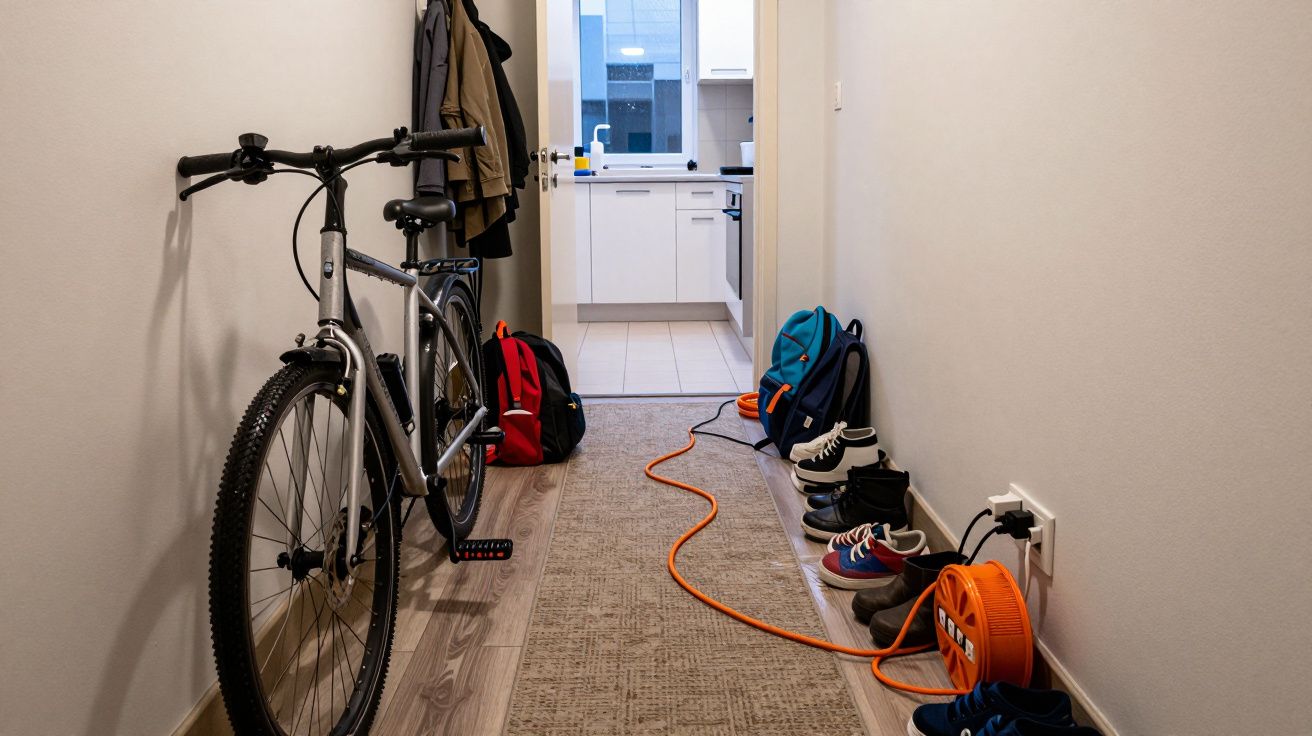
The battery hummed softly on the hall floor, a green LED winking above a tangle of white plastic. Outside, rain ticked against the windows. Inside, shoes, school bags and a narrow plug-in heater crowded the single double socket by the door. An orange extension reel snaked under a rug, carrying it all. Somewhere between the washing machine cycle and a late-night film, the cable began to warm.
Most house fires don’t start with a cinematic spark. They begin with an everyday compromise: “There’s no socket nearby, I’ll just run a lead.” With e‑bikes and e‑scooters, that quiet shortcut is exactly what fire crews are now begging people not to take.
The charger is designed for your battery. The extension lead is not designed for your charger and everything else you’ve plugged in.
Across UK brigades, the pattern is the same: overheated extension blocks, daisy-chained adaptors and batteries left on charge while people sleep. When lithium-ion cells fail, they don’t smoulder politely. They go from normal to ferocious in seconds, releasing toxic smoke and jets of flame difficult to extinguish. The difference between a close call and losing a home can be as small as where you plug in.
Why extension leads and e-bike chargers don’t mix
On paper, a 13‑amp extension looks generous. In practice, its small-gauge cables and tightly packed reels don’t like sustained high loads. An e‑bike charger can draw a steady current for hours, especially with bigger batteries. Add a fan heater, tumble dryer or another charger, and that safe margin vanishes.
Extension leads are also easy to mistreat. They’re left coiled on the reel so heat can’t escape, tucked under beds, trapped behind furniture, or run across doorways where they’re crushed and kinked. Each insult damages the insulation a little more. The charger keeps pulling power. The plastic quietly cooks.
Lithium batteries have their own risks: manufacturing defects, knocks from daily use, cheap replacement chargers that over-stress the cells. Put a stressed battery at the end of an overworked, ageing extension lead and you’ve built a fault line through your hallway. Once a cell goes into “thermal runaway”, the fire spreads inside the pack faster than most people can react.
Firefighters aren’t being dramatic when they say: plug directly into a wall socket, or don’t charge it indoors at all.
The safest ways to charge an e-bike at home
You don’t need a special room or industrial kit, but you do need a few non-negotiables. Think of them as your “charging rules of the house”, especially if several people own bikes or scooters.
- Plug the original charger straight into a wall socket, never through an extension, multi-way adaptor or cube.
- Keep the battery and charger on a hard, non-combustible surface: tiles, concrete, bare worktop, or a metal stand.
- Charge in a clear, ventilated area, away from sofas, curtains, beds, coats and escape routes like stairs and front doors.
- Start charges when you’re awake and at home, so you can spot smells, unusual noise or smoke early.
- Unplug once charged. Don’t use the battery or charger if either is damaged, swollen, cracked or unusually hot.
For many flats, that might mean choosing the kitchen over a narrow hallway, or a ground-floor utility over a cluttered landing. It’s less convenient than the plug by the front door. It’s also far easier to get out of if something goes wrong.
A good rule of thumb: if you’d struggle to carry a burning battery past where you’re charging it, pick another spot.
Common mistakes that quietly raise the risk
The habits that worry fire investigators most look ordinary until you line them up. They’re not about villainy, just busy lives and cramped homes.
- Daisy-chaining: plugging one extension into another to reach a “perfect” parking spot.
- Overloading sockets: running heaters, dryers, air fryers and chargers from a single block.
- Charging overnight: everyone asleep, doors closed, alarm removed from the room to stop it chirping.
- Covering leads: hiding cables under rugs or carpets where damage and heat build-up can’t be seen.
- Using unapproved chargers: cheap online replacements with the wrong voltage, no safety marks and poor thermal cut-outs.
Let’s be honest: nobody memorises wiring regs before buying an e‑bike in a sale. But the gap between “it’ll do” and “we lost everything in ten minutes” is often these small, fixable habits.
If you’re renting, ask your landlord about adding an extra wall socket near where bikes are stored, or a dedicated outdoor socket under cover. If you manage a block of flats, clear, written charging rules and secure ground-floor storage with proper electrics are not a luxury. They are now part of basic safety.
What to do if something looks or smells wrong
Lithium battery failures escalate quickly. That doesn’t mean you’re helpless; it means the first seconds matter.
- If you notice hissing, popping, smoke, a strong solvent smell, or rapid heating, unplug from the wall if you can do so without reaching through smoke or flames.
- Move away, close doors behind you to contain smoke, and get everyone out.
- Call 999 and tell them you suspect an e‑bike or e‑scooter battery fire.
Do not pour water directly onto a visibly venting or flaming battery pack, especially in a confined space. The reaction can be violent, and the smoke is highly toxic. Your priority is distance and oxygen, not heroics with a washing-up bowl.
Once out and safe, resist the urge to go back in for the bike, charger or anything else. Crews can and do tackle these fires, but they treat them as hazardous incidents, not simple kitchen blazes. Your role ends at the front door.
For households that already rely on extensions
Not every home has spare sockets and a brick outbuilding. If you’re reading this with a four-way trailing from a single outlet, here’s a realistic path to safer charging.
- Audit what’s plugged in. List which devices genuinely need that extension and which could move to another room or time-slot.
- Create a “no high-load” rule on extension blocks: no heaters, washing machines, tumble dryers or kettles, ever.
- Reserve a single wall socket specifically for e‑bike charging, even if that means rearranging furniture.
- Schedule charging windows when that socket is free and someone’s at home: for example, 6–9 pm after work.
- Plan for upgrades. When you decorate or renew a tenancy, prioritise adding a properly installed socket near ground-floor bike storage.
If none of that feels possible where you live, consider secure outdoor charging options at work, supervised community charging hubs, or removable batteries you can charge at a better-equipped location. The solution doesn’t have to be perfect. It just has to be safer than “lead off a lead under a coat rack”.
Key risks and safer swaps
| Risky habit | Why it’s dangerous | Safer swap |
|---|---|---|
| Charging on an extension reel | Cable overheats, especially when coiled or overloaded | Plug charger into a dedicated wall socket |
| Parking by the front door and charging there | Fire blocks your main escape route | Charge in a ventilated room with two ways out |
| Leaving battery on charge overnight | No one awake to spot early warning signs | Charge only when you’re up and nearby |
FAQ:
- Is any extension lead safe for e-bike charging? No. Fire brigades advise against using any extension, reel or multi-way adaptor for e‑bike and e‑scooter chargers. Go straight into a fixed wall socket.
- Can I charge in a hallway if it’s the only space I have? Hallways are escape routes. Avoid charging there if at all possible. If you must store the bike in the hall, wheel it to a safer room to charge and keep the hall clear.
- Are genuine chargers still a fire risk? They’re much safer than cheap copies, but no lithium battery system is risk-free. Using the correct charger, on a hard surface, in a clear space, drastically reduces the chance of a serious incident.
- What about charging in a shed or on a balcony? A well-ventilated shed with proper electrics and a smoke alarm is often safer than indoors. Balconies reduce indoor smoke, but falling burning debris can endanger people below. Never run flimsy indoor extensions through windows or doors.
- How can I tell if my extension is overloaded? Warmth, discoloration, buzzing, or a smell of hot plastic are warning signs. If you need to use extensions for other items, use a high-quality, fused block, keep it fully uncoiled, and stay under the total current rating. Keep e‑bike chargers off it entirely.





Comments (0)
No comments yet. Be the first to comment!
Leave a Comment