Why you should never rinse cooked pasta under the tap, even for cold salads
The colander is already in the sink, the pasta has just hit al dente, and steam fogs up your glasses as you tip the pan. Instinct takes over: colander under the tap, quick rinse, shake off the water, job done. The pasta feels cool to the touch, the steam disappears, everything looks tidy and “lighter”.
Yet something subtle but important has just happened. In those few seconds under the tap, you’ve stripped away exactly what makes pasta behave properly in sauces and salads. You’ve turned a bowl of potential into a bowl of polite, slippery nothing.
At the table, the result shows up quietly. Sauces slide off instead of clinging. Dressings lurk at the bottom of the bowl. That pasta salad you meant to be glossy and flavourful turns dull and oddly watery. It’s not that you “can’t cook”. It’s that the cold tap has quietly sabotaged you.
What rinsing really does to your pasta
Every piece of dried pasta carries starch in its surface. When you cook it in properly salted boiling water, part of that starch swells and lifts to the outside. That thin film is not a flaw; it’s the glue that helps sauces hold on, the soft focus filter that gives your dish body instead of a thin, soupy feel.
The moment you rinse under cold water, you do two things at once. You chill the pasta abruptly, shocking the structure, and you wash off the very starch that helps sauce and dressing cling. It feels “cleaner” under your fingers, but that cleanliness is precisely the problem. You’ve polished away the grip.
Professional kitchens almost never rinse pasta for this reason. Even when they cook ahead for service, they prefer to undercook slightly, cool gently on trays, or toss in a tiny bit of oil rather than blast everything under the tap. They’re preserving that invisible coating that makes a sauce behave the way you want.
Then there is flavour. Your pasta just spent 8–12 minutes in water you hopefully seasoned with a good hand of salt. Rinsing swaps that seasoned cooking water for plain tap water. If your tap water tastes flat, metallic or chlorinated, that’s now sitting on the surface of every mouthful. You won’t see it, but your palate will.
Why even “cold pasta salads” should start with hot pasta
Cold dishes tempt people to reach for the tap. You want to stop the cooking, cool things quickly, get on with the recipe. The logic seems sound. If the end goal is a salad that lives in the fridge, surely a rinse is harmless?
The structure of the salad says otherwise. Dressings - whether a simple olive oil and lemon mix, or a thicker mayo‑based sauce - need texture to hold onto. Warm, just‑drained pasta has tiny rough edges from the cooking process. That warmth relaxes the dressing slightly, helping it wrap itself around each piece. As the salad cools, the dressing and starch set into a light, clingy coating.
With rinsed pasta, you have the opposite. The surface is smooth and wet from the tap, so the dressing slides instead of gripping. It collects in pockets, under pieces, at the bottom of the bowl. You end up chasing flavour with a spoon, discovering that the best bit of the dish is the puddle left when everyone has picked through the pasta.
There’s also seasoning to consider. Good pasta salads rely on layering: salty cooking water, flavourful dressing, a final check of salt and acid before serving. When you rinse, you reset everything back to neutral. You’re asking the dressing alone to carry all the taste, which is why so many home‑made salads feel either too bland or suddenly too sharp when people compensate with extra vinegar or lemon.
A chef’s trick is simple: dress the pasta while it is still warm, but not scalding. The warmth helps aromatics - garlic, herbs, spices - bloom gently in the oil. It opens up the pasta so flavours sink in, not just sit on top. You can always chill the salad afterwards. What you should not do is cool it with a tap.
The role of starch: invisible, but decisive
If you cook pasta until just al dente in plenty of salted water, you create an ideal balance. The surface starch is soft enough to grab sauce, the core still has bite, and the water around it carries dissolved starch you can put to work.
That cooking water is sometimes called “liquid gold” in recipes for a reason. A small ladle added to a sauce in the pan helps emulsify fat and water, turning an oily mix into a silky coating. It’s the same principle in a salad bowl. The residue of starch on your pasta, mixed with a little oil and acidity, acts like a natural emulsifier.
When you rinse, you throw away both players: the cooking water down the drain, and the starch on the pasta into the sink. What’s left is just bare wheat, literally stripped of the thing that makes it play nicely with fat and liquid. No amount of “finishing” oil at the table can quite replace what you’ve washed away in five seconds.
On a microscopic level, the starch granules on the surface are like tiny hooks and pads. They catch micro‑droplets of oil and hold aromatic molecules close to the pasta. Without them, flavour molecules have fewer places to attach. The difference is subtle, but it’s the gap between “fine, I suppose” and “I’d happily serve this to guests”.
This is also why pasta reheats better when it was never rinsed. Leftover pasta coated in a bit of sauce or oil and stored in the fridge can be revived with a splash of water and gentle heat. The starch and fat re‑emulsify. Rinsed pasta, on the other hand, tends to go rubbery and refuses to welcome moisture back in.
How to cool pasta without ruining it
The good news is that you don’t need the tap to stop pasta overcooking or to prepare it for a cold dish. You just need a small shift in how you handle the pan and the colander.
- Cook slightly under al dente if you know the pasta will sit or be baked later. Drain 1–2 minutes earlier than the packet suggests.
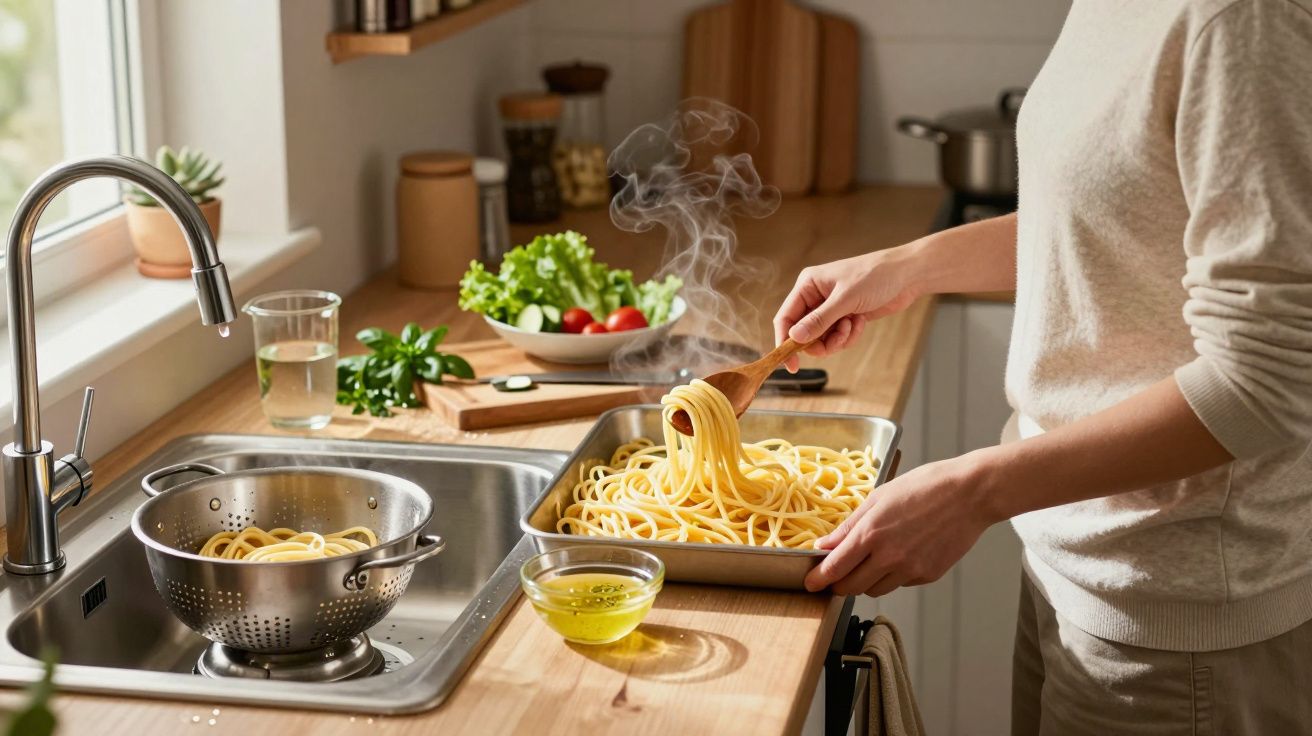
- Drain quickly, then spread the pasta out on a large tray or a wide, shallow bowl. The increased surface area lets steam escape fast, cooling it naturally.
- Toss with a little oil - just enough to stop sticking, not to drown it. For salads, use the same oil that appears in your dressing so flavours stay coherent.
- Dress while warm, adding part of the dressing immediately, then the rest once the pasta has cooled. This builds flavour in stages.
- Chill smartly: once mixed, cover and place the salad in the fridge. Stir briefly before serving and adjust seasoning.
For large batches cooked ahead, restaurants sometimes portion the pasta onto trays in a single layer, letting air do the cooling in minutes. No tap, no starch loss, no rubbery chew. At home, a baking tray does the same job on a smaller scale.
If food safety worries you - especially in warm weather - remember that you’re not leaving pasta at room temperature for hours. Ten to twenty minutes spread out on a tray, then into the fridge once it’s no longer steaming, keeps you within safe cooling time while protecting texture and flavour.
When rinsing is the exception, not the rule
There are a few narrow cases where rinsing can make sense, and they’re worth knowing so you can choose, not guess.
When you’re making stir‑fried noodle dishes with a lot of high‑heat frying, some cooks briefly rinse and oil pasta or noodles to break up clumps before they hit the wok. Even then, they often undercook the pasta and use intense sauces that bring back richness.
For cold Asian‑style noodle salads meant to be very light, springy and separate, a fast rinse in very cold water can stop cooking and firm the texture by tightening the starch. That’s a deliberate stylistic choice, usually supported by punchy sauces packed with soy, sesame, chilli and aromatics that can cling despite the smoother surface.
In lasagne production lines or catering, sheets may be par‑cooked and cooled in water to stop them sticking together in huge stacks. Here the priority is practicality over perfection, and sauces are rich enough to compensate.
These are edge cases, not everyday pasta dinners. The common thread is that when rinsing is used, it’s part of a broader system that compensates for what’s lost: stronger sauces, shorter cooking, different expectations for texture. For a typical bowl of penne with pesto or a simple tuna pasta salad, rinsing does more harm than good.
What really changes when you stop rinsing
The difference is rarely theatrical. Nobody will stand up and applaud your spaghetti. What changes is how quietly competent your pasta starts to feel.
Sauces cling in a soft, even layer, instead of forming puddles. Cold salads taste seasoned all the way through, not just where the dressing happened to fall. Leftovers reheat with less sulking from the pasta. You need less oil to create a sense of richness, because the starch is doing its part.
There’s a psychological shift too. Many home cooks carry a vague sense that pasta is “fussy” or that theirs never turns out like the photos. Removing one unnecessary step - the automatic rinse - simplifies the ritual. You salt the water properly, cook to al dente, drain, and move on with confidence.
Your kitchen habits start to align more closely with how professionals work, without any special equipment or extra cost. A colander, a pan of well‑salted water, and the restraint to leave the tap alone are enough.
| Key point | What it means | Why it matters |
|---|---|---|
| Surface starch | Thin layer formed during cooking | Helps sauce and dressing cling to pasta |
| No rinsing | Keep starch and seasoning in place | Better flavour, better texture, fewer soggy salads |
| Smart cooling | Trays, timing and a touch of oil instead of tap water | Works for hot dishes and cold pasta salads alike |
FAQ:
- Does rinsing pasta ever improve the taste?
Very rarely. Rinsing mostly dilutes flavour and removes starch. In most everyday dishes, it makes sauces thinner and salads blander, not better.- What if I’m worried about the pasta overcooking while I prepare the sauce?
Cook the pasta 1–2 minutes less, keep a mug of cooking water, and finish it directly in the sauce over low heat. This gives you more control than using the tap.- Can I at least rinse with the cooking water instead of tap water?
There’s usually no need. If you want to cool pasta slightly, draining well and spreading it out is enough. Pouring more water over it, even cooking water, still washes off useful starch.- Why do some packet instructions mention rinsing?
Some manufacturers assume you might be making very specific dishes or need to cool pasta quickly for storage. They write broad instructions. For most home cooking, especially pasta with sauce or salads, you can safely ignore the rinse step.- Is this advice the same for gluten‑free pasta?
The principle still holds, but gluten‑free pasta can be more fragile. Handle it gently, avoid overcooking, and cool it on a tray with a little oil rather than rinsing, so you keep what little surface starch it has.



Comments (0)
No comments yet. Be the first to comment!
Leave a Comment