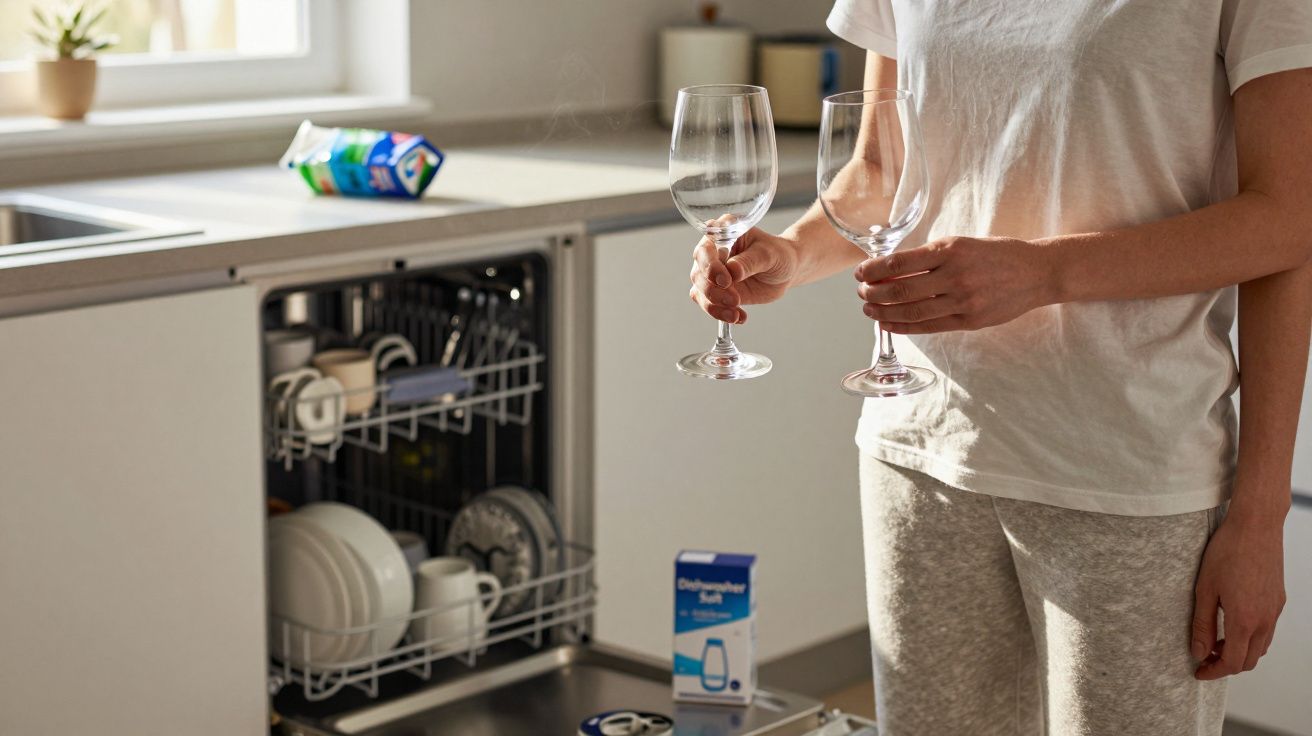
Why your dishwasher salt level affects glass cloudiness more than the tablet you use
The cycle finishes, the door clicks open, and a puff of hot steam hits your face. You reach in for a wine glass, expecting that showroom shine the advert promised. Instead, the glass looks… tired. Cloudy, streaked, with a milky veil that no tea towel quite fixes. You blame the tablet. Maybe you even switch brands, “upgrade” to the platinum, ultra‑max, 12‑in‑1 version.
Weeks later, the glasses still look dull. The tablets have changed. One quiet detail often has not: the level of dishwasher salt hiding in a compartment you hardly ever open.
For all the marketing around capsules and shiny wrappers, the battle for clear glass is won or lost somewhere far less glamorous: in how your machine softens the water.
The myth of the miracle tablet
Dishwasher tablets are easy to fall in love with. One neat block, big promises: degreaser, rinse aid, salt, glass protection, limescale defender. Drop, close, press start, forget. Somewhere between the supermarket aisle and the influencer reel, a reassuring story has taken hold: if you pick the right tablet, you can ignore the rest.
Your dishwasher never signed up for that story.
Inside the base of most machines sits a built‑in water softener filled with resin beads. Their job is boring but crucial: they grab calcium and magnesium ions from hard tap water, swapping them for sodium ions, so that hot water and detergent can do their work without leaving chalky traces. Every time they do that swap, they get a bit “full”. Dishwasher salt is what resets them.
When that salt runs low, the resin can’t keep softening properly. The machine still runs. The tablet still dissolves. But instead of gliding over glass, the wash water drags minerals with it. The result isn’t always dramatic limescale crust; often, it’s that persistent haze that makes your glassware look older than it is.
The tablet may help at the margins, especially if it contains a small amount of built‑in softening and rinse aid. It cannot replace a whole softening system designed to handle the full hardness of your local supply. As one appliance engineer put it after a decade of call‑outs:
“Nine times out of ten, when someone shows me cloudy glasses and a bag of expensive tablets, the salt compartment is bone dry.”
What’s really making your glasses cloudy
Not all “cloudiness” is the same problem in disguise. To understand why salt matters so much, you need to know what you’re actually looking at on the surface of the glass – or inside it.
There are two main culprits:
Limescale and mineral film
This is a thin layer of calcium carbonate and other mineral deposits baked on during the drying phase. It feels slightly rough, looks patchy or streaked, and often improves with white vinegar or specialist descaler. It’s a chemistry problem linked to water hardness and poor softening.True glass corrosion (etching)
Here the glass itself has been microscopically damaged. Over time, harsh conditions in the dishwasher – very soft water, high temperatures, strong alkalinity – leach minerals out of the glass surface. It looks uniformly cloudy, sometimes with a rainbow or frosted effect, and no amount of vinegar removes it. The damage is permanent.
Here’s the twist that surprises many people: both extremes of water hardness can make things worse for glass. Very hard water leaves visible limescale. Very aggressively softened water, especially combined with hot, long cycles and strong detergents, can accelerate etching.
Dishwasher salt is the dial that lets your machine aim for the middle ground. When correctly adjusted to your local hardness, it keeps enough minerals out to avoid chalky film, without oversoftening to the point that your glassware is slowly “matted” from the inside.
When salt runs too low for your water hardness, every other product in the system is forced to work harder. Tablets struggle to rinse completely. Rinse aid has more droplets to deal with. Heat fixes tiny mineral spots in place. You see that consequence as a cloudy wine glass and assume the last thing you changed – the tablet brand – is to blame.
In reality, the quieter component in the story has been drifting out of range for months.
Why salt beats the tablet in the clarity hierarchy
If you strip a dishwasher down to its basics, crystal‑clear glass depends on three broad levers:
- Water quality (hardness, temperature, cleanliness)
- Mechanical action (spray pressure, coverage)
- Chemistry (detergent, rinse aid, salt, additives)
Within that chemistry basket, salt is the foundation, not the garnish. It changes the water that touches every millimetre of the glass, from pre‑wash to final rinse. Tablets, by contrast, are more like a carefully balanced recipe riding on top of whatever water they’re given.
Think about it this way:
- A perfect tablet in badly softened water will still leave a haze of minerals and spots.
- A basic, no‑frills powder in properly softened water can still leave glasses surprisingly clear, as long as the dose and programme are reasonable.
Salt affects:
- How easily detergent can do its job without being “used up” tackling hardness.
- How likely limescale is to form on heaters, spray arms and internal surfaces, which in turn affects wash performance.
- How cleanly water sheets off the glass during the rinse, even before rinse aid has a chance to help.
Most modern tablets do contain some softening ingredients. They are designed as a backup, not a replacement, for a properly set softener. Manufacturers quietly say so in the small print: they still tell you to fill the salt reservoir if your water is medium to hard. There’s a reason for that: their internal testing rigs don’t run with “tablet only” softening, because the results don’t stay consistent.
The human bias here is understandable. It feels more satisfying to change something visible – the tablet brand, the fancy “glass protection” logo – than to open a heavy cap at the bottom of the machine, pour in coarse salt, and consult a water‑hardness table. But if you ranked interventions by impact per minute of effort, filling the salt wins, almost boringly.
How to get your salt level right (without turning into a technician)
You don’t need a lab or a toolbox to use salt properly. You need a couple of quiet minutes and a rough idea of how hard your tap water is.
The basic sequence looks like this:
Check your local water hardness
Your water supplier’s website usually lets you enter your postcode and see hardness in °dH, mmol/L or ppm. Your dishwasher manual then shows which softener setting matches that hardness.Set the softener in the machine
On older models, this might involve a small dial near the salt compartment. On newer ones, it’s often in the electronic settings menu. The idea is simple: harder water = higher softening setting = more salt used.Fill the salt reservoir completely
Use proper dishwasher salt, not table salt. The grains are larger, purer and designed not to clog the system. The first time, fill it right up until just covered by water, even if it feels like a lot. The machine will draw what it needs.Watch the salt indicator, not guesswork
Most dishwashers have a light or symbol that comes on when salt is low. If your machine doesn’t, a rough habit works: check once a month if you’re in a hard water area, once every couple of months if not.
A few small practical points often make a big difference:
- If you spill salt into the tub while filling, run a short rinse cycle before loading dishes. Direct contact with concentrated salt can mark metal temporarily.
- Don’t assume that “all‑in‑one” tablets mean “no salt ever again”. Treat their salt function as a cushion, not a complete solution.
- If you live in a very soft water area, your softener setting should be lower, and you’ll use less salt. Oversoftening there is as unhelpful for glass as undersoftening in hard‑water regions.
Once the softener is set correctly and the reservoir is genuinely full, give the system a few washes to stabilise. Cloudiness that is just mineral film often improves visibly over three or four cycles. Permanent etching won’t heal, but fresher glasses will age more gracefully.
Simple habits that matter more than marketing
Once salt and softening are under control, the rest of the clarity puzzle comes down to a handful of unglamorous habits rather than chasing the perfect tablet.
Some low‑effort tweaks:
Use the right programme, not always the hottest one
Very high temperatures and long cycles add stress to glass, especially if it’s thin or decorative. For everyday glassware, an eco or standard cycle is often kinder than a constant “intensive” setting.Don’t overdose detergent
More powder or an extra tablet doesn’t mean cleaner. It can leave residue, especially in softer water, and push the wash chemistry into a harsher range for glass.Top up rinse aid if you see droplets
Rinse aid doesn’t replace salt either, but it helps water sheet off rather than bead. That reduces drying marks and helps glasses emerge with a more uniform shine.Keep the inside of the machine free of heavy scale
If you can see white crust on the heating element or around the door, the inside surfaces are already holding on to minerals. A machine cleaner or a hot, empty cycle with a cup of dishwasher‑safe descaler can reset things.
None of this requires daily heroics. Soyons honnêtes : personne ne démonte ses bras d’aspersion tous les week‑ends. But a few well‑placed routines – checking salt, choosing a gentler cycle, resisting detergent overshoot – do more for your glassware than swapping between three nearly identical “ultra‑shine” tablets.
Rethinking what’s really “at fault” when glasses go dull
There’s a quiet mental shift hiding behind all this: moving the blame from the bright object (the tablet) to the invisible setting (water softness). It feels less intuitive, because you can’t hold “correct softening” in your hand in a supermarket aisle. You can’t photograph it easily for a review.
Yet if you talk to people who service dishwashers for a living, a pattern appears. Machines with well‑maintained softeners and regular salt rarely produce chronic cloudy‑glass complaints, no matter which mainstream tablet or powder the owner picks. Machines run for years on tablet‑only softening in hard‑water areas are the ones that age glass fast and clog up inside.
That shift in focus nudges another question: instead of asking “Which tablet will fix my cloudy glasses?”, it becomes more useful to ask “Does my machine have the right water to work with in the first place?”. The answer costs less to change than a year of premium capsules.
You also gain a bit of freedom. Once salt and softening are sorted, you can choose detergent based on price, fragrance, or eco‑credentials without feeling that the wrong box will wreck your glassware in a month. The foundation is set. The rest is personal taste and budget.
In a way, the promise of the miracle tablet was always too simple for the messy, mineral‑rich water running through our pipes. Clear glass comes from a quieter alliance: the salt you hardly see, the settings you rarely touch, and a tablet that is no longer expected to bend basic chemistry on its own.
| Key point | Detail | Why it matters |
|---|---|---|
| Salt sets the foundation | It feeds the softener that controls water hardness | Without it, even premium tablets can’t prevent cloudiness |
| Not all haze is the same | Mineral film can be cleaned; etched glass is permanent | Knowing the difference avoids chasing impossible fixes |
| Settings beat brand‑hopping | Matching softener level to local water hardness protects glass long‑term | One 10‑minute adjustment outperforms constant tablet changes |
FAQ:
- Do I really need dishwasher salt if my tablet says “all‑in‑one”?
In medium and hard water areas, yes. Tablet softening is only a supplement. Your built‑in softener still needs proper salt to work consistently and protect both the machine and your glassware.- How can I tell if cloudiness is limescale or permanent etching?
Soak a cloudy glass rim in warm white vinegar for a few minutes and rinse. If the haze improves, minerals were the main issue. If it looks unchanged, the glass surface itself is likely etched.- Can too much softening damage my glasses?
Extremely soft water, combined with hot, long cycles and strong detergent, can speed up glass corrosion. That’s why it’s important to set the softener to match your actual water hardness, not simply to the maximum.- Does switching to a more expensive tablet fix cloudy glasses?
Not if the root cause is incorrect softening or no salt. A premium tablet may improve cleaning, but it cannot reliably stop mineral film forming in hard water on its own.- What’s the single most useful habit for clearer glasses?
Keep the salt reservoir filled and the softener set to your local water hardness, then use a standard or eco programme with a normal dose of detergent. That combination solves far more cloudiness than any specific tablet branding.





Comments (0)
No comments yet. Be the first to comment!
Leave a Comment