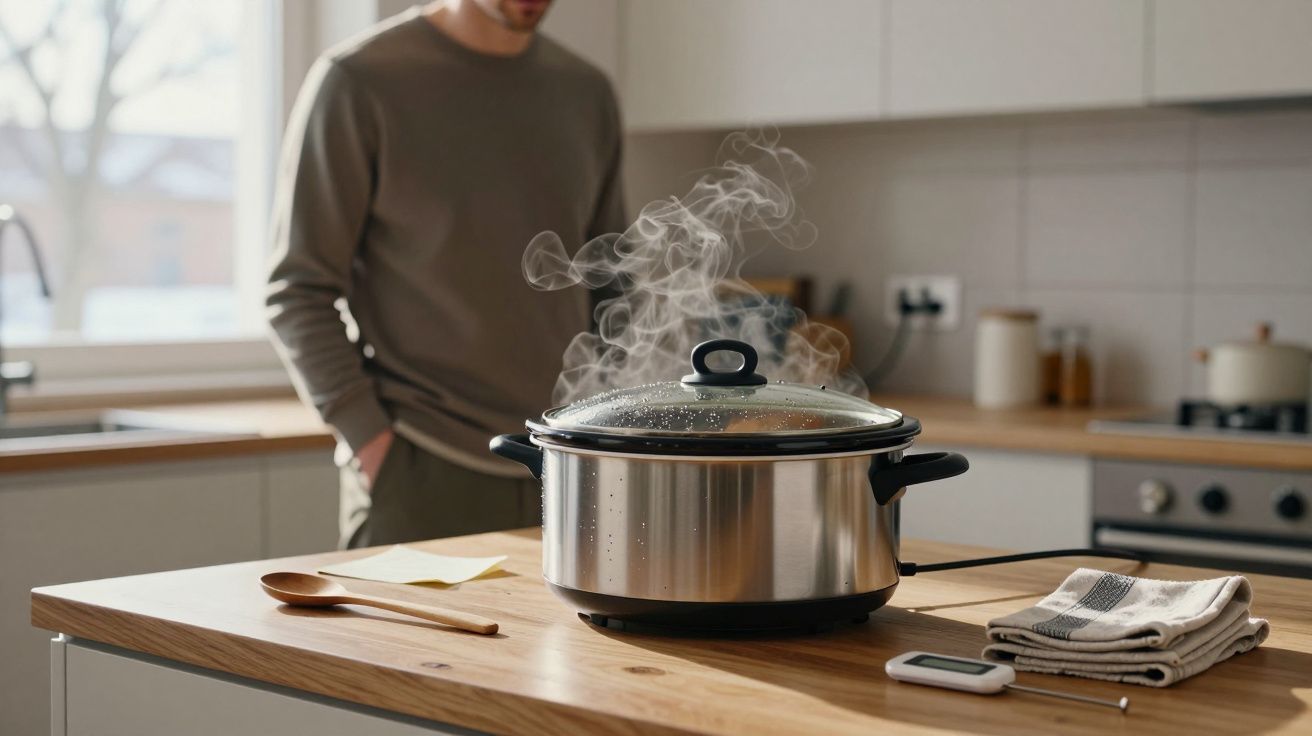
Why your slow cooker is using more energy than it should – and the lid habit to fix it
The slow cooker is meant to be the frugal friend humming away in the corner, quietly saving you money. Yet in many kitchens it is burning through more electricity than necessary. The culprit is rarely the appliance itself, but how we use it – and in particular, how often we touch the lid.
A slow cooker’s efficiency depends on holding a stable, steamy micro‑climate inside the pot. Break that seal too often and the device spends hours reheating what it has already cooked. One small habit, repeated through the day, can wipe out most of the savings you thought you were making.
How a slow cooker actually uses power
A slow cooker is not a miniature oven. It behaves more like a lidded saucepan on a very low hob. A heating element surrounds the crock, warming it gently and steadily. Once the contents reach temperature, the thermostat simply tops up the heat to maintain it.
This pattern matters for energy use. The first hour is where the heavy lifting happens: the appliance must raise several litres of food from fridge‑cold to around 90–95°C. After that, its job is mostly to replace the heat escaping from the sides, base and – crucially – the lid. Anything that increases that escape pushes up consumption.
A slow cooker is most efficient when it is left alone, lid on, heat steady, for the full cooking time.
Under those conditions, many models use less power than a standard electric oven doing the same job. Disturbed regularly, they can edge close to, or even exceed, the energy used by a short oven session.
The hidden cost of lifting the lid
Every time you lift the lid, a plume of steam and heat rushes out. That cloud represents water and energy, both of which your slow cooker must replace. The effect is not trivial. Tests on typical 200–300 W models suggest that a single long peek can stretch cooking time by 15–30 minutes.
Multiply that by a few checks – a stir here, a taste there, a quick photo to send to a friend – and you quietly add one to two extra hours of running. The appliance keeps cycling the element on more often to rebuild the lost temperature and moisture.
From the outside, nothing seems dramatic. The indicator light stays on, the contents still bubble. Yet the energy graph, if you could see it, would show spikes after each lid lift. Over weeks of stews, chillies and stocks, those spikes stack into a visible line on your electricity bill.
How long it takes to recover from a “quick” lift
- A brief 5–10 second lid lift on high might cost you 5–10 minutes of extra cooking.
- A longer inspection with stirring on low can mean 20–30 minutes more.
- Repeating that four or five times in an eight‑hour cook can add more than an hour to the schedule.
The habit feels harmless because the cooker still finishes the meal. The damage shows not in flavour, but in kilowatt‑hours.
Steam, condensation and the missing seal
Slow cookers rely on a simple trick: they build their own seal as they heat. Moisture inside the pot turns to steam, rises and condenses on the underside of the lid. That condensation ring helps block gaps and reduce escaping vapour.
If you tip the lid regularly to “just have a look”, that seal never fully establishes. The rim dries, steam vents freely, and you turn a semi‑sealed system into a permanent open chimney. The cooker behaves more like a pan with a loose cover than the economical capsule it was designed to be.
A dry, rattling lid is a sign of lost efficiency. A gently beading lid, with droplets running back into the pot, is what you want.
Some models ship with vent holes or slightly loose‑fitting lids by design. These still assume you will leave them alone while they work. Extra disturbance compounds the built‑in losses.
The lid habit that cuts energy use
The single best change you can make is to treat the lid like an oven door: only open it when you must, and then as swiftly as you can. In practice, that means adopting a few simple rules.
A calm‑lid routine that actually works
- Decide in advance when you will check the dish, and limit it to one or two moments near the end of cooking.
- Use a clear‑glass lid, if you have one, to observe bubbling and liquid level without lifting.
- When you do open, have your spoon, thermometer or seasoning ready so the lid is off for seconds, not minutes.
- Wipe and reseat the lid rim quickly to re‑establish the condensation seal.
For many recipes, especially soups, stews and braises, you can skip mid‑cook checks entirely. The slow cooker’s strength is consistency, not improvisation.
Other quiet mistakes that waste power
Lid lifting is only part of the story. Several other habits nudge slow cookers into higher consumption without owners noticing.
Under‑filling or over‑filling the pot
Slow cookers are designed to run most efficiently when they are between half and three‑quarters full. Below that, a larger share of the heat warms empty space and ceramic, not food. Above that, lids can be pushed up slightly, breaking the seal and causing more steam loss.
A simple guideline helps:
| Pot level | What happens |
|---|---|
| Less than ½ full | Heats quickly but loses heat faster; relatively more energy per portion |
| ½–¾ full | Best balance of heat retention, cooking time and efficiency |
| Over ¾ full | Risk of overflow, poor seal, longer time to reach safe temperatures |
Batching meals to hit that middle band often uses less energy overall than cooking several very small, sparse pots across the week.
Using high when low would do
The high and low settings on many slow cookers lead to similar final temperatures. The difference lies in how fast they get there. High fires the element more often early on. That can be useful when you are under time pressure, but for dishes simmering across a full day, low usually wins on efficiency.
In some homes, people start on high “to get it going” and then forget to turn it down. The result is an unnecessarily aggressive cycle that overshoots, cools, and overshoots again.
Parking the cooker badly
Placing a slow cooker under an extractor fan, in a cold draught, or in direct contact with a cold stone surface increases heat loss. The thermostat dutifully compensates, but at the cost of more electricity. A stable, room‑temperature countertop, with a little air gap around the sides, helps it do its job with fewer top‑ups.
When opening the lid is worth it
Some recipes need intervention. Root vegetables at the top of a very full pot may cook unevenly. Dairy‑based sauces can split if left untouched for hours. Food safety sometimes demands a check with a thermometer, especially for large joints of meat.
In those cases, efficiency should not trump safety or quality. The key is to plan those necessary lid lifts, not to graze the pot out of habit. Booking one precise check at the three‑quarter mark is very different, energetically, from five casual peeks spaced an hour apart.
Use the lid deliberately, as part of the recipe, rather than reflexively whenever you walk through the kitchen.
If you find you cannot resist stirring, a different method – pressure cooker, oven, or hob – may suit your cooking style better, even if the theoretical energy use is higher. An appliance that fits your habits tends to waste less in real life than one you fight.
How to tell if your slow cooker is behaving efficiently
You do not need a plug‑in energy monitor to sense whether the appliance is running hard or cruising. Your senses provide good clues once you know what to watch for.
- The outside should feel warm but not dangerously hot; very high outer temperatures can signal excessive heat loss.
- The lid should bead with condensation within the first hour and stay visibly moist.
- The contents should reach a gentle simmer on low within 3–4 hours when correctly filled, depending on the model.
If, under those conditions, the indicator light or heating cycle seems to be on almost constantly, you may have a poor lid fit, an under‑filled pot or a failing thermostat. In those cases, careful use will help, but there is a limit to what lid discipline alone can fix.
Practical steps to cut energy use from tomorrow
You do not need to overhaul your recipes to benefit. Small operational tweaks, repeated over time, produce the biggest savings.
- Plan slow‑cooked meals for days when you are not constantly in and out of the kitchen.
- Load ingredients chilled but not frozen, so the cooker spends less time on the thaw.
- Fill the pot to at least halfway, on recipes that can be batched and portioned.
- Commit to a “no‑lid before lunch” rule on all‑day cooks, to give the seal time to form.
Over a winter of stews and curries, those habits will do more for your bill than any exotic gadget or one‑off tip. The slow cooker remains an efficient tool – provided we give it the stillness it expects.
Treat the lid as a boundary, not a suggestion, and your slow cooker will finally perform like the low‑energy workhorse it was sold to be.
FAQ:
- Is it ever safe to leave the lid slightly ajar to thicken a sauce? Yes, but do this only near the end of cooking, once ingredients are fully tender and at a safe temperature. Propping the lid for the final 30–45 minutes on high can reduce liquid without a major energy penalty compared with running the whole dish that way.
- Does wrapping the slow cooker in a towel help save energy? It can reduce heat loss slightly, but manufacturers generally advise against covering vents or blocking air gaps. If you try it, keep fabric away from controls and never leave the appliance unattended in that state.
- Is switching to ‘keep warm’ more economical than turning the cooker off? The ‘keep warm’ setting uses less power than active cooking, but it still draws energy. For holding food beyond an hour or two, chilling and reheating later is usually safer from a food‑hygiene perspective and often more efficient overall.
- Do smaller slow cookers always use less energy than large ones? Per hour, a smaller unit often consumes less, but if you need to cook in multiple batches to feed the same number of people, the total can exceed that of a single well‑filled larger pot.
- Will a smart plug or timer help reduce slow‑cooker costs? A timer can stop the cooker automatically once the main cooking window is over, preventing unnecessary extra hours on ‘low’ or ‘keep warm’. Just ensure total time at warm temperatures remains within food‑safety guidelines.



Comments (0)
No comments yet. Be the first to comment!
Leave a Comment