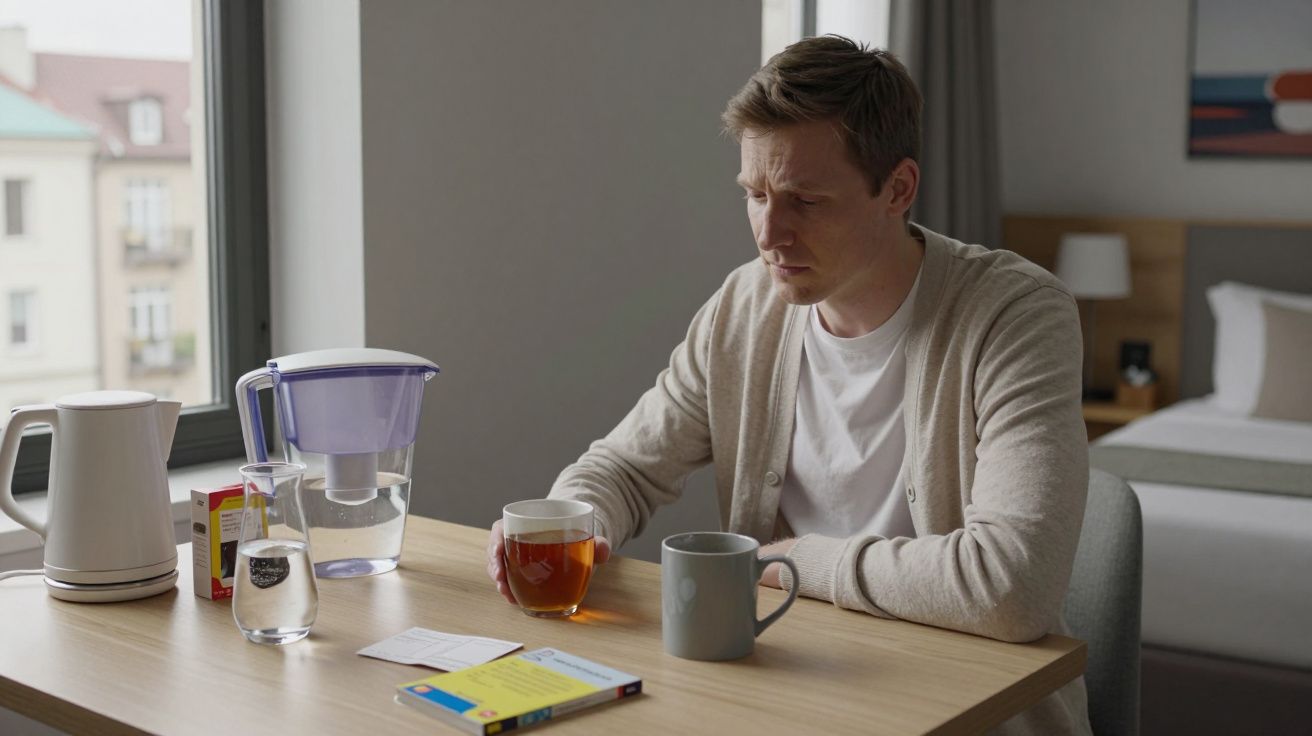
Why your tea tastes different abroad – and what British water chemistry has to do with it
The first time you make a cuppa abroad, it can feel like a small betrayal. Same teabags, same mug, same splash of milk – yet the taste is flatter, harsher, or oddly thin. You stare into the cup like it’s hiding the joke. Did you forget how to make tea, or did the country forget how to make water?
Somewhere between the kettle and your tongue, chemistry quietly rewrites what “a proper brew” means. For many Britons, that shift is the first hint that home isn’t just a place; it’s a recipe.
The invisible ingredient in your mug
We talk about tea as if the leaf is doing all the work: Assam versus Darjeeling, builder’s versus delicate oolong. But every cup is mostly water, and water is never just “H₂O”. It carries minerals, dissolved gases and trace compounds picked up on its way through rock, soil and pipework.
In the UK, that underground journey varies wildly. Chalky aquifers in the South and East load water with calcium and magnesium, while soft, peaty sources in parts of Scotland and Wales strip it back. Those differences don’t show up in the tap’s sound, but they show up in your teapot.
Tea is a chemistry experiment you repeat every day – only the lab conditions change when you cross a border.
When you fly to Spain, or Germany, or the US, your tea habit meets a new baseline. The kettle boils, the bag steeps, and the local geology pulls up a chair.
Hard, soft and somewhere in between
Water “hardness” sounds like a plumbing problem, not a flavour profile. Yet the same minerals that fur your kettle also shape the way tea tastes, looks and even smells.
At its simplest:
- Hard water is rich in calcium and magnesium.
- Soft water has relatively few dissolved minerals.
- Many British taps sit on a spectrum between the two, postcode by postcode.
Those ions don’t just float around politely. They bind with flavour compounds in tea, change how quickly they extract, and react with natural tannins to create the thin scum you sometimes see on the surface of a brew. That dull film on your morning cuppa is chemistry made visible.
In much of England’s South-East, hard water can mute delicate teas and push black tea towards a more robust, sometimes slightly bitter profile. In parts of Scotland, where water is softer and slightly acidic, the same teabag can taste brighter and more aromatic, with a cleaner aftertaste.
Why tea turns strange when you travel
Abroad, your taste buds are calibrated for “home water”, whether you know it or not. The first foreign cup collides with those expectations.
Picture it:
- In a soft‑water city like Oslo, your usual strong English Breakfast might suddenly taste sharper and more tannic, because the flavour compounds rush out more quickly in the gentler water.
- In a very hard‑water region of central Europe, a light green tea can come out dull and swampy, smothered by minerals that cling to its more subtle aromatics.
- In parts of North America where water is chlorinated more heavily, a faint swimming‑pool note can sneak into the steam if the kettle isn’t filtered.
Your brain often blames the tea brand, the hotel kettle, or the “foreignness” of it all. Underneath, it’s usually a mix of hardness, pH and treatment methods teaming up to shift the taste.
Your favourite teabag is more loyal to the water than to the passport in your pocket.
The shock feels disproportionate because a brew is habit made liquid. When that taste wobbles, small comforts wobble with it.
What British water chemistry actually does to your brew
Dig a little deeper and the picture becomes more specific, and more interesting.
Three quiet players matter a lot:
Calcium and magnesium (hardness)
- Bind with tea polyphenols (tannins), changing bitterness and body.
- Encourage that surface film, especially when milk joins the party.
- Can make dark teas feel heavier, but wash out floral or grassy notes.
Carbonate and bicarbonate (temporary hardness)
- Act like tiny buffers, nudging pH towards alkaline.
- Higher alkalinity can flatten acidity and brightness, making tea taste “stale” or “muddy”.
- When boiled, some of this hardness drops out as limescale, subtly changing the water mid‑cup.
pH and trace chemistry
- Slightly acidic water can make black tea look richer and more coppery.
- More alkaline water often gives a greyer, cloudier liquor when milk is added.
- Chlorine and other treatment residuals add faint off‑notes unless boiled or filtered away.
Put together, these factors explain why a builder’s tea in a hard‑water London kitchen looks dark, takes milk well and feels sturdy, while the same leaf in a Highland cottage might look lighter and taste almost perfumed.
A quick flavour map
| Water type | Typical British example | What it does to tea |
|---|---|---|
| Hard, alkaline | Much of southern England | Strong, darker brews; can taste flat or bitter, film on top |
| Soft, slightly acidic | Parts of Scotland, Wales | Brighter, clearer tea; delicate flavours show up more |
| Medium, variable | Many urban blends | “Average” cup that varies street by street |
Abroad, you’re simply stepping onto a different square of this flavour map.
How to hack your tea abroad without a chemistry degree
You don’t need lab kit to rescue your morning ritual in a hotel room or rental flat. A few small tweaks go a surprisingly long way.
Start with the water:
- Filter it if you can. Even a basic jug filter knocks out some hardness and chlorine, giving a cleaner base.
- Boil once, not three times. Re‑boiling concentrates minerals slightly and can make off‑flavours more obvious.
- Let it stand for a minute. Off the boil, oxygen levels stabilise and scalding extraction slows, especially important for green tea.
Then adapt the tea itself:
- Switch styles for local water.
- In very hard‑water regions, robust black teas (Assam, CTC “breakfast” blends) generally cope better than delicate green or white teas.
- In very soft water, lighter or more aromatic teas often shine.
- In very hard‑water regions, robust black teas (Assam, CTC “breakfast” blends) generally cope better than delicate green or white teas.
- Adjust brew time, not just strength. Shorten the steep in soft water to avoid harshness; lengthen it a little in hard water to coax flavour out.
- Re‑think milk. In very soft water, you may need less milk than at home. In very hard water, a small extra splash can round off bitterness but may also encourage that surface scum.
Treat your first foreign cup as a test run, not a verdict on the trip.
Two or three experimental brews are often enough for your hands to “learn” the new water quietly while your brain is busy unpacking.
What this says about Britain’s love affair with tea
The chemistry isn’t just a party trick. It has shaped what “British tea” even means.
Historically, blends sold in different parts of the UK were tweaked to suit local water. Tea merchants in Manchester or Birmingham would adjust leaf origins and cut size so the brew behaved properly in the hard, industrial‑era supplies. Delicate Darjeelings were never meant to be drowned in London’s chalk.
Milk in tea has a chemistry angle too. Hard, tannic brews soften when milk proteins bind with bitter compounds and when fats add body. In many soft‑water cultures, milk never becomes an automatic addition because the tea doesn’t demand that rescue act.
So when you sit abroad with a disappointing cup and mutter that “they don’t know how to do tea here”, part of what you’re really saying is: their geology wrote a different story.
Bringing a bit of home with you
If a decent brew feels non‑negotiable, you can stack the odds without packing an extra suitcase.
Practical moves that travel well:
- Slip a small, portable filter bottle into your bag; run tap water through it before boiling.
- Carry a handful of your usual teabags, not to convert the locals, but to remove one variable while you learn the water.
- Note where the best cup on your trip came from – was it a café with filtered water, a mountain spring, bottled still? Use that clue for the rest of your stay.
- If all else fails, lean into local specialities: mint tea in Morocco, chai in India, herbal infusions in central Europe. Sometimes the answer to bad tea is good, different tea.
Chemistry sets the constraints; culture supplies the workarounds.
FAQ:
- Why does tea look grey or form a film in some places? Hard, alkaline water reacts with natural tea compounds and milk proteins to form that thin surface scum and a duller colour. It’s mostly harmless, just not pretty.
- Is bottled water better for tea when I’m abroad? Often, but not always. Very mineral‑rich bottled waters can be just as unkind to tea as hard tap water. A low‑to‑medium mineral still water, ideally filtered, usually works best.
- Can I “soften” water at home for better tea? A jug filter or countertop cartridge is a practical middle ground; full water softeners that replace calcium with sodium aren’t ideal for drinking. Filtering plus small brew adjustments tend to give the best results.
- Why does the same brand of tea taste different in my new UK city? Even within Britain, hardness and treatment change between regions and suppliers. A move from, say, Glasgow to Reading can feel like a move abroad as far as your teapot is concerned.
- Does any of this matter if I’m not fussy? Only as much as it bothers you. If the first sip makes you frown, water chemistry is a useful lever to pull. If you’re happy with “hot and brown”, you’ve already solved the problem in your own way.





Comments (0)
No comments yet. Be the first to comment!
Leave a Comment