Why your towels never feel hotel-soft at home – and the surprising ingredient laundry experts use instead of fabric softener
You are not imagining it: hotel towels really do feel different. Thick, weighty, somehow both crisp and cloud-like, they have that particular “wrap” you never quite manage after a Sunday wash at home. You buy the plush ones, you follow the label, you pour in the fabric softener that promises “fluffy”, and yet they emerge slightly stiff, a bit flat, and nowhere near “spa”. Somewhere between the drum and the airing cupboard, the magic seems to vanish.
What most of us don’t see is that hotel softness is less about expensive products and more about what you leave out. Professional laundries care about absorbency first, scent second, and they are ruthless about anything that clings to fibres and weighs them down. The surprise? Many of them skip fabric softener altogether and rely on a humble store-cupboard staple you probably already own.
Why towels go stiff, flat and scratchy
Towels are designed to drink water, not perfume. The tiny loops (the “pile”) trap moisture and air. Anything that coats those loops, even if it smells glorious, will eventually make them collapse. Fabric softeners and some pods leave a thin, waxy film that builds up wash after wash. At first it feels silky; over time it turns into a layer that repels water and locks in detergent residue.
Hard water quietly adds to the problem. Minerals in the water bind with soap and surfactants, forming a chalky deposit that clings to cotton fibres. That’s the rough, board-like feeling you notice when you line-dry towels and skip conditioner. Add in overloading the machine, too little water and very hot drying, and you end up with flattened loops that feel heavy and dull rather than bouncy and soft.
The short version: product build-up, hard water and too much heat crush towel fibres and coat them, so they can neither absorb properly nor move freely.
The good news is that most of this is reversible. You do not need a commercial laundry; you just need to reset the fibres and stop suffocating them in the first place.
The surprising hotel trick: vinegar, not softener
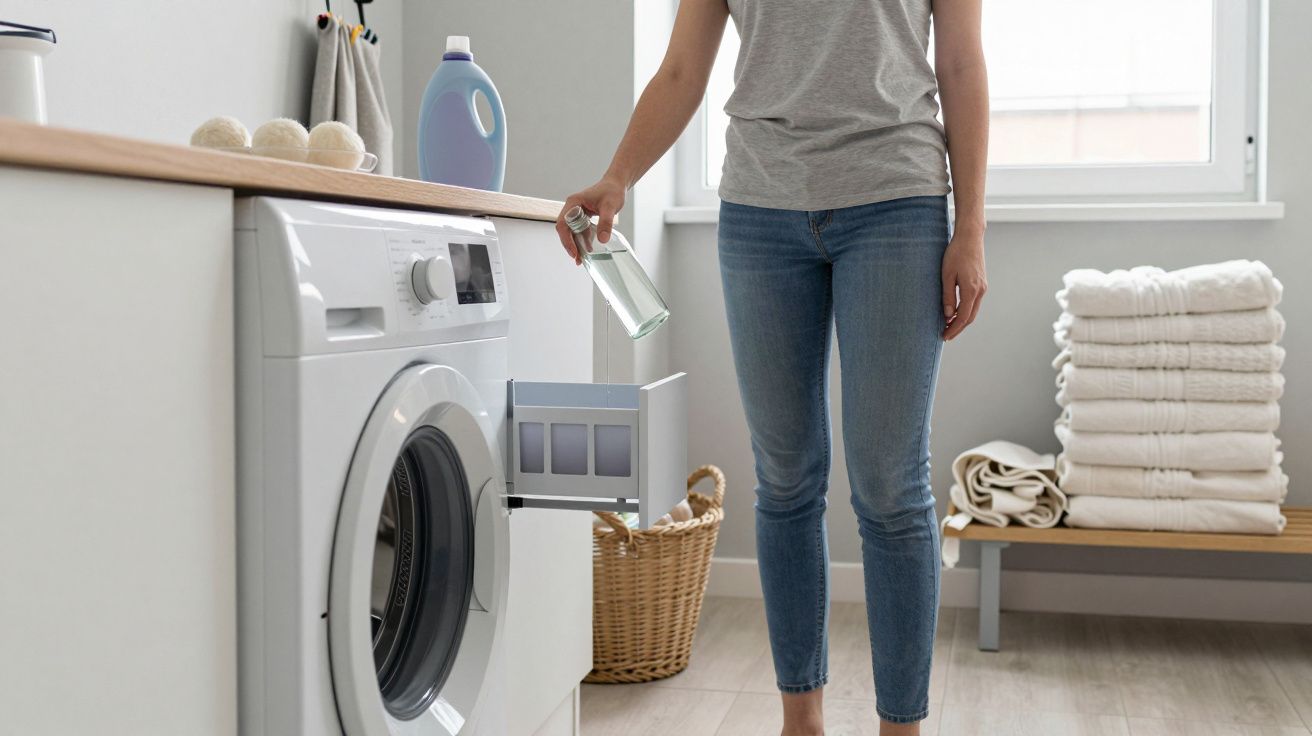
In many hotel laundries, the “secret ingredient” is not a premium conditioner but plain white distilled vinegar. Used in the right dose, it does three things at once: it helps break down mineral and product build-up, it balances the pH of the rinse water, and it leaves cotton feeling supple without adding a coating.
Vinegar works because its mild acidity dissolves alkaline residues from detergent and hard water. Instead of covering fibres, it clears them. That lets loops spring back up, which your skin reads as softness. It also helps towels rinse cleaner, so they dry faster and stay fresher between washes.
Method in a line: skip fabric softener and add 120–150 ml of white distilled vinegar to the rinse compartment for towels only.
You should not smell chips. Used in the rinse, vinegar scent disappears as the towels dry. If you do notice a whiff, you are likely using too much or your machine is not rinsing fully.
Step-by-step: the “hotel-soft” wash
- Wash towels on a warm cycle (40–60°C), following the care label.
- Use a measured dose of detergent; more does not mean cleaner.
- Do not add fabric softener for towels.
- Pour 120–150 ml of white distilled vinegar into the softener drawer.
- Choose an extra rinse if your machine has the option.
- Dry on a low–medium heat in the tumble dryer or on a line until fully dry.
If your towels are already quite stiff, you may need a one-off “reset” before this routine works at its best.
The reset: stripping built-up towels
When towels feel beyond help, laundry experts talk about “stripping”: essentially a deep cleanse to remove layers of residue. You do not need a cauldron or a special powder; for home use, a simple two-stage wash usually does the job.
Simple at-home strip wash
First wash – hot, no detergent
Run towels on the hottest temperature they can handle with no detergent, but with 200 ml of white vinegar in the drum or dispenser. This breaks down build-up.Second wash – hot, with bicarbonate of soda
Wash again immediately with warm to hot water, adding ½ cup (about 100 g) of bicarbonate of soda directly to the drum. Skip softener again.Thorough drying
Dry on low–medium heat with dryer balls, or outside on a breezy day. Shake towels out before and halfway through drying to lift the pile.
This is not an every-week ritual. Think of it as a reset once or twice a year, or when towels start to feel oddly slick yet not very absorbent.
The small changes that make a big difference
Hotel softness is less about one miracle product and more about a repeatable routine that protects the fibres. A few habit shifts at home get you most of the way there.
Wash routine tweaks
Stop overloading the drum
Towels need space to move. Aim for the drum to be about two-thirds full, not crammed tight.Dose detergent properly
Too much leaves residue; too little leaves body oils behind. Follow the scoop, adjust slightly for very hard or very soft water, and consider a liquid or powder labelled for hard water if limescale is an issue in your area.Lower the temperature sometimes
Very high heat every single wash can weaken fibres over time. Alternate 60°C “deep” washes with 40°C maintenance washes, especially for coloured towels.
Drying and storage
The drying stage is where that “hotel” feel really appears. Hotels rely on big commercial dryers, but you can copy the principles.
Use dryer balls (or clean tennis balls)
They separate layers, increase air flow and help fluff the pile.Avoid high heat
A medium setting with a bit more time is kinder to cotton and reduces that baked-hard feel.Shake and fold
A firm shake when they come out of the machine, and again before they go into the cupboard, helps loops stand up. Store towels loosely folded rather than rammed onto a shelf.
Think movement, not intensity: space in the drum, air in the dryer, and room on the shelf all help towels feel springy rather than compacted.
Common myths that are quietly ruining your towels
We pick up a lot of “rules” about laundry that sound plausible and quietly wreck fabrics over time. Towels fall victim to some of the worst ones.
| Myth | What actually happens |
|---|---|
| “More softener = softer towels” | Extra softener builds more residue, making towels slick, less absorbent and eventually stiff. |
| “Hotter is always better” | Constant high heat breaks fibres, shrinks loops and can fade colour. |
| “Towels must feel heavy to be ‘luxury’” | Over-washed, waterlogged fibres feel heavy but not necessarily soft or absorbent. |
| “You can wash towels with anything” | Heavy cotton washed with synthetics and lint-prone items picks up fluff and pills. |
Whenever possible, wash towels alone or with similar cottons. It is dull, but your skin will feel the difference.
A quick “softness rescue” when guests are on the way
If you have an hour and a stack of slightly sad towels before people arrive, you can still improve things fast.
- Run a short warm wash with a small dose of detergent and 120 ml vinegar in the softener compartment.
- Spin at a medium speed so they are damp but not dripping.
- Tumble-dry on medium with two dryer balls or tennis balls, pausing once to shake them out.
- Fold while warm and stack loosely to cool before use.
You will not completely undo years of build-up in one go, but you will noticeably boost softness and remove that “stale cupboard” smell.
FAQ:
- Will vinegar damage my washing machine or towels? Used in sensible amounts (120–200 ml per towel load), white distilled vinegar is safe for cotton and for most modern machines. Avoid pouring neat vinegar onto rubber seals every wash; use the dispenser and an extra rinse if you are concerned.
- Can I use scented vinegar or malt vinegar? It is best to stick to plain white distilled vinegar. Malt and darker vinegars can stain light fabrics and leave a lingering smell; scented versions may contain oils that reintroduce residue.
- What if I do not have a tumble dryer? Line-dry towels in a breezy spot, then give them a vigorous shake once they are almost dry. A quick 10–15 minute tumble on low in a friend’s or shared dryer, if available, can soften air-dried towels significantly.
- Does this work with bamboo or microfibre towels? Yes, but they are more delicate. Use cooler temperatures (30–40°C), a gentle cycle and a shorter, low-heat dry. Still avoid fabric softener; the same residue issues apply.
- How often should I wash towels for best feel? Bath towels used daily usually need washing every three to four uses. Washing too rarely lets body oils build up; washing after every single use can wear fibres faster unless you are very gentle with temperature and heat.


Comments (0)
No comments yet. Be the first to comment!
Leave a Comment