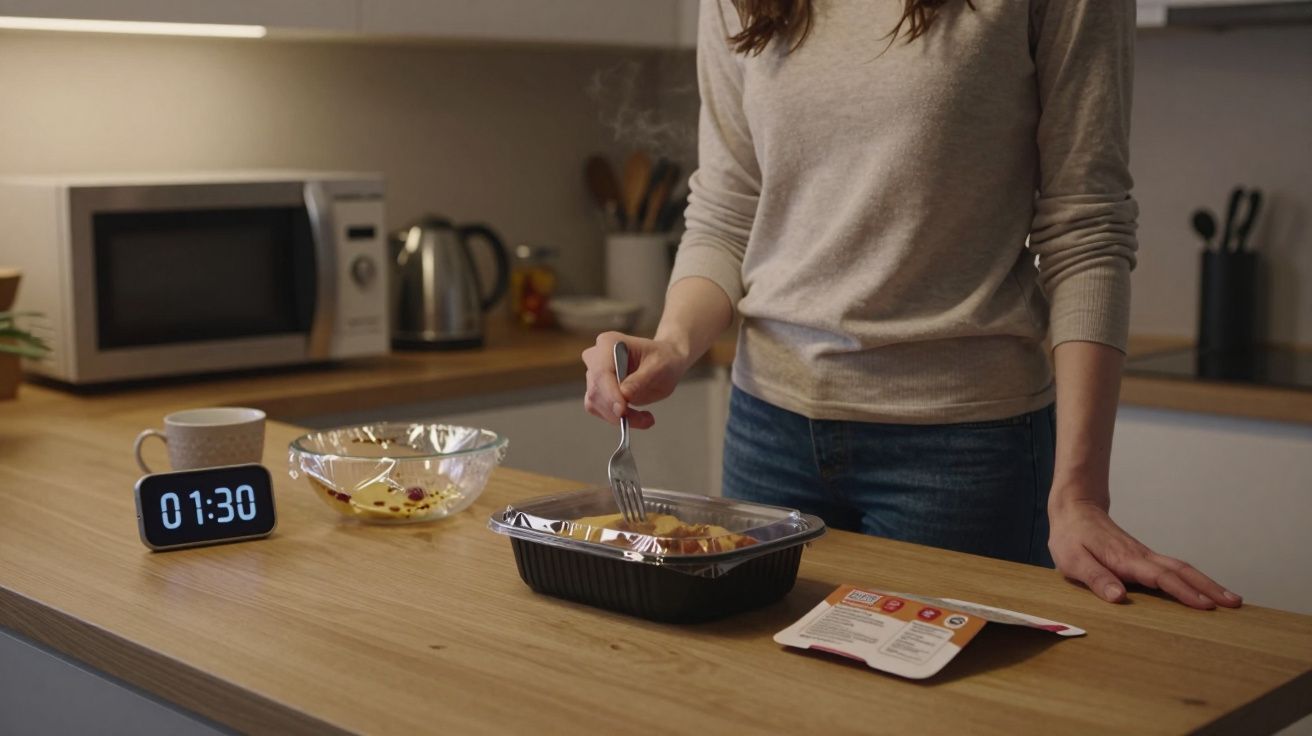
Your microwave’s “standing time” isn’t optional – food safety teams explain why
Across UK kitchens, one small instruction keeps getting ignored: “leave to stand for 1–2 minutes before eating”. It looks like a suggestion to help the sauce thicken or the cheese cool, so many people treat it as optional. Food safety teams, however, treat that line as part of the cooking time itself, not a polite add‑on.
The quiet part of cooking that does the heavy lifting
What “standing time” actually does inside your food
When a microwave beep sounds, the energy has not spread evenly through your meal. Microwaves heat water and fat molecules in patches, creating hot spots and stubborn cold pockets. Standing time lets that heat move from the hotter zones into the colder ones, a bit like letting a stew sit so the warmth evens out.
That period also matters for safety. Bacteria such as Salmonella and Campylobacter do not disappear just because one part of the dish feels piping hot. They need the whole portion to spend enough time above a critical temperature. The standing phase extends that “kill time” without using more electricity.
Food agencies describe standing time as “part of the cooking process”, not a pause while your dinner cools down.
Why it matters more for some foods than others
Thin liquids, like clear soups, tend to spread heat fairly quickly. Thick, dense or layered foods behave differently. Ready meals with rice, lasagne, stuffed chicken, or leftovers piled into a bowl often hide cooler areas in the centre or along the base.
Those cold spots are exactly where dangerous bacteria can survive. If standing time gets skipped and the food is eaten straight away, the middle may never have reached a safe temperature, even if the edge is too hot to touch. That trade‑off-burnt tongue outside, lukewarm core inside-is a classic sign that standing time did not do its job.
How manufacturers and safety teams set those timings
The testing you never see behind “4 minutes + 1 minute standing”
When a food label says “Heat for 4 minutes (800 W). Leave to stand for 1 minute”, that number is not guessed. Manufacturers run repeated tests in calibrated microwaves. They place temperature probes in several parts of the meal, then measure not only at the end of the microwave cycle but also after the stand.
Only when the whole portion reliably reaches safe temperatures do they sign off those instructions. Without the standing phase, some test points often sit several degrees cooler. That small difference can decide whether bacteria decline or persist.
- Cooking time: pushes the hottest parts of the food above target temperature.
- Standing time: lets heat soak into the colder pockets.
- Combined time: what safety teams use when judging if a product is safe.
Why your microwave’s wattage changes the rules
Most guidelines assume a particular power level, often 700 W or 800 W. Higher‑powered microwaves may reach those safe temperatures more quickly, but they can also exaggerate hot and cold spots. That makes standing even more important, not less.
If your machine is lower wattage than the label suggests, the situation flips. The food warms more slowly and may not hit the target by the end of the stated time. Food Standards Agency advice is clear: in that case, extend the cooking time slightly and still keep the standing time. Cutting the stand short does not compensate for weaker power.
Common myths that keep people skipping the wait
“It’s just to avoid burning your mouth”
Cooling is a side effect, not the main purpose. In many trials, the core temperature of a meal continues to rise for up to a minute after the microwave stops. That phenomenon-known as “carryover cooking”-is the reason roasts rest before carving and why ready meals rest before eating.
If you remove food early to avoid a hot surface, you may also remove it before the centre finishes climbing to a safe zone. Letting it stand on the counter for the stated time keeps that gentle temperature rise going.
If the instructions say 3 minutes plus 2 minutes standing, you have not “cooked it properly” at 3 minutes, even if steam is visible.
“I always stir halfway, so I don’t need to wait”
Stirring helps, especially for soups, sauces and stews. It breaks up very hot spots and drags cooler pockets towards the middle. It does not replace standing time. Tests show that even with a thorough stir, temperatures keep shifting for another minute or two after heating ends.
The safest pattern combines both steps:
- Pause and stir when the instructions ask.
- Finish the stated microwave time.
- Leave the food to stand for as long as the packaging specifies.
Skipping any of those three stages increases the odds of undercooked sections, particularly in the centre or along the bottom.
Where the risks really show up
Ready meals, leftovers and the “that’ll do” habit
Public health investigations into foodborne illness often track back to under‑heated foods in home kitchens. Three patterns surface regularly:
- People shorten the cooking time “because it looked done”.
- They ignore the standing time entirely.
- They reheat leftovers only once, but not thoroughly enough.
Rice dishes are a particular concern. Bacteria such as Bacillus cereus can survive initial cooking and multiply if rice is cooled slowly and left at room temperature. Incomplete reheating then fails to kill them, especially if standing time is skipped. The result is a higher risk of vomiting and diarrhoea, sometimes within hours.
Children, older adults and those with weaker immune systems
For healthy adults, a mild dose of bacteria might mean a rough day. For children, older relatives, pregnant women or people with weakened immune systems, the same exposure can trigger more serious illness. Food safety teams therefore consider microwave instructions through the lens of these more vulnerable groups.
That is one reason why instructions can feel cautious, with longer stands than impatient cooks would like. The timings aim to cover a wide range of microwaves, portion sizes and household habits, while still delivering a margin of safety.
Making your own microwave routine safer (without overthinking it)
Simple habits that improve safety immediately
You do not need a food‑science degree to make microwave meals safer. A handful of small changes do most of the work:
- Match the instructions to your microwave wattage and adjust cooking time if needed.
- Use microwave‑safe, shallow containers rather than deep, narrow bowls when reheating.
- Stir or turn food when the label or recipe suggests it.
- Always respect the full standing time as part of cooking, not as optional waiting.
- Check a thick part of the food before serving; it should be steaming hot all the way through.
For households that reheat food frequently, a basic kitchen thermometer can remove guesswork. A core temperature of at least 75°C during reheating is the usual safety benchmark used by UK agencies.
When you should extend standing time, not cut it
Certain situations justify a slightly longer stand than the minimum on the pack:
- Very full plates or large portions piled up.
- Frozen items that were still icy in the centre after the first stir.
- Old microwaves with no turntable or clear hot‑spot issues.
In those cases, extra standing time helps the heat catch up in the slow‑to‑warm sections. If, after standing, any part still feels lukewarm, return it to the microwave for short bursts and repeat the stand. Constantly reheating just the edge while eating from the middle reverses the logic: the safest part keeps getting hotter while the risky part never quite arrives.
The bigger picture: convenience and caution can live together
Microwaves sit at the heart of modern convenience cooking. They cut down washing‑up, rescue late dinners and keep leftovers from going to waste. The trade‑off is that they heat unevenly, which means the quiet minute after the beep matters more than the sound itself.
Seen from a food safety lab, standing time is not a fussy detail but a built‑in safety step. It turns patchy, fast heating into complete cooking that reaches all the way to the centre of your plate. In practice, that means one simple shift in mindset: when the microwave stops, the cooking has not finished. It is just moved into its final, invisible phase on your worktop.





Comments (0)
No comments yet. Be the first to comment!
Leave a Comment